Interim Trade Deal Latest News
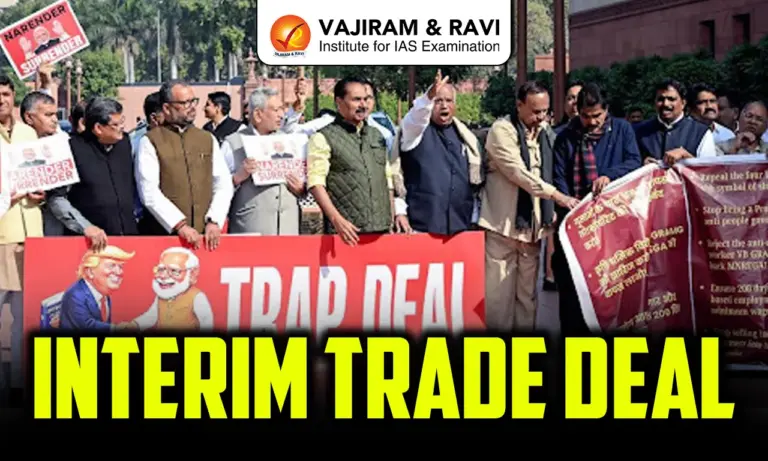
- India and the United States have signed an interim trade agreement, triggering debates over its economic impact, agricultural implications, and sovereignty concerns.
Background of U.S.-India Trade Relations
- India and the United States share a deep strategic and economic partnership.
- Bilateral trade in goods and services has grown significantly over the past decade, with the U.S. emerging as one of India’s largest trading partners.
- India has traditionally maintained a trade surplus with the U.S., exporting pharmaceuticals, textiles, engineering goods, and IT services, while importing energy, aircraft, and high-value technology products.
- However, trade tensions escalated in August 2025 when U.S. President Donald Trump imposed 25% tariffs on Indian imports, along with an additional 25% penalty linked to India’s continued import of Russian crude oil.
- These measures strained bilateral ties and disrupted trade flows.
- Nearly a year later, both countries agreed to an interim trade agreement as the first step towards a broader bilateral trade deal.
- While this agreement is being presented as a breakthrough in restoring ties, it has raised several policy and economic questions.




Key Provisions of the Interim Agreement
- Tariff Reduction by the U.S.: The U.S. will reduce tariffs on Indian imports from 50% to 18%.
- India’s Concessions on Market Access: India will eliminate or significantly reduce tariffs and non-tariff barriers on imports of industrial goods and a wide range of food and agricultural products from the U.S.
- Energy and Strategic Commitments: India has expressed its intent to purchase $500 billion worth of U.S. energy products, aircraft, aircraft parts, precious metals, technology products, and coking coal over the next five years.
- Russian Oil Imports: An Executive Order issued alongside the Joint Statement indicates that India would stop directly or indirectly importing Russian oil, although Indian officials have not formally confirmed this commitment.
- Monitoring Mechanism: The U.S. administration has indicated that additional tariffs could be reimposed if India resumes Russian oil imports.
Potential Benefits of the Agreement
- Supporters argue that lower U.S. tariffs could provide opportunities for Indian exporters, particularly in labour-intensive sectors such as textiles and clothing.
- A tariff reduction to 18% may offer some competitive advantage compared to countries facing higher duties.
- However, this advantage may be limited. The U.S. has also concluded trade arrangements with countries like Bangladesh, offering preferential treatment to certain textile products. This reduces India’s relative edge in the American market.
- Moreover, the agreement could strengthen strategic ties between the two countries and signal policy stability to global investors.
Concerns Regarding the Agricultural Sector
- Impact on Farmers
- The interim agreement does not explicitly state that tariff protection on sensitive agricultural products, especially cereals, will be maintained.
- Historically, India has safeguarded such products in all its Free Trade Agreements, including the recent EU-India FTA.
- If tariff barriers on cereals and other agricultural commodities are reduced, Indian farmers may face competition from highly subsidised American agribusiness. This could undermine farm incomes and threaten food security.
- Genetically Modified (GM) Products
- The U.S. has long objected to India’s restrictions on genetically modified (GM) food imports, treating them as non-tariff barriers.
- The agreement’s reference to resolving “long-standing concerns” has raised fears that India may allow GM food imports in the future.
- This has implications not only for farmers but also for public health, biosafety, and regulatory autonomy.
Unequal Tariff Structure
- A critical concern is the asymmetry in tariff concessions.
- While India is eliminating or reducing tariffs on U.S. imports, the U.S. is retaining an 18% tariff on Indian exports.
- Before the tariff dispute, average U.S. tariffs on Indian goods were around 2.5%. Thus, the new arrangement represents a significant increase in protection against Indian exports.
- This raises questions about negotiating leverage and whether India has accepted an unequal arrangement under external pressure.
Sovereignty and Strategic Autonomy
- The clause related to Russian oil imports and the potential reimposition of tariffs has broader geopolitical implications.
- The possibility of U.S. surveillance over India’s oil imports and the conditionality attached to tariff relief could be viewed as constraining India’s strategic autonomy.
- For a country that has historically maintained an independent foreign policy, this aspect of the agreement has sparked intense debate.
- Additionally, several countries, such as China and Brazil, have resisted similar tariff pressures. Critics question why India has chosen accommodation over resistance.
Broader Economic and Political Implications
- The interim agreement must be seen as a precursor to a full-fledged U.S.-India Trade Agreement. Its final contours will determine:
- The balance between export opportunities and domestic protection.
- The future of India’s agricultural policy.
- The degree of regulatory autonomy India retains.
- The strategic alignment between the two democracies.
- The government faces the challenge of ensuring that economic gains do not come at the cost of food security, farmer livelihoods, and sovereign decision-making.
Source: TH

 Last updated on March, 2026
→ UPSC Final Result 2025 is now out.
→ UPSC has released UPSC Toppers List 2025 with the Civil Services final result on its official website.
→ Anuj Agnihotri secured AIR 1 in the UPSC Civil Services Examination 2025.
→ UPSC Marksheet 2025 Will be out soon.
→ UPSC Notification 2026 & UPSC IFoS Notification 2026 is now out on the official website at upsconline.nic.in.
→ UPSC Calendar 2026 has been released.
→ Check out the latest UPSC Syllabus 2026 here.
→ UPSC Prelims 2026 will be conducted on 24th May, 2026 & UPSC Mains 2026 will be conducted on 21st August 2026.
→ The UPSC Selection Process is of 3 stages-Prelims, Mains and Interview.
→ Prepare effectively with Vajiram & Ravi’s UPSC Prelims Test Series 2026 featuring full-length mock tests, detailed solutions, and performance analysis.
→ Enroll in Vajiram & Ravi’s UPSC Mains Test Series 2026 for structured answer writing practice, expert evaluation, and exam-oriented feedback.
→ Join Vajiram & Ravi’s Best UPSC Mentorship Program for personalized guidance, strategy planning, and one-to-one support from experienced mentors.
→ Shakti Dubey secures AIR 1 in UPSC CSE Exam 2024.
→ Also check Best UPSC Coaching in India
Interim Trade Deal FAQs
Q1. What triggered the recent U.S.-India interim trade agreement?+
Q2. What is the new tariff rate imposed by the U.S. on Indian exports?+
Q3. Why are Indian farmers concerned about the agreement?+
Q4. What is the controversy regarding Russian oil imports?+
Q5. Why is the agreement termed unequal by critics?+
Tags: interim trade deal mains articles upsc current affairs upsc mains current affairs