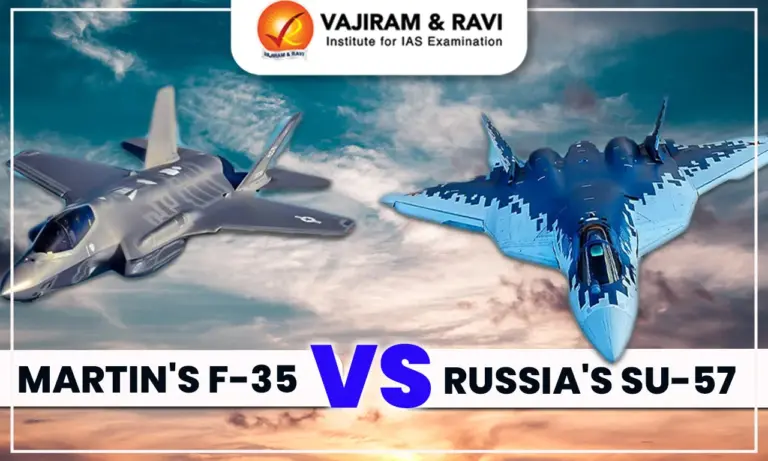
As India aims to modernize its air combat capabilities, the choice between two fifth-generation fighter jets, the US Lockheed Martin’s F-35 vs Russia’s Su-57 has become a strategic decision with global implications. With both aircraft making headlines at Aero India 2025, India’s next move could reshape its military weapon inventory for decades.
Why India Needs a Fifth-Gen Fighter
India’s weapon inventory currently includes around 600 fighter jets, but none belong to the fifth-generation category. With increasing regional threats from China’s rapidly growing stealth fleet and Pakistan’s reported interest in acquiring similar technologies, India faces pressure to have a fifth-generation fighter. While domestic efforts like the Advanced Medium Combat Aircraft (AMCA) are underway, operational readiness is not expected before 2036. This opens the door for immediate imports, where the F-35 and Su-57 are top options.
F-35 Lightning II
The US Lockheed Martin’s F-35, is widely regarded as the world’s most advanced multirole fighter. It is available in three variants:
- F-35A for the Air Force
- F-35B with short take-off and vertical landing (STOVL) capabilities for the Marine Corps
- F-35C designed for aircraft carriers in the Navy
Key Features:
- Top Speed: Mach 1.6
- Combat Range: ~1,500 km
- Payload: 8,160 kg
- Fuel Capacity: 18,498 lbs
- Operational Altitude: Over 50,000 feet
- Sensors: Electro-Optical Targeting System (EOTS), Distributed Aperture System (DAS)
- Helmet-Mounted Display System (HMDS): Provides real-time targeting data and situational awareness
With more than 1,000 operational units worldwide and development support from nine partner nations, the F-35 is a battle-tested and interoperable platform in NATO operations.





Sukhoi Su-57
The Su-57, developed by Russia’s Sukhoi Design Bureau, is a twin-engine multirole stealth fighter designed for both air superiority and ground strike roles. Russia has pitched its export version, Su-57E, as a cost-effective alternative for partners like India.
Key Features:
- Top Speed: Mach 2
- Combat Range: ~1,900 km
- Payload: 7,400 kg
- Max Operating Altitude: ~54,100 feet
- Engine: Saturn AL-41F1
- Stealth Enhancements: Serrated exhaust nozzle and internal weapon bays
- AI Integration: Onboard “electronic second pilot” system
- Radar Spread: Distributed radar array across the airframe
Although only around 40 Su-57s have been produced as of 2025, Russia claims the aircraft matches or exceeds the F-35 in certain performance metrics, especially agility and range.
US Lockheed Martin’s F-35 vs Russia’s Su-57
The Lockheed Martin F-35 and the Sukhoi Su-57 represent two of the most advanced fifth-generation fighter aircraft developed by the United States and Russia, respectively. Designed for air superiority, stealth, and multi-role capabilities, both jets showcase cutting-edge technologies in modern aerial warfare. This comparison offers a detailed analysis of their design philosophies, capabilities, and strategic roles in shaping the future of air combat.
| US Lockheed Martin’s F-35 vs Russia’s Su-57 | ||
| Feature | F‑35B (STOVL) | Sukhoi Su‑57 |
|
Origin & Manufacturer |
US – Lockheed Martin (with Pratt & Whitney engine) |
Russia – Sukhoi (United Aircraft Corporation) |
|
Stealth Generation |
5th-generation, with advanced RCS reduction (~0.005–0.3 m²) |
5th-generation, RCS ~0.1–0.5 m² |
|
Engine Configuration |
Single-engine (Pratt & Whitney F135) |
Twin-engine (AL-41F1) with 3D thrust vectoring |
|
Max Speed |
~Mach 1.6 (supersonic dash, no supercruise) |
Up to Mach 2; can supercruise at Mach 1.3 |
|
Combat Range |
Ferry range ~1,670 km (no external tanks); combat radius shorter |
Combat range ~1,900 km; ferry ~3,500 km |
|
Maneuverability |
Fly-by-wire, high-alpha capability; no thrust-vectoring |
Super-maneuverable with 3D TVC, high-alpha & Cobra maneuvers |
|
Weapon Bays / Payload |
Internal bays + up to 6 external hardpoints |
Two internal bays + side bays; also 6 external hardpoints |
|
Avionics & Sensors |
Advanced sensor fusion, AESA radar, EW, targeting pods |
AESA X-band radar + L-band sensors, IRST, DIRCM, sensor fusion suite |
|
Operational Service |
F‑35B IOC since July 31, 2015; over 100 built |
Introduced in 2020; about 32 built as of late 2023 |
|
Unit Cost |
~$109 million (per F‑35B) |
~$35–40 million |
|
Operational Cost |
F‑35 program estimated lifetime cost > $1.5 trillion (total fleet) |
Less well documented; lower unit cost implies lower O&M overall |
|
Export Version |
Foreign Military Sales (F‑35B available to US allies) |
Su‑57E export version marketed |
Strategic Considerations for India
India’s defense ties with both Russia and the US make the decision complex. Russia has been a longstanding defense partner, known for easier technology transfer and fewer restrictions. The US, while offering advanced systems, often includes stringent end-use monitoring clauses.
- Technology Transfer: Russia is more open to sharing tech; the US is more restrictive.
- Sanctions Risk: Buying from Russia risks CAATSA-related US sanctions; buying from the US risks geopolitical dependencies.
- Parts and Servicing: Russian jets can be supported locally with fewer dependencies.
- Geopolitical Alignment: A deal with the US could strengthen Indo-Pacific ties, especially in countering China.
Global Landscape
- F-35: Operated by over 14 nations, including the US, UK, Italy, Australia, and Japan.
- Su-57: Operational only in Russia, with no confirmed international buyers yet.
China, meanwhile, is rapidly closing the gap with over 200 J-20 stealth fighters and a growing fleet of J-35s, posing a real threat to India’s air dominance.

 Last updated on March, 2026
→ UPSC Final Result 2025 is now out.
→ UPSC has released UPSC Toppers List 2025 with the Civil Services final result on its official website.
→ Anuj Agnihotri secured AIR 1 in the UPSC Civil Services Examination 2025.
→ UPSC Marksheet 2025 is now out.
→ UPSC Notification 2026 & UPSC IFoS Notification 2026 is now out on the official website at upsconline.nic.in.
→ UPSC Calendar 2026 has been released.
→ Check out the latest UPSC Syllabus 2026 here.
→ UPSC Prelims 2026 will be conducted on 24th May, 2026 & UPSC Mains 2026 will be conducted on 21st August 2026.
→ The UPSC Selection Process is of 3 stages-Prelims, Mains and Interview.
→ Prepare effectively with Vajiram & Ravi’s UPSC Prelims Test Series 2026 featuring full-length mock tests, detailed solutions, and performance analysis.
→ Enroll in Vajiram & Ravi’s UPSC Mains Test Series 2026 for structured answer writing practice, expert evaluation, and exam-oriented feedback.
→ Join Vajiram & Ravi’s Best UPSC Mentorship Program for personalized guidance, strategy planning, and one-to-one support from experienced mentors.
→ Shakti Dubey secures AIR 1 in UPSC CSE Exam 2024.
→ Also check Best UPSC Coaching in India
US Lockheed Martin's F-35 vs Russia's Su-57 FAQs
Q1. Which is faster: F-35 or Su-57?+
Q2. Which fighter jet is cheaper?+
Q3. Which fighter has better stealth?+
Q4. Is India buying the F-35 or Su-57?+
Q5. How many F-35s are in service globally?+
Tags: martins f35 vs russias su57