US Tariff Reset Latest News
- A recent ruling by the US Supreme Court striking down tariffs imposed under the International Emergency Economic Powers Act (IEEPA) has disrupted the legal foundation of U.S. trade policy.
- In response, the U.S. administration has imposed temporary 10% global tariffs under Section 122 and is exploring a more durable tariff regime through Section 301 investigations by the United States Trade Representative (USTR).
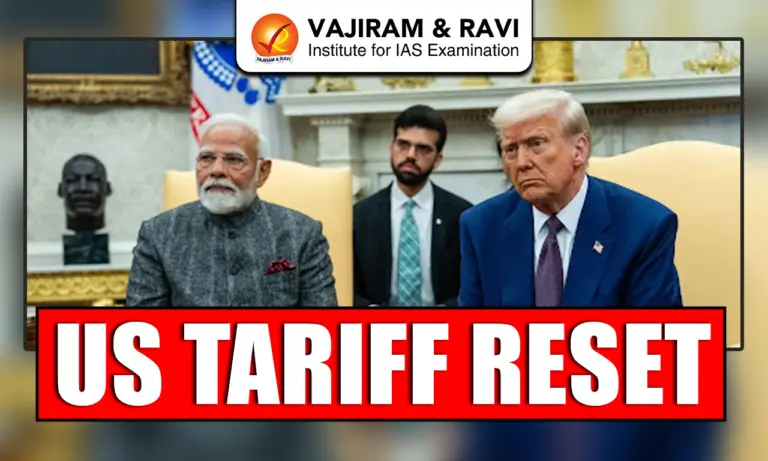
- This shift has created uncertainty in ongoing and prospective trade agreements, including the India–U.S. trade deal.
Shift in US Trade Strategy
- From IEEPA to Section 122 and Section 301:
-
- IEEPA-based tariffs were invalidated, undermining earlier “reciprocal tariff” arrangements.
- Temporary 10% global tariffs are imposed under Section 122 of the Trade Act, 1974 (valid till July).
- The USTR is now pursuing Section 301 investigations to –
- Establish a new legal basis for tariffs.
- Enable country-specific and sector-specific tariffs.
- Replace Section 122 tariffs before expiry.
- Fast-track investigations: Section 301 probes are being conducted rapidly. They allow the executive to impose long-lasting and flexible tariff measures without Congressional approval.





Rationale Behind Section 301 Investigations
- Key grounds for investigation:
- Structural excess capacity in manufacturing sectors.
- Overproduction and export distortions.
- Use of forced labour in supply chains.
- Strategic objective:
- Recreate a reciprocal tariff framework with stronger legal backing.
- Maintain trade pressure even on countries that have signed agreements.
Impact on Global Trade Agreements
- Erosion of existing trade deals:
- Countries like Japan, South Korea, Vietnam, Indonesia, Bangladesh, India, and the EU had accepted tariffs of 15–20% and offered significant concessions on market access, procurement, and regulations.
- With uniform 10% tariffs post-ruling, earlier concessions appear politically costly and economically redundant.
- Global reactions:
- Malaysia declared its trade agreement with the U.S. null and void.
- The European Commission has put EU–U.S. trade talks on hold, seeking clarity on future U.S. tariff policy.
- South Korea has expressed concerns over investment commitments and currency stability.
Implications for India
- Trade and tariff concerns:
- India faces Section 301 scrutiny for excess capacity in sectors like solar modules, petrochemicals, steel.
- In 2025, India had a bilateral trade surplus with the US of $58 billion.
- Comparative advantage consideration: Any India–U.S. trade deal will depend on India’s tariff advantage in the U.S. market, the structure of new U.S. tariffs.
- Uncertainty in trade negotiations: Even negotiated deals may not guarantee protection from future investigations, stability in tariff treatment.
Key Challenges
- Legal and policy uncertainty: Frequent shifts in U.S. tariff frameworks undermine predictability.
- Weakening multilateralism: Rise of unilateral tariff actions over WTO-based dispute resolution.
- Erosion of trust in trade agreements: Countries question the value of concessions when tariff benefits are not assured, trade pressure persists.
- Impact on global supply chains: Increased tariffs may disrupt value chains, raise production costs, encourage protectionism.
Way Forward
- For India:
- Diversify export markets to reduce U.S. dependency.
- Strengthen domestic manufacturing competitiveness (PLI schemes, logistics).
- Engage in strategic trade negotiations focusing on stable tariff commitments, dispute resolution mechanisms.
- Align with like-minded countries to revive multilateral trade norms.
- For Global trade system:
- Reinforce rules-based trading order under WTO.
- Ensure legal certainty in tariff regimes.
- Promote transparent and predictable trade policies.
Conclusion
- The U.S. shift from IEEPA-based tariffs to a Section 301-driven framework marks a significant recalibration of global trade dynamics.
- While it aims to provide a stronger legal basis for tariffs, it has simultaneously eroded trust in trade agreements and heightened uncertainty.
- For India and other trading partners, the challenge lies in navigating this evolving landscape by balancing strategic engagement with economic self-reliance and diversification.
Source: IE

 Last updated on April, 2026
→ UPSC Final Result 2025 is now out.
→ UPSC has released UPSC Toppers List 2025 with the Civil Services final result on its official website.
→ Anuj Agnihotri secured AIR 1 in the UPSC Civil Services Examination 2025.
→ UPSC Marksheet 2025 is now out.
→ UPSC Notification 2026 & UPSC IFoS Notification 2026 is now out on the official website at upsconline.nic.in.
→ UPSC Calendar 2026 has been released.
→ Check out the latest UPSC Syllabus 2026 here.
→ UPSC Prelims 2026 will be conducted on 24th May, 2026 & UPSC Mains 2026 will be conducted on 21st August 2026.
→ The UPSC Selection Process is of 3 stages-Prelims, Mains and Interview.
→ Prepare effectively with Vajiram & Ravi’s UPSC Prelims Test Series 2026 featuring full-length mock tests, detailed solutions, and performance analysis.
→ Enroll in Vajiram & Ravi’s UPSC Mains Test Series 2026 for structured answer writing practice, expert evaluation, and exam-oriented feedback.
→ Join Vajiram & Ravi’s Best UPSC Mentorship Program for personalized guidance, strategy planning, and one-to-one support from experienced mentors.
→ Shakti Dubey secures AIR 1 in UPSC CSE Exam 2024.
→ Also check Best UPSC Coaching in India
US Tariff Reset FAQs
Q1. How has the recent ruling of the US Supreme Court impacted global trade agreements?+
Q2. What is the significance of Section 301 investigations by the USTR? +
Q3. Why are countries reconsidering trade agreements with the United States? +
Q4. What are the implications of U.S. tariff restructuring for India’s export sectors? +
Q5. How does the evolving U.S. tariff regime challenge the multilateral trading system? +
Tags: mains articles upsc current affairs upsc mains current affairs us tariff reset