US Tariffs Latest News
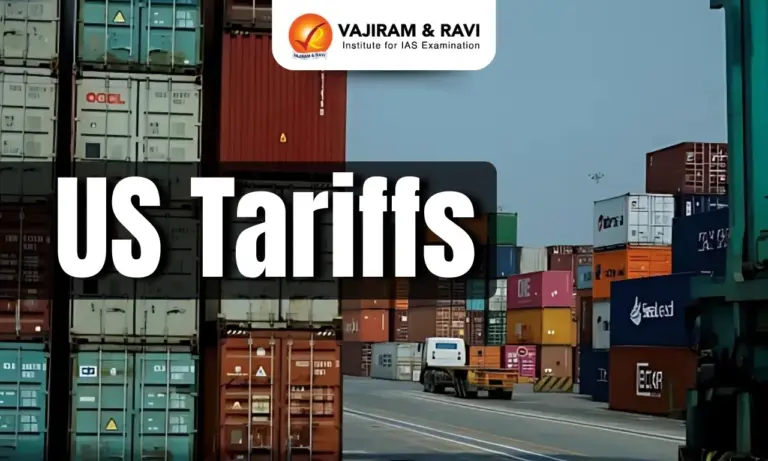
- The US has imposed steep 50% tariffs on Indian exports since August 27, hitting key sectors like textiles, gems, and jewellery, and prompting calls for trade diversification.
Introduction
- India is facing a significant external trade challenge as the United States has imposed steep 50% tariffs on Indian goods exports.
- This development comes at a time when India’s export sector has grown increasingly reliant on the American market, which has remained the country’s largest trading partner for four consecutive years.
- The tariffs have not only raised questions about India’s dependence on the US but have also triggered renewed debates on trade diversification, reforms, and the possibility of joining multilateral trade blocs.





Impact of US Tariffs on Indian Exports
- The 50% tariff makes India’s labour-intensive and low-margin exports, such as textiles, gems, jewellery, shrimps, furniture, and carpets, uncompetitive in the American market.
- Many small and medium exporters, particularly in hubs like Tirupur, Surat, and Noida, have already halted production due to falling demand and shrinking cost competitiveness.
- Although exports to the US account for less than 2% of India’s GDP, the employment impact is disproportionately large, given that the affected sectors are among the most labour-intensive.
- Competitors such as Vietnam, Bangladesh, and Cambodia are poised to benefit from India’s losses, as they currently face lower US tariffs.
India’s Overdependence on the US Market
- The latest tariff action has exposed the risks of India’s growing reliance on a single export destination.
- As of 2024, the US accounted for 18% of India’s exports, up from 11% in 2010. By contrast, China consciously reduced its dependence on the US by diversifying its export basket, with its share of exports to the US falling from 20% to 14% in the same period.
- This concentration has given the US significant leverage over India’s trade policy.
- Until now, Indian exporters enjoyed relatively smooth access to the US market, with average tariffs of just 4% and minimal non-tariff barriers.
- That comfort discouraged India from aggressively pursuing alternative export destinations or multilateral trade agreements.
Policy Space for Reform and Diversification
- The crisis has forced policymakers to reconsider three long-pending issues:
- Reducing dependence on the US market by aggressively pursuing trade with other regions, including Africa, Latin America, and Southeast Asia.
- Exploring multilateral trade deals, such as the Comprehensive and Progressive Agreement for Trans-Pacific Partnership (CPTPP), where key members like Japan, Australia, and ASEAN nations are supportive of India’s entry.
- Reframing India-US trade negotiations by highlighting the broader economic relationship. While the US claims a goods trade deficit, it actually enjoys a $40 billion overall surplus with India when revenues from digital services, education, financial activities, royalties, and defence are considered.
Domestic Measures to Cushion the Impact
- In the short term, exporters have demanded that the government facilitate domestic procurement by large buyers such as the Indian Railways and public sector undertakings.
- The Centre is also considering a relief package with cheaper credit, though the effectiveness of such measures remains uncertain without clarity on how long the tariffs will persist.
Positive Outcomes and Opportunities
- Trade Reform Momentum: The tariffs could accelerate much-needed reforms in India’s trade structure, such as lowering tariffs on intermediate goods to make domestic industries more competitive.
- Multilateral Leverage: India is better placed today to negotiate multilateral deals than during the RCEP talks, thanks to its greater willingness to adopt a “structured and balanced” approach to market access.
- Diversification Push: With the US market becoming riskier, India is likely to expand its trade footprint in Europe, Africa, and Latin America, while also strengthening its presence in digital services and high-value manufacturing.
Source: IE

 Last updated on March, 2026
→ UPSC Final Result 2025 is now out.
→ UPSC has released UPSC Toppers List 2025 with the Civil Services final result on its official website.
→ Anuj Agnihotri secured AIR 1 in the UPSC Civil Services Examination 2025.
→ UPSC Marksheet 2025 is now out.
→ UPSC Notification 2026 & UPSC IFoS Notification 2026 is now out on the official website at upsconline.nic.in.
→ UPSC Calendar 2026 has been released.
→ Check out the latest UPSC Syllabus 2026 here.
→ UPSC Prelims 2026 will be conducted on 24th May, 2026 & UPSC Mains 2026 will be conducted on 21st August 2026.
→ The UPSC Selection Process is of 3 stages-Prelims, Mains and Interview.
→ Prepare effectively with Vajiram & Ravi’s UPSC Prelims Test Series 2026 featuring full-length mock tests, detailed solutions, and performance analysis.
→ Enroll in Vajiram & Ravi’s UPSC Mains Test Series 2026 for structured answer writing practice, expert evaluation, and exam-oriented feedback.
→ Join Vajiram & Ravi’s Best UPSC Mentorship Program for personalized guidance, strategy planning, and one-to-one support from experienced mentors.
→ Shakti Dubey secures AIR 1 in UPSC CSE Exam 2024.
→ Also check Best UPSC Coaching in India
US Tariffs FAQs
Q1. What is the recent US tariff decision against India?+
Q2. Which Indian sectors are most affected by the tariffs?+
Q3. Why is India vulnerable to US tariff actions?+
Q4. What options does India have to counterbalance the impact?+
Q5. How could this tariff shock benefit India in the long run?+
Tags: mains articles upsc current affairs upsc mains current affairs US Tariffs