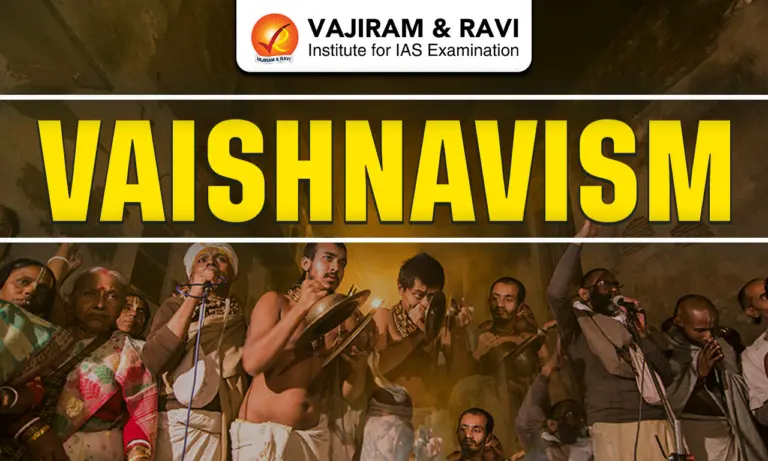
Vaishnavism is one of the main traditions of Hinduism that focuses on the worship of Vishnu as the supreme god. It teaches that God cares for the world and takes different forms, like Krishna and Rama, to protect people and maintain balance. The tradition mainly emphasises devotion (bhakti), love, and faith in God as the path to a peaceful and meaningful life. Over time, Vaishnavism has grown through different teachings and practices, but its central idea remains simpledeveloping a close and loving relationship with God.
Vaishnavism Origin and Development
- Ancient Sources of Vaishnavism
- Vaishnavism is an important tradition of Hinduism that worships Lord Vishnu as the supreme god.
- Its origin is not based on a single source but comes from different ideas and traditions developed over time.
- Some scholars believe it started from the Vedic period, while others think it became prominent later with the rise of devotional texts.
- Different Concepts of Vishnu
- The idea of Vishnu developed through various forms:
- Vishnu in the Vedas: Described as a god who takes three strides, symbolizing his power over the universe.
- Narayana: Seen as the cosmic and philosophical form of God, representing the supreme being.
- Vasudeva: Considered a historical and personal form of God.
- Krishna: Viewed as a pastoral and loving deity, associated with devotion and human life.
- These different concepts together contributed to the growth of Vaishnavism.
- The idea of Vishnu developed through various forms:
- Development in South India
- In South India, Vaishnavism developed through different traditions:
- Some believe the Krishna cult began with the Yadavas in Madurai.
- Others say it came from ancient Tamil regions, especially the Mullai region, where the god Perumal was worshipped.
- Sacred Texts of Vaishnavism
- Vaishnavism is also called Bhāgavata tradition, meaning the worship of Bhagavan (the Lord).
- Important texts include:
- Bhāgavata Purāṇa
- Bhagavad Gita
- Nārāyaṇīya (part of Mahabharata)
- Other important religious texts:
- Pāñcarātra Āgamas: Explain rituals, meditation, temple building, and daily worship.
- Vaikānasa Āgamas: Give detailed rules for temple construction and idol making.
- Concept of Vishnu and His Abode
- Vishnu is believed to live in Vaikuṇṭha, his divine abode.
- He is seated there with his consort Lakshmi (Śrī), who represents wealth, prosperity, and good fortune.
- Five Forms of Vishnu
- Vaishnavism explains that Vishnu exists in five forms:
- Para (Transcendent): The supreme and highest form of God.
- Vyūha (Grouped forms): Includes four forms Vasudeva, Saṁkarṣaṇa, Pradyumna, and Aniruddha each with a role in creation and salvation.
- Vibhava (Incarnations): God takes birth on earth to protect the world.
- Antaryāmin (Immanent): God exists within all beings.
- Arcā (Idol form): Worshipped in temples as a visible form of God.
- Concept of Avatāras (Incarnations)
- Vishnu takes incarnations (avatāras) to protect the world from evil and restore order.
- Traditionally, there are nine main incarnations, and the tenth (Kalki) is yet to come.
- Important incarnations include:
- Animal forms: Fish, tortoise, boar (to save the world from natural dangers).
- Narasimha and Vamana: To defeat powerful demons.
- Parasurama: To destroy unjust rulers.
- Rama and Krishna: Most important and widely worshipped forms.
- Buddha: Added later, with different interpretations.
- The future incarnation Kalki is believed to appear at the end of the present age to destroy evil and restore righteousness.
- Importance of Idol Worship (Arcā)
- The idol (arcā) is considered a real and living form of Vishnu.
- It is believed that God enters the idol, making it accessible to devotees.
- Worship and service to the idol is an important duty in Vaishnavism.
Also Read: Buddhism
Philosophers of Vaishnavism
- Vaishnavism developed strongly through the Bhakti movement, led by many saints and philosophers.
- These thinkers explained the nature of God, soul, and liberation in different ways, but all emphasized devotion (bhakti) to Lord Vishnu or Krishna.
- Ramanuja (Qualified Monism)
- Ramanuja was one of the greatest Vaishnava philosophers and taught the path of bhakti (devotion) as the way to attain happiness and liberation.
- He believed that:
- The soul is a part of God, but not completely identical with Him.
- The soul depends entirely on God and must surrender fully to Him.
- Liberation is achieved through complete surrender and God’s grace.
- God has a personal form, and creation is an expression of His love.
- Even after liberation, the soul remains separate but united with God, keeping its individuality.
- His philosophy is called Qualified Monism (Viśiṣṭādvaita), meaning unity with some difference.
- Madhva (Dualism)
- Madhva taught the philosophy of Dualism (Dvaita).
- According to him:
- God, soul, and matter are completely different and remain separate forever.
- Liberation does not mean becoming one with God, but living close to Him and enjoying His presence.
- Liberation depends mainly on God’s grace, not just human effort.
- He emphasized devotion and moral life, but believed God’s will is the most important factor.
- Nimbarka (Duality in Unity)
- Nimbarka was a devotee of Krishna, especially associated with Mathura.
- His philosophy is called Dvaitādvaita (duality in unity) or Bhedābheda (difference and non-difference).
- Main ideas:
- There are three eternal realities: God (Brahman), soul (cit), and matter (acit).
- God is independent, while soul and matter depend on Him.
- The soul and world are different from God, but also not separate from Him.
- The relationship is like clay and pot both different and the same.
- Liberation does not destroy individuality; the soul remains distinct but close to God.
- Liberation is achieved through karma (action), jnana (knowledge), meditation, surrender, and devotion.
- He emphasized pure love for God (mādhurya bhakti) as the highest path.
- Vallabha (Pure Non-Dualism)
- Vallabha was a great saint and philosopher, who promoted devotion to Krishna.
- His philosophy is called Śuddhādvaita (pure non-dualism).
- Main teachings:
- God (Krishna) is the Supreme Reality, full of bliss (sat-cit-ananda).
- The world is real and not an illusion; it is a form of God.
- Souls are parts of God, like sparks from fire.
- He classified souls into three types:
- Pravāha: Attached to worldly life.
- Maryāda: Follow religious rules.
- Puṣṭi: Devotees who love God with pure devotion.
- Liberation comes through loving devotion to Krishna.
- Chaitanya (Achintya Bhedābheda)
- Chaitanya was a famous Vaishnava saint from Bengal who spread devotion through kirtans (devotional songs).
- He focused on the love of Radha and Krishna as the highest form of devotion.
- His philosophy is called Achintya Bhedābheda (incomprehensible difference and non-difference). Key ideas:
- God has many powers (śaktis) such as:
- Svarūpaśakti: Divine inner power.
- Māyāśakti: Creates the material world.
- Jīvaśakti: Represents individual souls.
- The soul is both different and not different from God in a way that cannot be fully explained.
- He taught that:
- Bhakti is higher than knowledge or yoga.
- Complete self-surrender and love for God is the ultimate goal.
- Devotion itself is the highest aim of life, even beyond liberation.






 Last updated on March, 2026
→ UPSC Final Result 2025 is now out.
→ UPSC has released UPSC Toppers List 2025 with the Civil Services final result on its official website.
→ Anuj Agnihotri secured AIR 1 in the UPSC Civil Services Examination 2025.
→ UPSC Marksheet 2025 is now out.
→ UPSC Notification 2026 & UPSC IFoS Notification 2026 is now out on the official website at upsconline.nic.in.
→ UPSC Calendar 2026 has been released.
→ Check out the latest UPSC Syllabus 2026 here.
→ UPSC Prelims 2026 will be conducted on 24th May, 2026 & UPSC Mains 2026 will be conducted on 21st August 2026.
→ The UPSC Selection Process is of 3 stages-Prelims, Mains and Interview.
→ Prepare effectively with Vajiram & Ravi’s UPSC Prelims Test Series 2026 featuring full-length mock tests, detailed solutions, and performance analysis.
→ Enroll in Vajiram & Ravi’s UPSC Mains Test Series 2026 for structured answer writing practice, expert evaluation, and exam-oriented feedback.
→ Join Vajiram & Ravi’s Best UPSC Mentorship Program for personalized guidance, strategy planning, and one-to-one support from experienced mentors.
→ Shakti Dubey secures AIR 1 in UPSC CSE Exam 2024.
→ Also check Best UPSC Coaching in India
Vaishnavism FAQs
Q1. What is Vaishnavism?+
Q2. What are the main sources of the origin of Vaishnavism?+
Q3. What are the important sacred texts of Vaishnavism?+
Q4. What are the five forms of Vishnu?+
Q5. What is the concept of avatāra in Vaishnavism?+
Tags: history history notes vaishnavism