Vande Mataram Row Latest News
- The Union government’s January 28 directive mandating the singing of all six stanzas of the National Song Vande Mataram at official functions has triggered objections from several organisations.
- The notification requires the full 3-minute-10-second version to be played before Jana Gana Mana when both are included in state events, with the audience standing in attention.
- Traditionally, only the first two stanzas have been sung at public functions. The later four stanzas contain explicit religious imagery, which has historically been a source of controversy and discomfort for some communities.
- The directive comes amid the government’s commemoration of 150 years of Vande Mataram, during which references to the “dropped” stanzas have been repeatedly raised in Parliament.
- The move aligns with this broader effort but has revived debates over the song’s composition and the objections surrounding its later verses.
Origins and Evolution of Vande Mataram
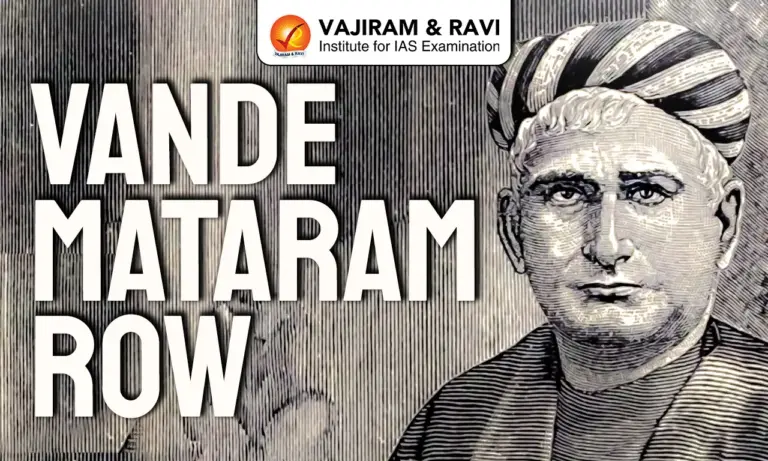
- Vande Mataram (“Mother, I bow to thee”) was composed in 1875 by Bankim Chandra Chattopadhyay in Sanskritised Bengali.
- It was later included in his 1882 novel Anandamath, which depicted the late-18th century Sanyasi Rebellion against the rule of Mir Jafar and the East India Company.
- The song became a powerful nationalist slogan during the Swadeshi movement (1905–08), symbolising resistance to British rule.
- However, concerns about its religious undertones emerged early on.
- In 1937, Jawaharlal Nehru wrote to Subhas Chandra Bose acknowledging apprehensions among Muslims, though he described the controversy as being amplified by communal elements.
Congress Compromise on Stanzas
- In October 1937, the Congress Working Committee recommended that only the first two stanzas be sung at national gatherings.
- It observed that these verses, which celebrate the natural beauty and bounty of the motherland, were free of objectionable religious imagery, unlike the lesser-known later stanzas.
National Song Status and Protocol
- In 1950, the first two stanzas were formally adopted as India’s National Song.
- The Constituent Assembly accorded it equal honour with the National Anthem but did not prescribe mandatory protocols regarding posture or recital.
- The recent government directive marks a shift toward formalising etiquette and performance requirements.




Religious and Constitutional Objections to Vande Mataram
- Objections from Muslim scholars centre on the portrayal of “Mother India” as a goddess, which conflicts with Islam’s core principle of strict monotheism.
- Worship of any entity other than Allah is considered impermissible in Islamic belief.
Controversy Over the Later Stanzas
- The latter four stanzas intensify the controversy.
- The third stanza refers to “crores and crores” of arms ready for battle.
- The fourth suggests the motherland’s image is present in shrines.
- The fifth likens the nation to Hindu goddesses Durga, Lakshmi, and Saraswati.
- Historians argue that in the context of Anandamath, these verses frame Muslims as adversaries and depict the motherland in explicitly Hindu religious imagery, alienating non-Hindu communities.
- Various organizations have termed the move a “blatant attack” on religious freedom under Article 25 of the Constitution.
- They clarified that Muslims do not object to others singing the song but oppose being compelled to recite verses that conflict with monotheistic beliefs.
Political Flashpoint Over Vande Mataram
- In December 2025, Parliament marked 150 years of Vande Mataram, triggering sharp political exchanges over its historical interpretation and contemporary relevance.
- In the Lok Sabha, PM Modi accused Jawaharlal Nehru of truncating the song in 1937 under pressure from the Muslim League.
- He cited Nehru’s correspondence with Subhas Chandra Bose, arguing that Nehru acknowledged Muslim League objections instead of firmly defending the song.
- Opposition leaders responded by quoting additional portions of Nehru’s letter, where he described the opposition to Vande Mataram as largely “manufactured by communalists” and criticised what he termed the Muslim League’s “low type of communalism.”
- Many contended that forcing citizens to sing the song violates constitutional principles.
- They maintained that portraying Bharat as a goddess turns nationalism into a religious expression, conflicting with secular values.
Source: IE

 Last updated on March, 2026
→ UPSC Final Result 2025 is now out.
→ UPSC has released UPSC Toppers List 2025 with the Civil Services final result on its official website.
→ Anuj Agnihotri secured AIR 1 in the UPSC Civil Services Examination 2025.
→ UPSC Marksheet 2025 Will be out soon.
→ UPSC Notification 2026 & UPSC IFoS Notification 2026 is now out on the official website at upsconline.nic.in.
→ UPSC Calendar 2026 has been released.
→ Check out the latest UPSC Syllabus 2026 here.
→ UPSC Prelims 2026 will be conducted on 24th May, 2026 & UPSC Mains 2026 will be conducted on 21st August 2026.
→ The UPSC Selection Process is of 3 stages-Prelims, Mains and Interview.
→ Prepare effectively with Vajiram & Ravi’s UPSC Prelims Test Series 2026 featuring full-length mock tests, detailed solutions, and performance analysis.
→ Enroll in Vajiram & Ravi’s UPSC Mains Test Series 2026 for structured answer writing practice, expert evaluation, and exam-oriented feedback.
→ Join Vajiram & Ravi’s Best UPSC Mentorship Program for personalized guidance, strategy planning, and one-to-one support from experienced mentors.
→ Shakti Dubey secures AIR 1 in UPSC CSE Exam 2024.
→ Also check Best UPSC Coaching in India
Vande Mataram Row FAQs
Q1. What triggered the Vande Mataram row?+
Q2. Why are the later stanzas controversial?+
Q3. What was the 1937 Congress decision regarding Vande Mataram?+
Q4. What constitutional concerns are raised in the Vande Mataram row?+
Q5. Why is the Vande Mataram row politically significant?+
Tags: mains articles upsc current affairs upsc mains current affairs vande mataram row