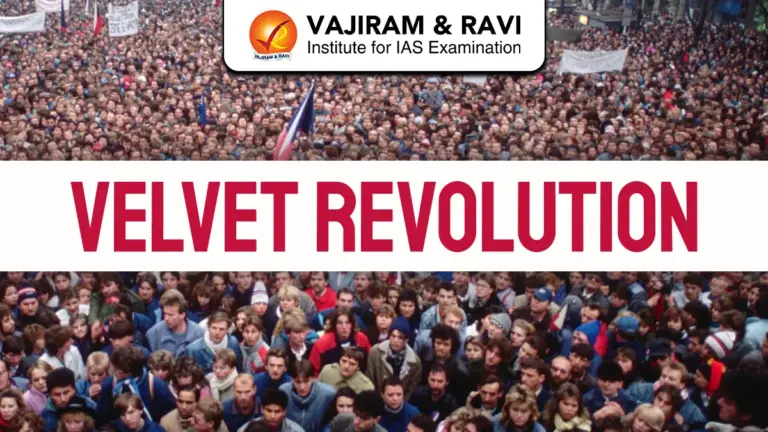
The Velvet Revolution (known in Czech as sametová revoluce and in Slovak as nežná revolúcia) was a historic non violent transition of power in the former state of Czechoslovakia. It occurred between 17 November and 29 December 1989. This movement marked the end of 41 years of one-party rule by the Communist Party. The revolution is celebrated for its peaceful nature, characterized by the avoidance of illegitimate violence and a focus on civic humanist values. It resulted in the dismantling of the command economy and the establishment of a parliamentary republic, setting a precedent for subsequent “Colour Revolutions” globally.
Velvet Revolution Background
The roots of the Velvet Revolution lie in decades of systemic suppression and the eventual awakening of civil society.
- Since the Communist Party seized power on 25 February 1948, no official opposition was permitted.
- Dissidents faced severe persecution, including blacklisting, travel bans and dismissal from employment for actions such as signing Charter 77, a landmark human rights manifesto issued by figures like Václav Havel, Jan Patocka and Jiri Hájek.
- This document paved the way for the events of 1989 by demanding that the state adhere to the rule of law and human rights.
- The environmental context of the late 1980s was shaped by Mikhail Gorbachev’s policies of Glasnost (openness) and Perestroika (restructuring).
- While the Czechoslovak leadership verbally supported these reforms, they made few actual changes.
- However, discontent with living standards grew and by the summer of 1989, petitions calling for an end to censorship and political reform circulated widely.
- The immediate spark was provided by the collapse of neighboring Warsaw Pact governments, including the fall of the Berlin Wall on 9 November 1989, which signaled the end of the Soviet Union’s rigid grip on Eastern Europe.
Read about: Cuban Revolution
Velvet Revolution Events
The Velvet Revolution unfolded through a series of rapidly escalating demonstrations and political shifts:
- 17 November 1989: Riot police suppressed a student demonstration in Prague marking International Students’ Day. This sparked widespread outrage and turned a commemorative event into an anti-communist movement.
- 20 November 1989: Protests swelled from 200,000 to an estimated 500,000 participants in Prague alone, demanding the resignation of the ruling elite.
- 24 November 1989: The entire top leadership of the Communist Party, including General Secretary Miloš Jakeš, resigned under pressure from the massive street protests.
- 27 November 1989: A two hour general strike involving all citizens took place, demonstrating the total lack of public support for the existing regime.
- 28 November 1989: The Communist Party formally announced it would relinquish power and end the one-party state.
- 10 December 1989: President Gustáv Husák appointed the first largely non-communist government since 1948 and subsequently resigned.
- 29 December 1989: Rebel playwright and human rights activist Václav Havel was elected President of Czechoslovakia, symbolizing the revolution’s final victory.





Velvet Revolution Influence of Gandhi
The Velvet Revolution is a significant case study in the “Ethicalisation of Politics,” heavily influenced by Gandhian principles of non violence (Satyagraha) as highlighted below:
- Political Jiu-Jitsu: Protestors employed a technique described by theorist Gene Sharp as “political jiu-jitsu.” This strategy uses the opponent’s violent force against them by maintaining non violence, thereby winning moral and political sympathy.
- Ethical Foundation: Václav Havel invited people to “live in truth.” This mirrored Gandhi’s commitment to truth and justice, shifting the struggle from a purely political level to an ethical one centered on human dignity and conscience.
- Civic Pluralism: The movement rejected ideological monism in favor of a philosophical pluralism, creating horizontal, self organized groups that could limit state power without resorting to arms.
- Grammar of Non Cooperation: By organizing mass strikes and peaceful dissent, the Czech and Slovak public echoed Gandhi’s methods of non cooperation to render the authoritarian state machinery inoperable.
Velvet Revolution Outcomes
The immediate outcomes of the Velvet Revolution transformed the geopolitical and economic landscape of Central Europe:
- Restoration of Democracy: The monopoly of the Communist Party was expunged from the Constitution, leading to the first democratic elections in June 1990.
- Soviet Withdrawal: President Havel successfully negotiated the removal of approximately 73,500 Soviet troops from Czechoslovak territory within months.
- Economic Transition: The government moved toward a market economy by liberalizing prices, de-monopolizing industries and privatizing state assets.
- Social Security Implementation: To mitigate the rise in unemployment following the end of the command economy, the government established a minimum wage and unemployment benefits.
- Diplomatic Renewal: Czechoslovakia renewed ties with the Vatican and Israel, reflecting a significant increase in freedom of religion and international openness.
Velvet Revolution Impacts
The aftermath of the Velvet Revolution was characterized by both successful democratization and structural division.
- In January 1993, the country underwent a peaceful dissolution known as the “Velvet Divorce,” splitting into the Czech Republic and the Slovak Republic. This split was primarily due to national governance issues between the two major ethnicities rather than violent conflict.
- The revolution’s impact was global, proving that civil society, defined as self organized groups separate from the state, could successfully topple ruthless regimes through “gentle” means.
- It remains a model for non violent resistance, emphasizing that truth, conscience and responsibility are potent tools against political power.
- The term “Velvet Revolution” (coined by translator Rita Klímová) continues to be used internationally to describe this transition, while Slovakia refers to it as the “Gentle Revolution.”

 Last updated on April, 2026
→ UPSC Final Result 2025 is now out.
→ UPSC has released UPSC Toppers List 2025 with the Civil Services final result on its official website.
→ Anuj Agnihotri secured AIR 1 in the UPSC Civil Services Examination 2025.
→ UPSC Marksheet 2025 is now out.
→ UPSC Notification 2026 & UPSC IFoS Notification 2026 is now out on the official website at upsconline.nic.in.
→ UPSC Calendar 2026 has been released.
→ Check out the latest UPSC Syllabus 2026 here.
→ UPSC Prelims 2026 will be conducted on 24th May, 2026 & UPSC Mains 2026 will be conducted on 21st August 2026.
→ The UPSC Selection Process is of 3 stages-Prelims, Mains and Interview.
→ Prepare effectively with Vajiram & Ravi’s UPSC Prelims Test Series 2026 featuring full-length mock tests, detailed solutions, and performance analysis.
→ Enroll in Vajiram & Ravi’s UPSC Mains Test Series 2026 for structured answer writing practice, expert evaluation, and exam-oriented feedback.
→ Join Vajiram & Ravi’s Best UPSC Mentorship Program for personalized guidance, strategy planning, and one-to-one support from experienced mentors.
→ Shakti Dubey secures AIR 1 in UPSC CSE Exam 2024.
→ Also check Best UPSC Coaching in India
Velvet Revolution FAQs
Q1. What was the Velvet Revolution?+
Q2. Why was it called "Velvet Revolution"? +
Q3. Who led the Velvet Revolution? +
Q4. How did the Velvet Revolution protest start? +
Q5. What were the major outcomes of the Velvet Revolution? +
Tags: velvet revolution