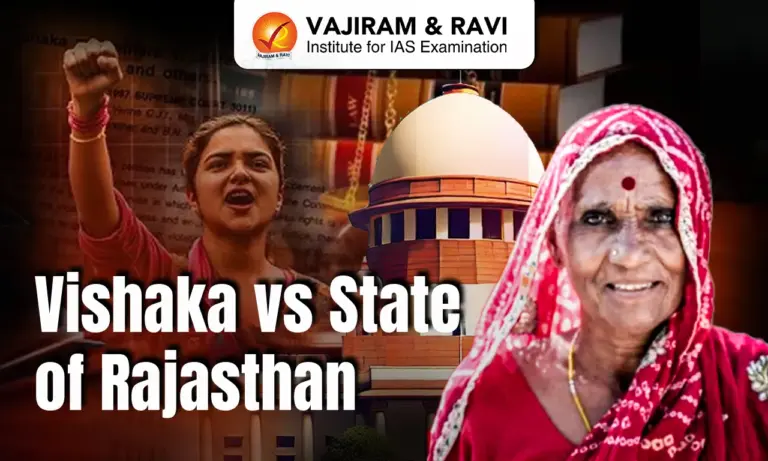
The Vishaka vs State of Rajasthan case became a landmark case law that addressed workplace sexual harassment after the brutal assault of activist Bhanwari Devi. It led to the first legally enforceable guidelines in India to ensure women’s safety at work, recognizing sexual harassment as a violation of equality, dignity, and the fundamental rights guaranteed under Articles 14, 19, and 21 of the Constitution.
Vishaka vs State of Rajasthan Issue
The Vishaka vs State of Rajasthan 1997 focused on whether formal, enforceable guidelines were essential to address increasing workplace sexual harassment and ensure safe working conditions for women. The assault of Bhanwari Devi during her attempt to stop a child marriage and the failure of institutional mechanisms raised urgent concerns about women’s safety and legal protection at workplaces across India. This case led to the filing of multiple PILs by NGOs and Activists.
Vishaka vs State of Rajasthan Judgment
The Vishaka vs State of Rajasthan 1997 judgment emphasized creating legally binding guidelines to prevent workplace sexual harassment and ensure women’s constitutional rights are protected effectively.
- The Supreme Court relied on Articles 14, 19, and 21 to state that every workplace must guarantee safety, dignity, and equal opportunity.
- It recognized sexual harassment as a fundamental rights violation affecting women’s liberty, equality, and freedom of profession.
- The judgment defined sexual harassment clearly, covering physical, verbal, and non-verbal misconduct impacting working conditions.
- The court formulated a detailed guideline for the safety of woman at workplace as- Vishaka Guidelines.
- The Court criticized lack of statutory support and directed immediate guidelines until formal legislation is made.
- It acknowledged that gender equality at work cannot be achieved without strict preventive and redressal mechanisms.
- It emphasized employer responsibility in preventing harassment and providing a secure, non-hostile environment.
- The Court considered international conventions like CEDAW for strengthening protections where Indian law remained silent.
- It held that workplace safety is essential to allow women full participation in social and economic life.





Vishaka Guidelines
Vishaka Guidelines provided mandatory procedures for workplaces to prevent and address sexual harassment until a law was enacted.
- Employers must ensure safety, dignity, and a secure environment for every woman employee.
- Government bodies were directed to develop strict rules prohibiting workplace sexual harassment.
- Any act of harassment should attract disciplinary action and, when necessary, criminal proceedings.
- Organizations must create a functional complaint mechanism with timely redressal.
- Each workplace must form a Complaint Committee headed by a woman with at least 50% women members.
- The committee must include an external NGO or expert familiar with sexual harassment issues.
- Annual reports must be submitted to authorities to ensure transparency and compliance.
- Discussions on sexual harassment must not be treated as taboo and should be addressed openly.
- Employers must regularly inform women employees of their rights and new guidelines.
- Responsibility extends to acts committed by third parties, requiring employers to provide support to victims.
- These guidelines applied to both government and private sector organizations.
POSH Act 2013
The POSH Act of 2013 transformed the Vishaka Guidelines into binding law, strengthening workplace safety mechanisms for women.
- Enacted in 2013, it replaced the Vishaka Guidelines with a comprehensive statutory framework.
- The Act aims to create a safe and supportive workplace environment for women across sectors.
- It defines sexual harassment, including unwelcome physical contact, sexual favours, remarks, pornography, and verbal or non-verbal misconduct.
- The Act lists circumstances that constitute harassment such as threats, favoritism, hostile environments, and interference with work.
- It mandates Internal and Local Complaints Committees for organizations and districts.
- The Act imposes fines up to Rs 50,000 for non-compliance, with repeated violations leading to stricter penalties and licence cancellation.

 Last updated on March, 2026
→ UPSC Final Result 2025 is now out.
→ UPSC has released UPSC Toppers List 2025 with the Civil Services final result on its official website.
→ Anuj Agnihotri secured AIR 1 in the UPSC Civil Services Examination 2025.
→ UPSC Marksheet 2025 is now out.
→ UPSC Notification 2026 & UPSC IFoS Notification 2026 is now out on the official website at upsconline.nic.in.
→ UPSC Calendar 2026 has been released.
→ Check out the latest UPSC Syllabus 2026 here.
→ UPSC Prelims 2026 will be conducted on 24th May, 2026 & UPSC Mains 2026 will be conducted on 21st August 2026.
→ The UPSC Selection Process is of 3 stages-Prelims, Mains and Interview.
→ Prepare effectively with Vajiram & Ravi’s UPSC Prelims Test Series 2026 featuring full-length mock tests, detailed solutions, and performance analysis.
→ Enroll in Vajiram & Ravi’s UPSC Mains Test Series 2026 for structured answer writing practice, expert evaluation, and exam-oriented feedback.
→ Join Vajiram & Ravi’s Best UPSC Mentorship Program for personalized guidance, strategy planning, and one-to-one support from experienced mentors.
→ Shakti Dubey secures AIR 1 in UPSC CSE Exam 2024.
→ Also check Best UPSC Coaching in India
Vishaka vs State of Rajasthan FAQs
Q1. What is the Vishaka vs State of Rajasthan case?+
Q2. Why did the Vishaka vs State of Rajasthan case reach the Supreme Court?+
Q3. What did the Supreme Court decide in the Vishaka vs State of Rajasthan?+
Q4. What are the Vishaka Guidelines?+
Q5. How did the POSH Act relate to the Vishaka case?+
Tags: vishaka vs state of rajasthan