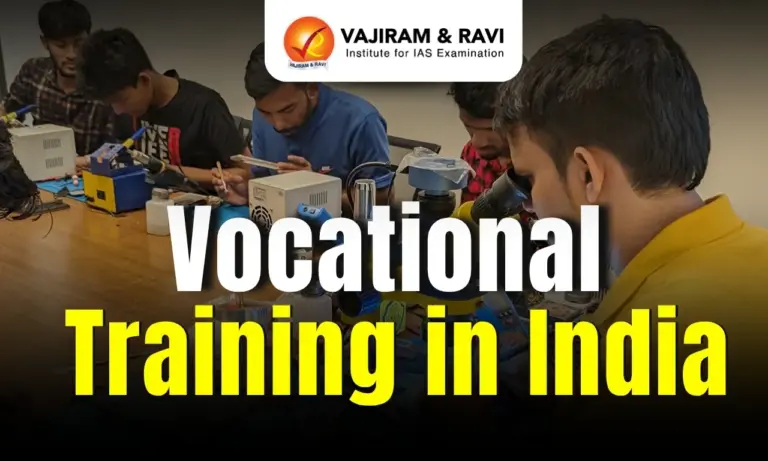
Vocational Training in India refers to education and skill development that equips individuals with practical, job oriented competencies required for specific occupations, trades and industries. It focuses on hands-on learning, technical expertise and employability rather than purely academic knowledge. India possesses one of the world’s largest vocational education and training (VET) ecosystems, comprising Industrial Training Institutes (ITIs), polytechnics, apprenticeship programmes and skill development centres. As India seeks to harness its demographic dividend and address skill shortages amid rapid technological change, vocational training has become a critical instrument for enhancing productivity, employment generation, entrepreneurship and inclusive economic growth.
Vocational Training in India
The ecosystem of Vocational Training in India aims to create industry ready manpower through practical skill development, apprenticeships, certification systems and employment oriented training programmes.
- Job Oriented Learning: Vocational Education and Training (VET) provides practical, occupation specific skills that prepare learners for direct employment, self employment, entrepreneurship and technical careers across manufacturing, services, construction, healthcare and emerging sectors.
- Extensive Institutional Network: India operates more than 14,000 Industrial Training Institutes (ITIs) with approximately 25 lakh sanctioned training seats, making it one of the world’s largest vocational training infrastructures.
- Formal and Informal Training Modes: The system includes ITIs, polytechnics, apprenticeship programmes, Recognition of Prior Learning (RPL), skill centres, private institutes and community based training models catering to diverse learners.
- Governance Framework: The Ministry of Skill Development and Entrepreneurship (MSDE) serves as the nodal ministry, while the National Council for Vocational Education and Training (NCVET) regulates standards, certifications and quality assurance mechanisms.
- National Skills Qualifications Framework: The NSQF establishes competency based qualifications across eight levels, enabling alignment between vocational education, higher education and labour market requirements.
- Large Scale Reach: Since 2014, various government skill development initiatives have empowered more than 6 crore individuals through training, certification, apprenticeship and entrepreneurship support programmes.
- Apprenticeship Based Learning: Vocational training combines classroom instruction with workplace exposure, enabling trainees to acquire practical industry experience through apprenticeship and on the job learning mechanisms.
- School Level Integration: NEP 2020 recommends vocational exposure from Grade 6 onward, promoting early skill development and reducing the historical divide between academic and vocational streams.
- Growing Skill Demand: Rapid digitalisation, automation, artificial intelligence, robotics, green technologies and Industry 4.0 transformations have increased demand for specialised vocational skills across sectors.
- Employment Focused Ecosystem: Vocational programmes increasingly emphasise employability outcomes, industry partnerships, placement support and market relevant training to bridge the gap between education and employment.
- Wide Sectoral Coverage: Training is offered across manufacturing, electronics, construction, healthcare, retail, information technology, automotive, agriculture, handicrafts, logistics, tourism and numerous service sectors.
- Improving Training Participation: Formal vocational training among individuals aged 15-59 increased from about 1.8% in 2017 to around 4.1% in 2023, indicating gradual improvement in skill acquisition.
- Historical Evolution: India’s formal vocational training framework began with the Craftsmen Training Scheme in 1950, followed by ITIs, the NCVT in 1956 and the Apprentices Act in 1961.
- Recognition of Traditional Skills: Hereditary skill acquisition increased from 1.45% in 2017 to 11.6% in 2023, reflecting greater recognition of traditional occupational knowledge and informal learning systems.
- Constitutional Support: Articles 41 and 46 encourage education, employment opportunities and advancement of weaker sections, providing a broad constitutional foundation for vocational education policies.
Vocational Training in India Government Initiatives
The government has launched multiple programmes to strengthen Vocational Training in India, improve employability, expand apprenticeships and modernise India’s skill development ecosystem.
- Skill India Mission: Launched in 2015, the mission promotes skill development, reskilling and upskilling through an extensive network of training institutions across the country.
- Restructured Skill India Programme: Approved in 2025, it integrates PMKVY 4.0, PM NAPS and Jan Shikshan Sansthan into a unified Central Sector Scheme.
- Pradhan Mantri Kaushal Vikas Yojana (PMKVY): The flagship programme provides short term skill training, Recognition of Prior Learning, certification and placement linked incentives across diverse sectors.
- PMKVY Coverage: More than 1.63 crore candidates have received training under PMKVY across manufacturing, healthcare, construction, retail, electronics, information technology and service sectors.
- National Apprenticeship Promotion Scheme (NAPS): NAPS provides financial support for apprenticeship stipends and promotes industry based practical learning through formal apprenticeship contracts.
- Apprenticeship Expansion: More than 43.47 lakh apprentices had been engaged across 36 States and Union Territories by May 2025 under apprenticeship promotion initiatives.
- Jan Shikshan Sansthan (JSS): The programme provides vocational skills to non literates, neo literates, school dropouts and disadvantaged groups between 15 and 45 years of age.
- JSS Achievements: Over 26 lakh individuals were trained between FY 2018-19 and FY 2023-24, improving livelihood opportunities among vulnerable populations.
- SANKALP Programme: It strengthens district level skill ecosystems through capacity building, institutional reforms, performance based funding and improved governance structures.
- STRIVE Programme: Supported by the World Bank, STRIVE enhances apprenticeship quality, institutional effectiveness, industry engagement and outcome oriented vocational training reforms.
- ITI Upgradation Scheme: The programme modernises 1,000 government ITIs through public private partnerships and aligns training infrastructure with evolving industry requirements.
- Skill Hubs Initiative: Shared training infrastructure enables school students to receive vocational exposure and practical skill training within local educational ecosystems.
- PM Vishwakarma Yojana: It supports artisans and craftspeople through skill upgradation, certification, toolkit incentives, digital transaction incentives, marketing assistance and credit support.
- DDU GKY: The Deen Dayal Upadhyaya Grameen Kaushalya Yojana targets rural youth, with approximately 65% of trained candidates securing employment after training completion.
- NEP 2020 Reforms: The policy promotes vocational education from Grade 6, introduces credit based mobility and aims to provide vocational exposure to 50% of learners.


Vocational Training in India Significance
Vocational Training in India plays a crucial role in improving employability, productivity, economic competitiveness, social inclusion and workforce preparedness in a rapidly changing economy.
- Enhances Employability: Vocational training equips individuals with industry relevant skills, increasing job readiness and reducing the gap between education and labour market requirements.
- Improves Earnings: Formal skill training increases average earnings by approximately 11%, supporting upward economic mobility and improved living standards.
- Supports Workforce Formalisation: Skill certification encourages workers to enter organised sectors and access better employment opportunities, wages and social security benefits.
- Boosts Productivity: A skilled workforce contributes to higher industrial efficiency, technological adoption, innovation and overall economic productivity growth.
- Addresses Skill Gaps: Vocational education helps industries access trained manpower and reduces shortages in critical sectors requiring technical competencies.
- Facilitates Reskilling: Digitalisation and technological transformation require nearly 50% of the workforce to undergo reskilling, making vocational training increasingly essential.
- Promotes Entrepreneurship: Practical training equips learners with technical and business capabilities needed to establish self employment ventures and small enterprises.
- Supports Inclusive Development: Marginalised youth experience 30-70% higher placement rates through vocational training, improving social mobility and economic participation.
- Reduces Unemployment: Job focused training improves labour market matching and helps young people transition more effectively from education to employment.
- Strengthens MSMEs: Skilled workers enhance productivity and competitiveness within micro, small and medium enterprises that generate substantial employment.
- Encourages Regional Development: Vocational institutions support local industries by providing trained workers aligned with regional economic requirements.
- Improves Adaptability: Transversal and technical skills acquired through VET help workers adapt to automation, technological disruption and changing occupational demands.
- Supports Demographic Dividend: India’s large youth population can become a productive economic asset through widespread skill development and workforce preparation.
- Promotes Social Equity: Vocational education creates employment opportunities for women, rural populations, school dropouts and economically weaker sections.
- Drives Economic Growth: A skilled workforce forms the foundation for industrial expansion, investment attraction, manufacturing competitiveness and long term economic development.
Vocational Training in India Challenges
Despite its scale, Vocational Training in India system faces structural, institutional, financial and social barriers that restrict its effectiveness and labour market outcomes.
- Low Formal Training Levels: PLFS 2022-23 indicates that only about 3.8% of workers possess formal vocational training, highlighting a substantial skill deficit within India’s workforce.
- Poor Seat Utilisation: Although ITIs offer around 25 lakh sanctioned seats, enrolment remains near 12 lakh, resulting in only 48% utilisation of available training capacity.
- Employment Absorption Gap: Only about 63% of ITI graduates secured employment in 2018, significantly below the 80-90% employment outcomes achieved by Germany, Singapore and Canada.
- Faculty Shortages: Nearly 30% of instructor positions remain vacant in ITIs, while limited training capacity in National Skill Training Institutes hampers recruitment and quality enhancement.
- Outdated Curriculum: Many vocational courses fail to incorporate digital technologies, artificial intelligence, automation, robotics and emerging industry requirements, reducing graduate employability.
- Late Entry into Education System: Vocational education is generally introduced after secondary education, limiting early skill exposure and reducing opportunities for long term competency development.
- Lack of Academic Mobility: Absence of seamless pathways between vocational and higher education discourages students who wish to maintain access to traditional academic progression.
- Weak Monitoring Mechanisms: Irregular grading of ITIs, limited performance assessments and inadequate trainee employer feedback systems weaken accountability and quality assurance.
- Social Stigma: Vocational careers are often perceived as inferior to engineering, medicine and university education, discouraging youth and families from pursuing skill based pathways.
- Limited Industry Participation: Employer involvement in curriculum design, training delivery, apprenticeship expansion and infrastructure development remains insufficient compared to international models.
- Funding Constraints: India allocates only about 3% of its education budget to vocational education and training, compared to 10-13% in many OECD economies.
- Infrastructure Deficiencies: Numerous training institutions lack modern laboratories, advanced machinery, digital infrastructure and industry standard equipment required for effective learning.
- Skill Mismatch: Economic Survey 2024-25 highlighted significant mismatches between educational qualifications and employment opportunities, reflecting inadequate alignment with labour market demand.
- Low Employability Levels: India Skills Report 2025 found only 54.8% of graduates employable, indicating persistent deficiencies in technical, practical and workplace competencies.
- Rural Access Gaps: Rural youth often face inadequate access to vocational institutions, trainers, technology and industry exposure, creating regional disparities in skill development.
Way Forward
Addressing Vocational Training in India challenges requires structural reforms, stronger industry partnerships, quality enhancement and improved institutional effectiveness beyond existing schemes.
- Early School Integration: Introduce vocational subjects from middle school onwards to build practical skills early and improve career awareness among students.
- National Credit Framework Implementation: Establish seamless academic vocational mobility through credit transfer systems that allow learners to move between educational pathways.
- Curriculum Modernisation: Regularly update training content based on labour market assessments and emerging sectors such as AI, robotics, green technologies and digital services.
- Instructor Recruitment Expansion: Increase capacity of National Skill Training Institutes and accelerate instructor appointments to reduce persistent faculty shortages.
- Industry Led Curriculum Design: Involve employers directly in curriculum development, competency standards, assessment frameworks and certification processes.
- Strengthen ITI Evaluation: Introduce regular institutional audits, trainee satisfaction surveys, employer feedback mechanisms and transparent performance rankings.
- Expand Public Private Partnerships: Encourage industries to co-finance infrastructure, provide equipment, share expertise and participate in training delivery.
- Increase Vocational Funding: Raise vocational education expenditure closer to international benchmarks to improve infrastructure, technology adoption and training quality.
- Enhance MSME Participation: Develop flexible partnership models enabling MSMEs to engage in apprenticeships, curriculum development and workplace training.
- Promote Social Awareness: Conduct nationwide campaigns highlighting successful vocational careers and employment outcomes to reduce social stigma associated with skill based education.
- Develop Rural Skill Infrastructure: Establish accessible training centres, digital learning facilities and industry linkages in underserved rural and remote regions.
- Leverage CSR Resources: Encourage corporate social responsibility investments for training infrastructure, advanced equipment, instructor development and innovation labs.
- Strengthen Certification Credibility: Ensure vocational certifications remain nationally recognised, industry accepted and aligned with international competency standards.
- Improve Labour Market Information: Create robust employability indices and skill demand forecasting systems to align training supply with economic requirements.
- Adopt Global Best Practices: Incorporate Germany’s dual apprenticeship system, Singapore’s SkillsFuture approach, Canada’s Red Seal certification model and polytechnic progression pathways to improve outcomes.

 Last updated on Oct, 2026
→ UPSC 2027 Notification will be released on 13 January 2027 at upsconline.nic.in.
→ Check Nobel Prize 2026 Winners List here.
→ Download PIB PRiSM Monthly Magazine 2026 here.
→ Check UPSC Monthly Current Affairs Magazine The Recitals here.
→ Check out the latest UPSC Syllabus here.
→ Download UPSC Model Answers for Mains 2026
→ UPSC Mains Question Paper 2026 is out now for Essay & GS Paper 1, 2, 3 & 4.
→ UPSC Calendar 2027 has been released.
→ Enroll in Vajiram & Ravi’s UPSC Mains Test Series 2027 for structured answer writing practice, expert evaluation, and exam-oriented feedback.
→ Join Vajiram & Ravi’s UPSC Mentorship Program 2027 for personalized guidance, strategy planning, and one-to-one support from experienced mentors.
→ Go through the UPSC Mains Previous Year Papers to enhance your preparation.
→ UPSC has released UPSC Toppers List 2025 with the Civil Services final result on its official website.
→ Also check Best UPSC Coaching in India
Vocational Training in India FAQs
Q1. What is Vocational Training in India?+
Q2. How many ITIs are there in India?+
Q3. Which is the flagship vocational training scheme in India?+
Q4. What are the major challenges facing Vocational Training in India?+
Q5. Why is vocational training important for India’s economy?+
Tags: technology & engineering vocational training in india