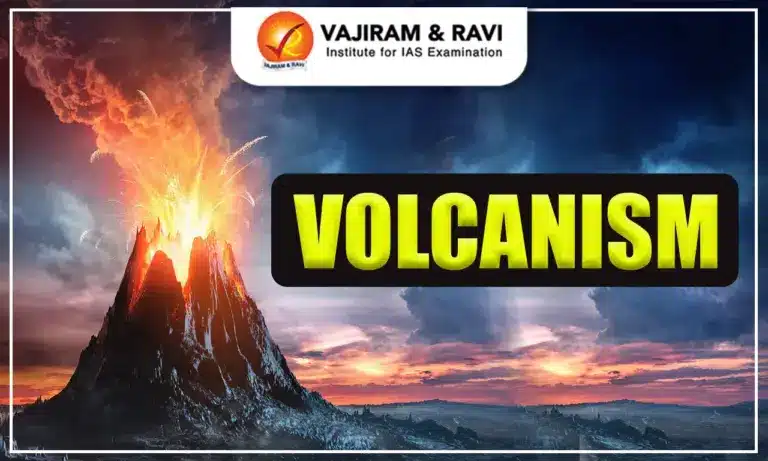
Volcanism is a geological process in which magma, gases and volcanic materials erupt from beneath the Earth’s crust to its surface. Natural forces shape landforms, create new terrains and trigger ecological shifts, volcanism, likewise contributes to generating energy sources, enriching soils and offers clues to Earth’s internal activity. In this article, we are going to cover volcanism, its causes, process and effects.
Volcanism
Volcanism refers to processes where magma, gases, and volcanic materials rise from the Earth’s interior to the surface. Driven mainly by tectonic plate movement, it occurs at divergent boundaries, subduction zones, and hotspots. When magma erupts, it appears as lava, which cools to form igneous rocks. Volcanoes are surface expressions of volcanism including shield volcanoes, stratovolcanoes, and cinder cones, each with unique eruption styles.
Eruptions may be explosive, releasing ash, pyroclastic flows, and gases, or effusive, marked by steady lava outpour. Though often destructive causing deaths, property loss, and climatic shifts volcanism also matures soils, provides geothermal energy, and continuously reshapes Earth. Studying it helps predict eruptions, reduce hazards, and strengthen resilience.
Volcanism Important Terminology
The following terms are important when it comes to terminology:
- Magma: Molten rock beneath Earth’s crust.
- Lava: Magma reaching the surface.
- Volcano: Landform from accumulated lava, ash, and pyroclasts.
- Vent: Opening where magma and gases escape.
- Crater: Bowl-shaped depression at the summit.
- Caldera: Large depression from magma chamber collapse.
- Pyroclastic Flow: Fast, hot current of ash, gases, and debris.
- Tephra: Rock and ash fragments ejected.
- Volcanic Ash: Fine material (<1 mm) dispersed widely.
- Hotspot: Magma upwelling away from boundaries (e.g., Hawaii).
- Fissure: Long crack releasing lava.
- Pumice: Light, porous volcanic rock.
- Basalt: Dense, dark volcanic rock from effusive eruptions.
- Andesite/Rhyolite: Silica-rich volcanic rocks causing explosive activity.
- Volcanic Dome: Steep mound of viscous lava.
- Lahar: Mudflow of volcanic ash and water.
- Plume: Vertical column of volcanic material.
- Geyser: Periodic eruption of water/steam in volcanic regions.
- Tuff: Rock from compacted volcanic ash.
- Volcanic Arc: Chain of volcanoes along subduction zones.





Volcanism Causes
Following are the causes of volcanism:
- Tectonic Plates: Divergent ridges (e.g., Iceland) form new crust; convergent zones (Pacific Ring of Fire) drive subduction-related volcanism.
- Hotspots: Mantle plumes form volcanic islands (Hawaii, Yellowstone).
- Mantle Convection: Heat-driven movement generates magma.
- Magma Pressure: Overfilled chambers fracture crust, causing eruptions.
- Crustal Weaknesses: Faults and fractures act as magma pathways.
- Volatile Gases: Expanding gases trigger explosive activity.
- Thermal Anomalies: Radioactive heat fosters magma formation.
- Asthenosphere Melting: Partial melting from pressure/temperature shifts fuels volcanism.
Volcanism Process
A volcano erupts by the following process:
- Magma Generation: Melting in mantle/crust due to heat, pressure drop, or volatiles.
- Magma Accumulation: Rising magma collects in chambers.
- Pressure Build-Up: Expanding gases raise chamber pressure.
- Crustal Fracturing: Pressure fractures crust, opening paths.
- Eruption: Magma erupts as lava, effusive (steady flow) or explosive (violent).
- Landform Formation: Volcanoes, domes, calderas, plateaus take shape.
- Cooling: Lava solidifies, ash enriches soils.
- Post-Volcanic Activity: Geysers, fumaroles, hot springs may persist.
Volcanism Effects
The impact of volcanism are:
- Shapes landscapes, alters climate, enriches soils, impacts ecosystems.
- Destroys property, endangers lives, displaces populations, causes health hazards.
- Damages infrastructure, but supports tourism, mineral resources, and energy.
- Geological/Hydrological impact that triggers landslides, tsunamis, and river changes.
- Holds spiritual value, enables research and hazard prediction.
- Super-eruptions may alter climate and agriculture worldwide.
Volcanism Distribution
The volcanoes are divided into the following areas:
- Ring of Fire: Most active belt, with 75% of active volcanoes (Japan, Indonesia, US West Coast)
- Mid-Ocean Ridges: Continuous volcanic activity along ocean ridges (Mid-Atlantic Ridge).
- Hotspots: Intraplate volcanism forming islands (Hawaii, Iceland, Yellowstone).
- Continental Boundaries: Tectonic collisions or separations drive volcanism (Himalayan region)
- Rift Zones: Regions like East African Rift allow magma upwelling
Subduction Zones: Converging plates create explosive volcanoes (Mount Fuji, St. Helens)

 Last updated on March, 2026
→ UPSC Final Result 2025 is now out.
→ UPSC has released UPSC Toppers List 2025 with the Civil Services final result on its official website.
→ Anuj Agnihotri secured AIR 1 in the UPSC Civil Services Examination 2025.
→ UPSC Marksheet 2025 is now out.
→ UPSC Notification 2026 & UPSC IFoS Notification 2026 is now out on the official website at upsconline.nic.in.
→ UPSC Calendar 2026 has been released.
→ Check out the latest UPSC Syllabus 2026 here.
→ UPSC Prelims 2026 will be conducted on 24th May, 2026 & UPSC Mains 2026 will be conducted on 21st August 2026.
→ The UPSC Selection Process is of 3 stages-Prelims, Mains and Interview.
→ Prepare effectively with Vajiram & Ravi’s UPSC Prelims Test Series 2026 featuring full-length mock tests, detailed solutions, and performance analysis.
→ Enroll in Vajiram & Ravi’s UPSC Mains Test Series 2026 for structured answer writing practice, expert evaluation, and exam-oriented feedback.
→ Join Vajiram & Ravi’s Best UPSC Mentorship Program for personalized guidance, strategy planning, and one-to-one support from experienced mentors.
→ Shakti Dubey secures AIR 1 in UPSC CSE Exam 2024.
→ Also check Best UPSC Coaching in India
Volcanism FAQs
Q1. What is the definition of volcanism?+
Q2. What are the processes of volcanism?+
Q3. What are the main causes of volcanism?+
Q4. What are the three types of volcanism?+
Q5. What are the effects of volcanoes?+
Tags: volcanism