Voyager 1 Latest News
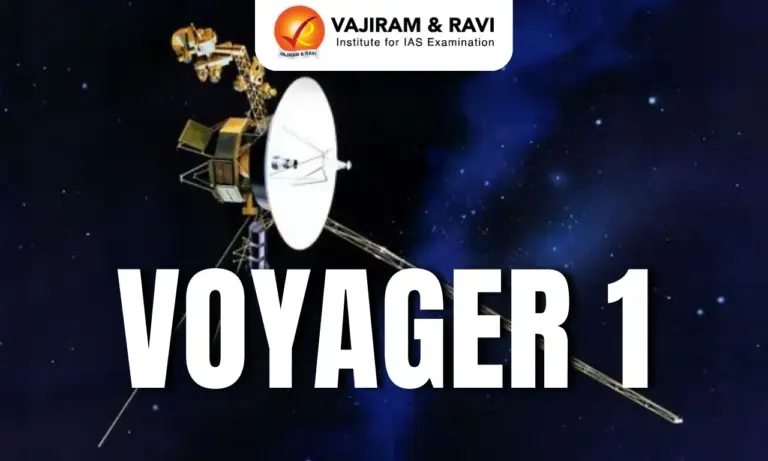
Voyager 1 is expected to become the first human-made object to reach a distance of one light-day from Earth.
About Voyager 1
- It is a space probe launched by NASA in 1977.
- Objective: To explore the outer planets in our solar system.
- It is the first spacecraft to travel beyond the solar system and reach interstellar space.
- It is currently the most distant human-made object from Earth.
- Voyager 1’s mission has included flybys of Jupiter and Saturn, with the goal of studying their moons, rings, and magnetic fields.
- Instruments of Voyager 1: Cosmic Ray Subsystem, Plasma Wave Subsystem, Infrared Interferometer Spectrometer and Radiometer (IRIS) etc.




Key Achievements of Voyager 1
- It was the first spacecraft to cross the heliosphere, the boundary where the influences outside our solar system are stronger than those from our Sun.
- It crossed into interstellar space in August 2012, making it the first human-made object to venture out of the solar system.
- It discovered a thin ring around Jupiter and two new Jovian moons: Thebe and Metis.
- It also found five new moons and a new ring called the G-ring at Saturn.
Source: LM

 Last updated on March, 2026
→ UPSC Final Result 2025 is now out.
→ UPSC has released UPSC Toppers List 2025 with the Civil Services final result on its official website.
→ Anuj Agnihotri secured AIR 1 in the UPSC Civil Services Examination 2025.
→ UPSC Marksheet 2025 is now out.
→ UPSC Notification 2026 & UPSC IFoS Notification 2026 is now out on the official website at upsconline.nic.in.
→ UPSC Calendar 2026 has been released.
→ Check out the latest UPSC Syllabus 2026 here.
→ UPSC Prelims 2026 will be conducted on 24th May, 2026 & UPSC Mains 2026 will be conducted on 21st August 2026.
→ The UPSC Selection Process is of 3 stages-Prelims, Mains and Interview.
→ Prepare effectively with Vajiram & Ravi’s UPSC Prelims Test Series 2026 featuring full-length mock tests, detailed solutions, and performance analysis.
→ Enroll in Vajiram & Ravi’s UPSC Mains Test Series 2026 for structured answer writing practice, expert evaluation, and exam-oriented feedback.
→ Join Vajiram & Ravi’s Best UPSC Mentorship Program for personalized guidance, strategy planning, and one-to-one support from experienced mentors.
→ Shakti Dubey secures AIR 1 in UPSC CSE Exam 2024.
→ Also check Best UPSC Coaching in India
Voyager 1 FAQs
Q1. What is the primary objective of Voyager 1?+
Q2. What is unique about Voyager 1?+
Tags: voyager 1