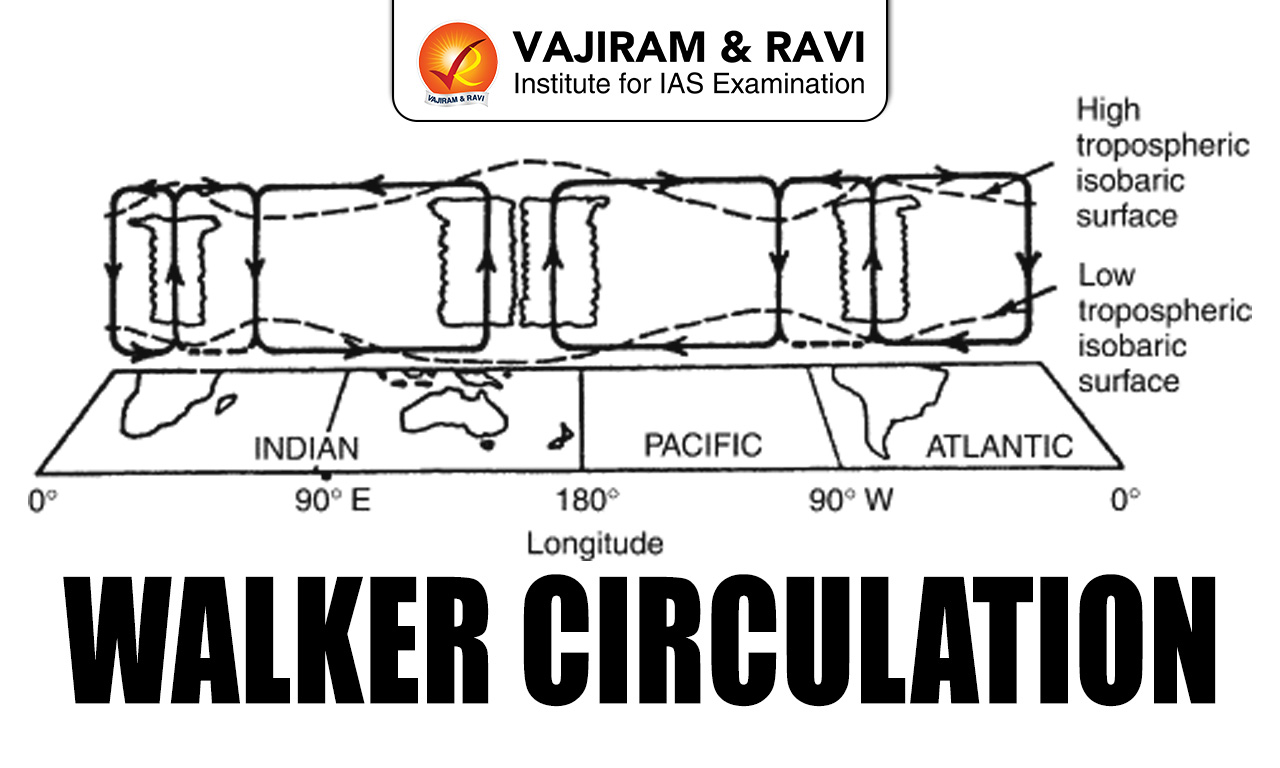
Walker Circulation is a large-scale system of air movement that occurs over the tropical regions of the Pacific Ocean. It describes the east-west movement of air in the atmosphere along the equatorial region. This circulation helps in the movement of heat, moisture, and air between different parts of the tropical Pacific. It plays an important role in influencing weather and climate patterns in many tropical regions of the world. Variations in this circulation are also associated with major climate phenomena such as El Niño and La Niña. Walker Circulation is discussed in detail below.
Discovery of Walker Circulation
The Walker Circulation was first identified by Gilbert Walker in the early 20th century. While studying the behaviour of the Indian Monsoon, he discovered a relationship between changes in atmospheric pressure across the tropical Pacific Ocean and variations in rainfall in different parts of the world. His work helped scientists understand the link between large-scale atmospheric circulation and global climate patterns.
About Walker Circulation
- Walker Circulation refers to the east-west movement of air over the tropical regions of the Pacific Ocean. It is an important part of the global climate system and plays a major role in controlling weather patterns in the tropics.
- The Walker Circulation is closely related to the El Niño-Southern Oscillation (ENSO), which is one of the main reasons for year-to-year changes in Earth’s climate. ENSO involves two major changes:
- Changes in the temperature of surface waters in the tropical Pacific Ocean.
- Changes in atmospheric circulation in the east-west direction above the Pacific Ocean.
- The second change forms the basis of the Walker Circulation. Because the Pacific Ocean is extremely large, changes in this circulation can influence rainfall, temperature, and weather conditions in many parts of the world.
- In normal conditions, warm air rises over the western Pacific region where ocean waters are warmer and rainfall is high. The air then moves eastward in the upper atmosphere and sinks over the eastern Pacific, where the water is relatively cooler. Near the surface, air flows back toward the west, completing the circulation cycle.
- Changes in the strength of the Walker Circulation are closely linked with climate events such as El Niño and La Niña, which can significantly affect global weather patterns, including monsoon rainfall and drought conditions.
Also Read: Climate of India


Walker Circulation Significance
- The Walker Circulation is an important system of air movement over the tropical Pacific Ocean. The Walker Circulation does not always remain the same; it can become stronger or weaker over time. These changes are closely linked with the phases of the El Niño-Southern Oscillation (ENSO).
- A weaker Walker Circulation is associated with El Niño conditions. During this time, the easterly surface winds over the tropical Pacific become weaker.
- A stronger Walker Circulation occurs during La Niña conditions, when the easterly winds blowing across the tropical Pacific become stronger.
- Changes in the strength of the Walker Circulation can significantly influence weather patterns in different parts of the world. For example, a stronger Walker Circulation usually brings cooler temperatures and higher rainfall to eastern Australia, which can sometimes lead to floods. On the other hand, a weaker Walker Circulation often results in warmer and drier weather in the same region.
- Due to these impacts, the Walker Circulation plays an important role in shaping global climate and rainfall patterns.

 Last updated on Oct, 2026
→ UPSC 2027 Notification will be released on 13 January 2027 at upsconline.nic.in.
→ Check Nobel Prize 2026 Winners List here.
→ Download PIB PRiSM Monthly Magazine 2026 here.
→ Check UPSC Monthly Current Affairs Magazine The Recitals here.
→ Check out the latest UPSC Syllabus here.
→ Download UPSC Model Answers for Mains 2026
→ UPSC Mains Question Paper 2026 is out now for Essay & GS Paper 1, 2, 3 & 4.
→ UPSC Calendar 2027 has been released.
→ Enroll in Vajiram & Ravi’s UPSC Mains Test Series 2027 for structured answer writing practice, expert evaluation, and exam-oriented feedback.
→ Join Vajiram & Ravi’s UPSC Mentorship Program 2027 for personalized guidance, strategy planning, and one-to-one support from experienced mentors.
→ Go through the UPSC Mains Previous Year Papers to enhance your preparation.
→ UPSC has released UPSC Toppers List 2025 with the Civil Services final result on its official website.
→ Also check Best UPSC Coaching in India
Walker Circulation FAQs
Q1. What is Walker Circulation?+
Q2. Who discovered Walker Circulation?+
Q3. How does Walker Circulation work under normal conditions?+
Q4. What is the relationship between Walker Circulation and ENSO?+
Q5. What happens to Walker Circulation during El Niño?+
Q6. What happens during La Niña?+
Tags: geography geography notes Walker Circulation