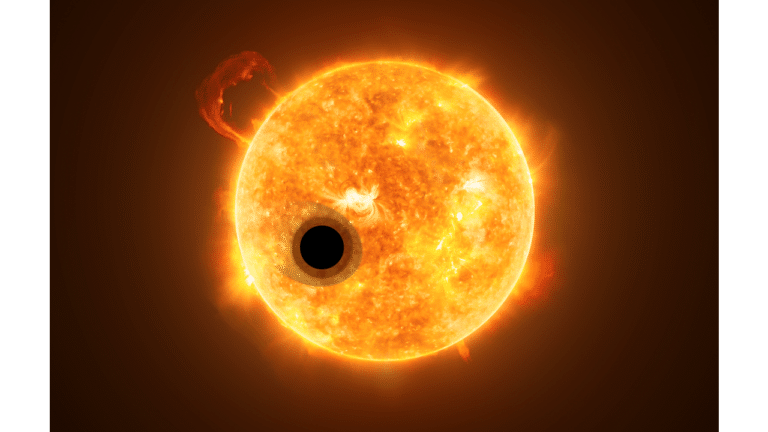
About Wasp-107b
- It is a newly discovered exoplanet situated 200 light-years away in the Virgo constellation.
- The mass of WASP-107b is 30.5 Earths, and it takes only six days to orbit its home star, which is slightly cooler and less massive than our sun.
- It shares Jupiter’s size but possesses the mass of Neptune, making it less dense than other gas giants.
- The planet’s low density allowed astronomers to look 50 times deeper into the atmosphere of the planet compared to observations achieved for more dense planets, like Jupiter.
- The exoplanet is scorching hot (with an outer atmosphere that’s more than 900 degrees Fahrenheit).
- Sand Rain:
- Wasp-107b exhibits a water cycle akin to Earth’s, but with one peculiar difference: instead of water droplets, the planet experiences sand rain.
- The falling grains are, in fact, silicate vapours rising from lower atmospheric levels.
- Similar to Earth’s water cycle, these sand clouds precipitate back to lower planetary atmospheric levels.
- In addition to the silicate clouds, scientists have identified water vapor and sulfur dioxide in the atmosphere of WASP-107b.
What are gas giants?
- Gas giants are large planets composed mostly of gases, such as hydrogen and helium, with a relatively small rocky core.
- The gas giants of our solar system- Jupiter, Saturn, Uranus, and Neptune- together make up a group known as the Jovian planets (Jupiter-like).
- The solar system’s four gas giants reside farthest from the Sun, past the orbits of Mars and the asteroid belt. So they are also called outer planets.
- All of the outer planets have numerous moons. They all also have planetary rings, composed of dust and other small particles that encircle the planet in a thin plane.
Q1) What is the James Webb Telescope?
This telescope was built in collaboration between NASA, the European Space Agency (ESA) and the Canadian Space Agency and was launched in December 2021. It is presently at a point in space known as the Sun-Earth L2 Lagrange point, approximately 1.5 million km beyond Earth’s orbit. It will examine every phase of cosmic history; from the Big Bang to the formation of galaxies, stars, and planets to the evolution of our Solar System.
Source: Jupiter-sized exoplanet “Wasp-107b” discovered by NASA






 Last updated on March, 2026
→ UPSC Final Result 2025 is now out.
→ UPSC has released UPSC Toppers List 2025 with the Civil Services final result on its official website.
→ Anuj Agnihotri secured AIR 1 in the UPSC Civil Services Examination 2025.
→ UPSC Marksheet 2025 is now out.
→ UPSC Notification 2026 & UPSC IFoS Notification 2026 is now out on the official website at upsconline.nic.in.
→ UPSC Calendar 2026 has been released.
→ Check out the latest UPSC Syllabus 2026 here.
→ UPSC Prelims 2026 will be conducted on 24th May, 2026 & UPSC Mains 2026 will be conducted on 21st August 2026.
→ The UPSC Selection Process is of 3 stages-Prelims, Mains and Interview.
→ Prepare effectively with Vajiram & Ravi’s UPSC Prelims Test Series 2026 featuring full-length mock tests, detailed solutions, and performance analysis.
→ Enroll in Vajiram & Ravi’s UPSC Mains Test Series 2026 for structured answer writing practice, expert evaluation, and exam-oriented feedback.
→ Join Vajiram & Ravi’s Best UPSC Mentorship Program for personalized guidance, strategy planning, and one-to-one support from experienced mentors.
→ Shakti Dubey secures AIR 1 in UPSC CSE Exam 2024.
→ Also check Best UPSC Coaching in India