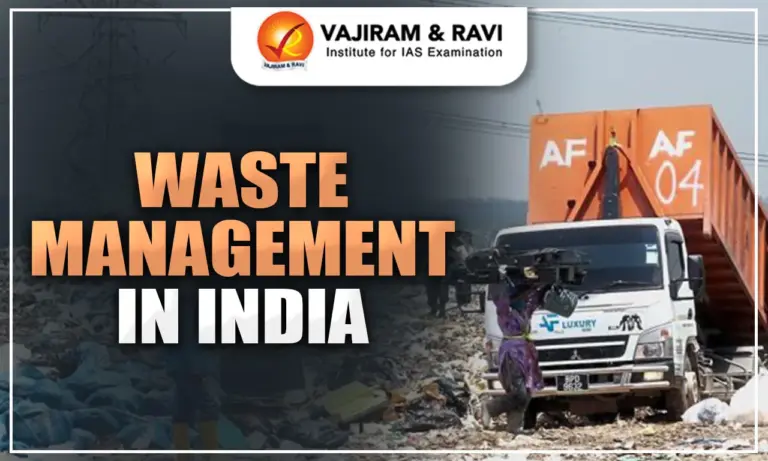
Waste Management in India is managed by the Union Ministry of Environment, Forests and Climate Change (MoEFCC). The policies and regulations that manage waste management are grounded in the principles of sustainable development, the precautionary approach and the polluter pays for the principle. These principles lay down a responsibility on urban local bodies, industries and citizens to manage waste responsibly, minimize environmental harm and bear the costs of remediation where damage happens. In this article, we are going to cover waste management in India, its challenges and solutions.
Waste Management in India
Waste Management in India is a result of rapid economic development, urbanisation and changing consumption patterns. This production has led to a quantum of waste being generated in India. In order to regulate this, India has introduced multiple rules and regulations under the Environment Protection Act, 1986. This law lays down frameworks for the management of multiple solid waste, plastic waste, e-waste, biomedical waste and hazardous waste.
- India generates nearly 62 million tonnes of waste annually, of which only 43 million tonnes are collected, and a mere 12 million tonnes are scientifically treated, while the rest is dumped in open landfills.
- Per capita waste generation in urban areas is projected to reach 0.7 kg/day by 2025, a four to six-fold increase from 1999 levels.
- The country’s municipal solid waste (MSW) generation is expected to escalate to 165 million tonnes by 2030, primarily due to lifestyle changes and economic growth.
- Waste composition includes solid waste, plastic waste, and e-waste, with e-waste emerging as a major challenge due to increasing dependence on electronics.
Waste Management in India Challenges
Waste Management in India has caused the following challenges to human and animal life in India:
- Rapid Urbanization: With over 377 million people in urban India, municipal bodies are struggling to cope with the rising waste volumes.
- Inadequate Collection: Only about 70% of waste is collected, and less than 30% is segregated or processed scientifically.
- Informal Sector Dependence: The informal sector extracts considerable recyclable value from waste, but its integration with formal systems remains weak.
- E-waste Explosion: India is the third-largest generator of e-waste globally, yet large-scale formal recycling infrastructure is lacking.
- Infrastructure Gaps: India has only 21 million garbage collectors, compared to China’s 700 million, showcasing severe manpower and logistical shortages.
- Recycling Inefficiencies: Valuable materials like plastics, aluminum, and glass often end up in landfills due to poor segregation.




Waste Management in India Managing Solutions
India has been taking up the following steps to control waste management:
- Scientific Planning and Studies: Conducts waste characterisation surveys, cost assessments and identifies optimal sites for waste disposal and treatment.
- Strengthening Waste Collection Systems: Deploys mechanised collection methods, ensures door to door collection and aligns collection schedules with waste generation patterns.
- Integration of Informal and Formal Sectors: Provide pickers with the responsibilities to link them with municipal systems and incentivize segregation at the source.
- Decentralized Waste Management: Encourages community led initiatives for composting and small-scale waste treatment at the ward and household levels.
- Organic Waste Treatment: Promote composting, bio-methanation, and anaerobic digestion to reduce landfill pressure and generate renewable energy.
- Technology Integration: Use RFID-enabled bins, GPS tracking of collection vehicles, and AI-based monitoring to streamline waste management.
- Waste-to-Energy Initiatives: Invest in converting non-recyclable waste into fuel or energy while ensuring emissions compliance.
- Upgrading Dumpsites: Transform existing dumps into sanitary landfills with leachate management and methane capture systems.
- Common Waste Treatment Facilities: Promote public-private partnerships (PPP) to establish shared treatment plants for biomedical, hazardous, and industrial waste.
- Strict Enforcement of Laws: Implement waste management rules rigorously, apply the polluter pays principle, and penalize non-compliance.
- Public Awareness and Participation: Launch campaigns through schools, self-help groups, and NGOs to encourage segregation at source, recycling, and composting.

 Last updated on March, 2026
→ UPSC Final Result 2025 is now out.
→ UPSC has released UPSC Toppers List 2025 with the Civil Services final result on its official website.
→ Anuj Agnihotri secured AIR 1 in the UPSC Civil Services Examination 2025.
→ UPSC Marksheet 2025 is now out.
→ UPSC Notification 2026 & UPSC IFoS Notification 2026 is now out on the official website at upsconline.nic.in.
→ UPSC Calendar 2026 has been released.
→ Check out the latest UPSC Syllabus 2026 here.
→ UPSC Prelims 2026 will be conducted on 24th May, 2026 & UPSC Mains 2026 will be conducted on 21st August 2026.
→ The UPSC Selection Process is of 3 stages-Prelims, Mains and Interview.
→ Prepare effectively with Vajiram & Ravi’s UPSC Prelims Test Series 2026 featuring full-length mock tests, detailed solutions, and performance analysis.
→ Enroll in Vajiram & Ravi’s UPSC Mains Test Series 2026 for structured answer writing practice, expert evaluation, and exam-oriented feedback.
→ Join Vajiram & Ravi’s Best UPSC Mentorship Program for personalized guidance, strategy planning, and one-to-one support from experienced mentors.
→ Shakti Dubey secures AIR 1 in UPSC CSE Exam 2024.
→ Also check Best UPSC Coaching in India
Waste Management in India FAQs
Q1. How is waste management in India?+
Q2. What are the 4 types of waste management?+
Q3. Which are the top 5 waste management companies in India?+
Q4. How to control waste management in India?+
Q5. What are the effects of waste management in India?+
Tags: waste management in india