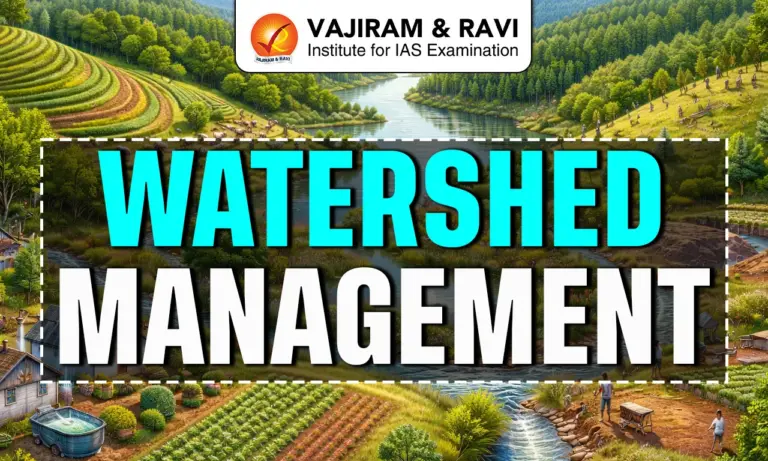
Watershed management is the careful use and protection of land and water in a particular area, where all rainwater drains into a common river, lake, or stream. It focuses on conserving water, soil, and vegetation to prevent problems like soil erosion, water shortage, and floods. By managing a watershed properly, we can improve water availability, support agriculture, and protect the environment. It helps maintain a healthy balance between human needs and natural resources.
About Watershed Management
- Watershed management is the proper planning and use of land and water resources in a specific area to prevent land degradation and improve productivity. It focuses on using natural resources in a careful and sustainable way so that they can support life for a long time without getting damaged.
- The main aim is to control the flow of rainwater so that it moves slowly over the land. This helps more water to soak into the ground (infiltration) and reduces soil erosion. Simple methods like reducing the impact of raindrops on soil, slowing down water flow, working along land contours, and safely diverting excess water are commonly used.
- Watershed management also involves planning and implementing different programs and activities to protect and improve the condition of the watershed. It includes studying the area’s features such as water supply, water quality, drainage, and runoff to use resources wisely.
- Overall, watershed management helps in conserving water, improving soil quality, increasing agricultural productivity, and protecting the environment. It is considered one of the most effective ways to manage natural resources for present and future needs.
Watershed Management Principles
- The main principles of watershed management focus on using land and water resources in a smart and sustainable way.
- Use land as per its capacity: Land should be used according to its type and ability (for farming, forestry, etc.) to avoid damage and increase productivity.
- Conserve rainwater where it falls: Efforts should be made to store rainwater in the same place (in situ) so that it can soak into the soil and improve groundwater levels.
- Manage excess water safely: Extra rainwater should be drained slowly and directed to storage structures like ponds or tanks for future use.
- Control soil erosion: Steps should be taken to prevent the formation of gullies. Structures like check dams can help reduce soil loss, store water, and recharge groundwater.
- Choose suitable crops: Crops should be selected based on the local conditions of the watershed to ensure better growth and efficient use of resources.
- Maximize productivity: The aim is to get the highest possible output using available land, water, and time without harming the environment.





Objectives of Watershed Management
- Conserve soil and water resources: Protect soil from erosion, conserve rainwater, and use surplus water for groundwater recharge and creating additional water sources.
- Promote sustainable agriculture and productivity: Encourage better farming practices, suitable cropping systems, intercropping, and crop rotation to maintain stable and higher yields.
- Develop and utilize land efficiently: Use non-arable, marginal, and wastelands through afforestation, horticulture, grazing, and agroforestry based on land capability.
- Improve livelihoods and reduce risks: Increase income through alternative activities and reduce the impact of extreme weather conditions on farmers’ income.
- Maintain ecological balance: Protect and sustain the ecosystem by ensuring the proper interaction of land, water, plants, animals, and humans.
- Strengthen infrastructure: Improve storage, transportation, and marketing facilities to support overall development.
Watershed Management Planning
- Planning for watershed management begins with collecting proper maps and data, often using remote sensing and satellite images. These tools help give a clear overall picture of the area, including land, water, vegetation, and how they are connected.
- Satellite images are very useful in identifying natural resources and understanding how the land is being used. They can show the area under different crops, crop production, and problems like pests, diseases, or drought.
- By studying this information, planners can understand how resources are distributed and what their current condition is. Based on this, detailed plans are prepared for managing the watershed.
- Finally, different methods are applied to conserve soil and water. These include mechanical measures (like building check dams), agricultural practices, ecological approaches, and forestry activities. All these steps together help in better use and protection of resources in the watershed.
Watershed Management in India
- In India, watershed management is carried out in a planned and organized way to ensure better use of land and water resources, especially in rural and drought-prone areas. The All India Soil and Land Use Survey Organization under the Department of Agriculture has developed a national system to identify, map, and classify watersheds.
- Watersheds in India are divided into different levels based on their size and drainage area. These include basins, catchments, sub-catchments, and watersheds. Overall, India has around 35 river basins, 112 catchments, 500 sub-catchments, and nearly 3200 watersheds, which helps in managing resources at different scales.
- For effective planning and implementation, watersheds are further classified into smaller units based on area:
- Sub-watershed: 10,000 to 50,000 hectares
- Milli-watershed: 1,000 to 10,000 hectares
- Micro-watershed: 100 to 1,000 hectares
- Mini-watershed: 1 to 100 hectares
- This classification allows better planning at the local level, especially for soil conservation, water harvesting, and agricultural development.
- In India, watershed management is also linked with various government programs like rainwater harvesting, afforestation, and rural development schemes. It plays a key role in improving groundwater levels, increasing agricultural productivity, reducing soil erosion, and supporting the livelihoods of farmers.
Integrated Watershed Management Programme (IWMP)
- The Integrated Watershed Management Programme (IWMP) was started in 2009-10 by the Ministry of Rural Development to improve and manage rain-fed areas in India. Its aim is to cover about 55 million hectares of land by 2027, especially in areas facing water scarcity and land degradation.
- This programme is implemented by the Department of Land Resources and was formed by combining three earlier schemes:
- Desert Development Programme (DDP)
- Drought Prone Areas Programme (DPAP)
- Integrated Wastelands Development Programme (IWDP)
- IWMP is one of the largest watershed development programmes in the world, second only to China.
- Main Objectives of IWMP
- Conserve natural resources: Protect and improve soil, water, and vegetation.
- Reduce soil erosion: Control runoff and prevent loss of fertile soil.
- Improve water availability: Collect rainwater and recharge groundwater.
- Increase agricultural productivity: Support better farming practices, multi-cropping, and diversified agriculture.
- Promote sustainable livelihoods: Create opportunities for income generation and improve living conditions of rural people.
- Restore ecological balance: Improve the overall health of the environment through proper resource management.
- Implementation and Features
-
- The programme is implemented across all states in India.
- It follows a 90:10 funding pattern, where most funds come from the central government and the rest from state governments.
- Gram Panchayats play an important role at the village level, ensuring local participation, transparency, and proper implementation.
Watershed Management Challenges
- Issues in Project Planning and Execution: Many watershed programs do not perform well due to poor planning, outdated methods, limited funding, and short project duration. Also, there is often a lack of proper understanding of how upland and lowland areas are connected.
- Lack of Strong Policies and Legal Support: In many countries, there are general environmental laws, but specific policies for watershed management are weak or missing.
- Weak Institutional Support: Local institutions created for watershed projects often become inactive after the project ends because they do not receive enough support. Self-help groups are also not fully involved, which affects long-term sustainability.
- Limited Inclusion of Forest Areas: Watershed programs often do not properly include reserved forest areas or give clear rights over forest resources. Poor coordination between departments like forestry and rural development also creates challenges.
Watershed Management Significance
- Reduces Pollution: Watershed management helps control pollution by reducing the harmful substances carried by rainwater runoff into rivers and lakes.
- Controls Harmful Activities: It identifies activities that can damage natural resources and suggests ways to manage them properly to reduce negative impacts.
- Encourages Community Participation: It brings together farmers, local people, and other stakeholders, promoting cooperation for better use of land and water resources.
- Efficient Use of Limited Resources: It helps in planning and using available resources wisely, especially when they are limited, by setting priorities.
- Promotes Sustainable and Inclusive Growth: Watershed management improves water availability, supports different farming practices, and helps rural communities grow in a balanced and sustainable way.
- Improves Water Quality: It helps in collecting and managing water in a way that makes it cleaner and more useful for domestic, agricultural, and industrial purposes.
- Increases Agricultural Productivity: By improving water availability and soil quality, it supports better crop production and provides farmers with more cropping options.
- Supports Economic Development: It creates opportunities for income and employment by making better use of land, including wastelands and forest areas, contributing to overall economic growth.
Watershed Management Related Initiatives
- Haryali Watershed Development Project: This project is supported by the Central Government and focuses on helping rural communities conserve water for daily use, farming, fisheries, and tree plantation. It is mainly carried out by Gram Panchayats with active participation from local people, making it a community-driven effort.
- Neeru-Meeru (Water and You) Programme: Started in Andhra Pradesh, this programme encourages people to take part in water conservation activities. It involves building structures like check dams, percolation tanks, and ponds to store rainwater and improve groundwater levels. Similar community efforts, like the Arvari Pani Sansad in Rajasthan, have also shown how local participation can successfully manage water resources.
- Rainwater Harvesting in Tamil Nadu: Tamil Nadu has made rainwater harvesting compulsory for buildings. No new building is allowed without proper water harvesting systems. This step has helped improve groundwater levels and water availability in many areas.

 Last updated on April, 2026
→ UPSC Final Result 2025 is now out.
→ UPSC has released UPSC Toppers List 2025 with the Civil Services final result on its official website.
→ Anuj Agnihotri secured AIR 1 in the UPSC Civil Services Examination 2025.
→ UPSC Marksheet 2025 is now out.
→ UPSC Notification 2026 & UPSC IFoS Notification 2026 is now out on the official website at upsconline.nic.in.
→ UPSC Calendar 2026 has been released.
→ Check out the latest UPSC Syllabus 2026 here.
→ UPSC Prelims 2026 will be conducted on 24th May, 2026 & UPSC Mains 2026 will be conducted on 21st August 2026.
→ The UPSC Selection Process is of 3 stages-Prelims, Mains and Interview.
→ Prepare effectively with Vajiram & Ravi’s UPSC Prelims Test Series 2026 featuring full-length mock tests, detailed solutions, and performance analysis.
→ Enroll in Vajiram & Ravi’s UPSC Mains Test Series 2026 for structured answer writing practice, expert evaluation, and exam-oriented feedback.
→ Join Vajiram & Ravi’s Best UPSC Mentorship Program for personalized guidance, strategy planning, and one-to-one support from experienced mentors.
→ Shakti Dubey secures AIR 1 in UPSC CSE Exam 2024.
→ Also check Best UPSC Coaching in India
Watershed Management FAQs
Q1. What is Watershed Management?+
Q2. What is the main aim of Watershed Management?+
Q3. What are the key principles of Watershed Management?+
Q4. What are the objectives of Watershed Management?+
Q5. What is IWMP?+
Tags: geography geography notes Watershed Management