Wet and Dry Lease Latest News
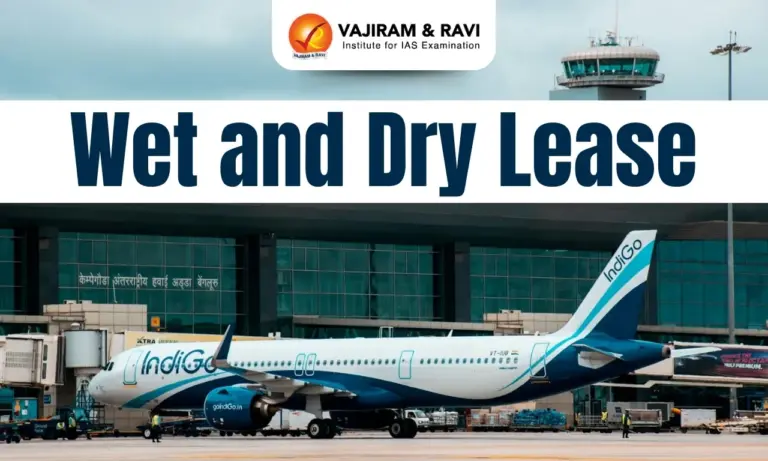
Wet and dry (aircraft sans crew) leases are increasingly being adopted by airlines in order to overcome the shortage of new aircraft globally that has grown acute since the pandemic because of supply chain challenges.
About Wet and Dry Lease
- In a wet lease, airlines acquire a fully operational aircraft along with a crew (pilots and cabin crew), maintenance personnel, and insurance (aircraft, crew, maintenance, and insurance).
- The lessee retains control over commercial operations (schedules, routes), while the lessor manages the operational aspects.
- This option is ideal for short-term exigencies such as seasonal spikes, route testing, or covering for grounded aircraft.
- In a dry lease, the airline rents only the aircraft itself, without crew, maintenance, or insurance.
- The lessee assumes full responsibility for these operational components, employing their own crews, arranging maintenance in accordance with DGCA (Directorate General of Civil Aviation) regulations, and obtaining appropriate insurance coverage.
- Dry leases are well-suited for long-term fleet expansion or modernization strategies.
- Aircraft leasing in India is governed by a robust legal framework, with the DGCA playing a pivotal role.
- Operations of an aircraft on wet lease are not encouraged by the DGCA, as the crew is often not approved by Indian authorities.





What is Damp Leasing?
- The damp lease is a more limited variant of the wet lease.
- It is a leasing agreement under which an airline, the lessor, leases one of its aircraft, including flight crew and maintenance services, to another air operator.
- However, unlike wet leasing, damp leasing does not include cabin crew, who must be assigned by the lessee.
- For this reason, a damp lease is referred to as a partial wet lease: the lessee is responsible for providing his own competent cabin crew.
Source: TH

 Last updated on March, 2026
→ UPSC Final Result 2025 is now out.
→ UPSC has released UPSC Toppers List 2025 with the Civil Services final result on its official website.
→ Anuj Agnihotri secured AIR 1 in the UPSC Civil Services Examination 2025.
→ UPSC Marksheet 2025 is now out.
→ UPSC Notification 2026 & UPSC IFoS Notification 2026 is now out on the official website at upsconline.nic.in.
→ UPSC Calendar 2026 has been released.
→ Check out the latest UPSC Syllabus 2026 here.
→ UPSC Prelims 2026 will be conducted on 24th May, 2026 & UPSC Mains 2026 will be conducted on 21st August 2026.
→ The UPSC Selection Process is of 3 stages-Prelims, Mains and Interview.
→ Prepare effectively with Vajiram & Ravi’s UPSC Prelims Test Series 2026 featuring full-length mock tests, detailed solutions, and performance analysis.
→ Enroll in Vajiram & Ravi’s UPSC Mains Test Series 2026 for structured answer writing practice, expert evaluation, and exam-oriented feedback.
→ Join Vajiram & Ravi’s Best UPSC Mentorship Program for personalized guidance, strategy planning, and one-to-one support from experienced mentors.
→ Shakti Dubey secures AIR 1 in UPSC CSE Exam 2024.
→ Also check Best UPSC Coaching in India
Wet and Dry Lease FAQs
Q1. Which type of lease involves only the aircraft, leaving crew, maintenance, and insurance responsibilities to the lessee?+
Q2. Wet leases are usually considered suitable for which situations?+
Q3. What is a damp lease commonly referred to as?+
Q4. Dry leases are best suited for which situations?+
Tags: prelims pointers upsc current affairs upsc prelims current affairs wet and dry lease of aircrafts