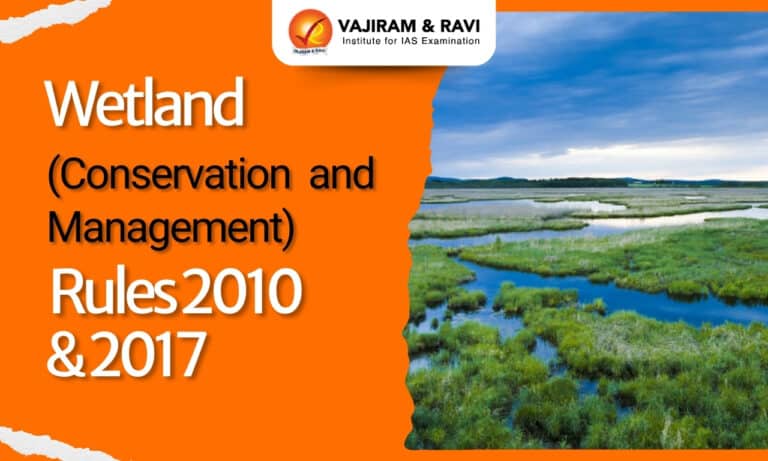
The Wetlands (Conservation and Management) Rules 2010 and 2017 are aimed at protecting and managing India’s wetlands in a sustainable way. They define what wetlands are, list activities that are prohibited or regulated, and set up authorities to monitor and manage these areas. The 2017 Rules strengthened the 2010 framework by including state-level authorities, expert committees, and a digital wetland inventory.
Together, these rules help conserve biodiversity, maintain water resources, and involve local communities in wetland protection.
What is a Wetland?
A wetland is an area where water is the primary factor influencing the environment and the plants and animals living there. It occurs where the water table is at or near the land surface or where the land is submerged under water, either permanently or seasonally. Wetlands are now recognised as distinct ecosystems with unique ecological functions, including water purification, flood control, biodiversity support, and groundwater recharge.
Wetland (Conservation and Management) Rules 2010 Provisions
The Wetlands (Conservation and Management) Rules 2010 were the first comprehensive framework in India for protecting wetlands under the Environment Protection Act, 1986. They aimed to regulate human activities and conserve wetland ecosystems.
- Defined wetlands to include marshes, fens, peatlands, lakes, reservoirs, tanks, backwaters, lagoons, estuaries, and man-made wetlands up to a depth of 6 meters, including their catchment areas.
- Prohibited activities: reclamation of wetlands, industrialization, dumping of hazardous substances, solid waste, and activities harmful to wetland ecology.
- Regulated activities: withdrawal of water, harvesting of resources, dredging, etc., requiring prior approval from authorities.
- Central Wetlands Regulatory Authority (CWRA) established to monitor activities, identify new wetlands, and evaluate state submissions.
- State governments required to submit a brief document on wetlands for potential protection under the rules.
- Upon approval, wetlands could be notified as “Protected Wetlands.”
- Appeals mechanism available through the National Green Tribunal for decisions made by the authority





Wetland (Conservation and Management) Rules 2010 Limitations
The Wetlands (Conservation and Management) Rules 2010 had several limitations that affected their effectiveness:
- Livelihood and Water Security Not Addressed: They did not consider wetlands critical for the livelihoods and domestic water supply of dependent populations.
- Exclusion of Smaller Wetlands: Many small wetlands, jheels, tanks, and rural/urban water bodies performing important ecological and socio-economic functions were not included.
- Lack of Local Authorities: The rules did not mandate the creation of state or district-level Wetlands Regulatory Authorities, limiting local participation and governance.
- No Community Representation: The Central Wetlands Regulatory Authority (CWRA) lacked members from local communities, farmers, or fishing associations, reducing stakeholder involvement.
- Limited Enforcement Mechanism: Monitoring and enforcement were largely centralized, making it difficult to address local threats effectively.
Wetland (Conservation and Management) Rules 2017 Provisions
The Wetlands (Conservation and Management) Rules 2017 aim to strengthen wetland protection in India by decentralizing authority, involving experts, and regulating activities to ensure sustainable use.
- Wetlands defined as lands between terrestrial and aquatic ecosystems with water at or near the surface.
- Establishment of State Wetlands Authority in each state/UT headed by Environment Minister.
- Experts in ecology, hydrology, fisheries, and socioeconomics to be included in state committees.
- Preparation of a comprehensive list of permitted, regulated, and prohibited activities for wetlands.
- Replacement of CWRA with a Central Advisory Committee to guide policies and Ramsar site nominations.
- Creation of a digital wetland inventory, updated every ten years.
- Prohibition of activities like industrial expansion, conversion for non-wetland use, hazardous waste disposal, and untreated effluent discharge.
- State governments are empowered to implement local protection, while the central government retains monitoring authority.
National Wetland Committee (NWC)
The National Wetland Committee (NWC) is a high-level advisory body constituted by the Government of India to oversee the conservation, management, and sustainable use of wetlands across the country.
It plays a pivotal role in implementing India’s wetland policies in line with the Wetlands (Conservation and Management) Rules 2010 & 2017 and the commitments under the Ramsar Convention.
Functions and Features of NWC:
- Policy Advisory: Advises the Central Government on formulating and implementing policies, programs, and strategies for wetland conservation.
- Ramsar Site Designation: Recommends wetlands of international importance for notification under the Ramsar Convention and ensures compliance with global standards.
- Scientific Guidance: Provides inputs based on wetland ecology, hydrology, fisheries, biodiversity, and socio-economic studies for informed decision-making.
- Coordination with States and UTs: Works closely with State Wetlands Authorities to ensure consistent and effective implementation of wetland rules at local levels.
- Capacity Building & Awareness: Suggests measures to educate stakeholders, local communities, and policymakers about the ecological and socio-economic importance of wetlands.
- Monitoring & Evaluation: Tracks the status and health of wetlands, assesses the effectiveness of conservation measures, and recommends improvements.
- International Collaboration: Facilitates partnerships with international agencies and organisations for technical support, research, and sustainable management practices.
- Reporting: Provides periodic reports to the Ministry of Environment, Forest and Climate Change (MoEFCC) on wetland conservation progress.
Case Studies of Wetland Management in India
India has witnessed several successful wetland conservation projects that combine government initiatives, scientific management, and community participation.
1. Sambhar Lake, Rajasthan
- Type: Saltwater lake and India’s largest inland salt lake.
- Issues: Encroachment, illegal salt mining, and pollution affecting biodiversity.
- Management Measures:
- Declared a Ramsar site in 1990.
- Implementation of strict regulations under Wetlands Rules 2010.
- Monitoring of illegal activities and restoration of degraded habitats.
- Outcome: Stabilization of migratory bird populations, especially flamingos, and improved water quality.
2. Chilika Lake, Odisha
- Type: Brackish water lagoon, India’s largest coastal wetland.
- Issues: Siltation, overfishing, and pollution affecting fish and bird species.
- Management Measures:
- Community-based co-management with local fisherfolk.
- Restoration of water channels and control of invasive species.
- Declared a Ramsar site in 1981.
- Outcome: Increase in fish catch, improved biodiversity, and enhanced ecotourism.
3. Vembanad-Kol Wetlands, Kerala
- Type: Largest Ramsar site in Kerala, including lakes, lagoons, and canals.
- Issues: Industrial pollution, urban encroachment, and habitat degradation.
- Management Measures:
- Implementation of state-level wetland authority programs under 2017 Rules.
- Promotion of sustainable tourism and eco-friendly aquaculture.
- Outcome: Improved water quality, restored bird habitats, and regulated human activities.
4. Keoladeo National Park, Rajasthan
- Type: Freshwater marsh and UNESCO World Heritage Site.
- Issues: Water shortage, invasive species, and fluctuating wetland health.
- Management Measures:
- Restoration of natural hydrology through canal and dam management.
- Active involvement of local communities in bird conservation programs.
- Strict enforcement of Wetlands Rules 2010.
- Outcome: Revival of migratory bird populations and enhanced ecotourism.
5. East Kolkata Wetlands, West Bengal
- Type: Urban wetland complex used for natural sewage treatment and fish farming.
- Issues: Urbanization, encroachment, and pollution threats.
- Management Measures:
- Recognized as a Ramsar site in 2002.
- Integrated urban planning with wetland protection.
- Promotion of traditional aquaculture and wastewater recycling.
- Outcome: Sustainable fish production, wastewater treatment, and biodiversity conservation.

 Last updated on April, 2026
→ UPSC Final Result 2025 is now out.
→ UPSC has released UPSC Toppers List 2025 with the Civil Services final result on its official website.
→ Anuj Agnihotri secured AIR 1 in the UPSC Civil Services Examination 2025.
→ UPSC Marksheet 2025 is now out.
→ UPSC Notification 2026 & UPSC IFoS Notification 2026 is now out on the official website at upsconline.nic.in.
→ UPSC Calendar 2026 has been released.
→ Check out the latest UPSC Syllabus 2026 here.
→ UPSC Prelims 2026 will be conducted on 24th May, 2026 & UPSC Mains 2026 will be conducted on 21st August 2026.
→ The UPSC Selection Process is of 3 stages-Prelims, Mains and Interview.
→ Prepare effectively with Vajiram & Ravi’s UPSC Prelims Test Series 2026 featuring full-length mock tests, detailed solutions, and performance analysis.
→ Enroll in Vajiram & Ravi’s UPSC Mains Test Series 2026 for structured answer writing practice, expert evaluation, and exam-oriented feedback.
→ Join Vajiram & Ravi’s Best UPSC Mentorship Program for personalized guidance, strategy planning, and one-to-one support from experienced mentors.
→ Shakti Dubey secures AIR 1 in UPSC CSE Exam 2024.
→ Also check Best UPSC Coaching in India
Wetland (Conservation and Management) Rules 2010 & 2017 FAQs
Q1. What is the main purpose of Wetlands (Conservation and Management) Rules?+
Q2. When were the Wetlands Rules first introduced?+
Q3. What is the key difference between the 2010 and 2017 Rules?+
Q4. How many Ramsar sites are there in India?+
Q5. Which activities are prohibited under Wetlands Rules 2017?+
Tags: wetland rules 2010 & 2017