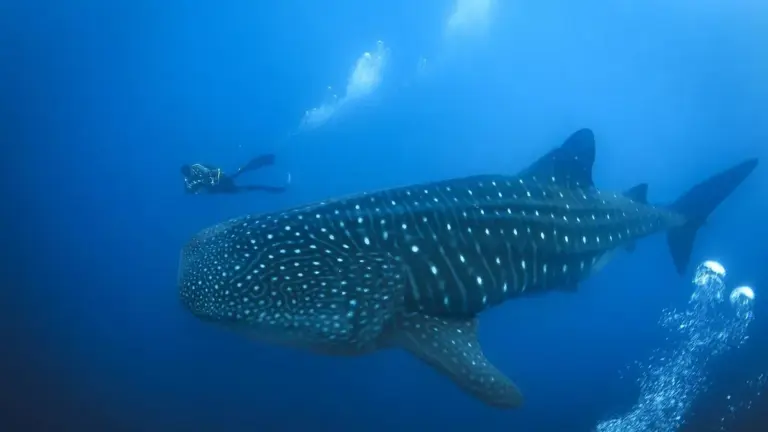
About Whale shark:
- It is the largest fish in the world and the largest fish known to have lived on this planet.
- They are one of only three species of filter feeding sharks.
- Distribution: They can be found in all temperate and tropical oceans around the world, except the Mediterranean Sea.
- Appearance
- They are dark gray on top and light underneath, with a series of light spots or stripes covering the dark parts of their bodies. This helps to camouflage them as they swim.
- Unlike most shark species, its mouth is located at the front of the head (terminal) instead of the underside of the rostrum (subterminal).
- They are filter feeders and can neither bite nor chew. They can process more than 6,000 litres of water an hour through their gills.
- Inside the mouth are specialized flaps called velums. These stop the backflow of water as the whale shark closes its mouth, preventing the loss of food.
- Food Habit: They feed on plankton and travel large distances to find enough food to sustain their huge size, and to reproduce.
- They also eat small and large fish and mollusks, including sardines, anchovies, mackerels, squid, and even small tuna and albacore.
- Conservation Status:
- IUCN: Endangered
- Wildlife Protection Act 1972: Schedule I
- Threats: The whale sharks continue to face challenges primarily due to bycatch and accidental capture in fishing nets, illegal hunting and habitat degradation.
- A global study indicates that over the past 75 years, the world’s whale shark population has decreased by 50%.
Q1: What are Cetaceans?
Cetaceans are a group of marine mammals that include whales, dolphins, and porpoises. They are well-adapted to life in aquatic environments and have a variety of unique features that enable them to thrive in the ocean.
Source: International Whale Shark Day: Saving the gentle giants of the sea along the Indian coast






 Last updated on March, 2026
→ UPSC Final Result 2025 is now out.
→ UPSC has released UPSC Toppers List 2025 with the Civil Services final result on its official website.
→ Anuj Agnihotri secured AIR 1 in the UPSC Civil Services Examination 2025.
→ UPSC Marksheet 2025 is now out.
→ UPSC Notification 2026 & UPSC IFoS Notification 2026 is now out on the official website at upsconline.nic.in.
→ UPSC Calendar 2026 has been released.
→ Check out the latest UPSC Syllabus 2026 here.
→ UPSC Prelims 2026 will be conducted on 24th May, 2026 & UPSC Mains 2026 will be conducted on 21st August 2026.
→ The UPSC Selection Process is of 3 stages-Prelims, Mains and Interview.
→ Prepare effectively with Vajiram & Ravi’s UPSC Prelims Test Series 2026 featuring full-length mock tests, detailed solutions, and performance analysis.
→ Enroll in Vajiram & Ravi’s UPSC Mains Test Series 2026 for structured answer writing practice, expert evaluation, and exam-oriented feedback.
→ Join Vajiram & Ravi’s Best UPSC Mentorship Program for personalized guidance, strategy planning, and one-to-one support from experienced mentors.
→ Shakti Dubey secures AIR 1 in UPSC CSE Exam 2024.
→ Also check Best UPSC Coaching in India