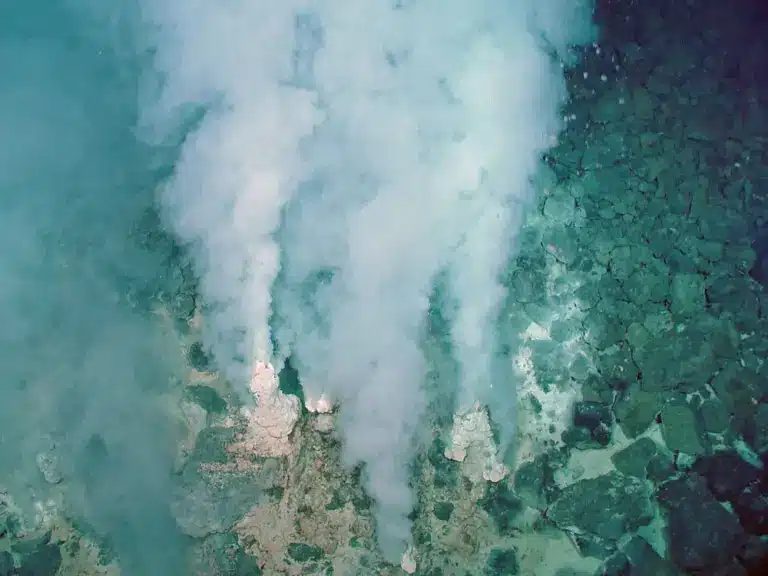
About Hydrothermal Systems:
- Hydrothermal systems occur in areaswith high heat fluxes,bothoncontinents, near convergent plate boundaries, and on the ocean floor, near the mid-ocean ridges.
- Their formation requires the existence of three important components: fluids, heat, and permeability through rocks so that fluids can circulate.
- These systems are often found near mid-ocean ridges, where tectonic plates diverge and new seafloor is created.
- How hydrothermal systems work?
o Hydrothermal systems occur when seawater percolates down through fractures in the oceanic crust,heating up as it nears the earth’s hot interior.
o Descending seawater interacts with the oceanic crust, removing chemicalsfrom the rocks as it heats to 350-400 degrees Celsius, about four times hotter than boiling water (the extreme pressure in the ocean’s depths prevents fluids from boiling).
o This interaction of seawater and crust produces hydrothermal fluid, chemically modified slurry of gases and dissolved elements, including metals.
o The superheated fluid is then ejected back up to the seafloor and promptly chilled by near-freezing ocean bottom waters.
o Chemicals dissolved in the fluid precipitate at the vent, forming chimney-like deposits.
o These depositssupport deep-sea chemosynthetic communities—organisms that rely on chemicals rather than photosynthesis to fuel their metabolism
Q1: What is the mid-ocean ridge?
The massive mid-ocean ridge system is a continuous range of underwater volcanoes that wraps around the globe, stretching nearly 65,000 kilometers (40,390 miles). The majority of the system is underwater, with an average water depth to the top of the ridge of 2,500 meters. They occur along divergent plate boundaries, where a new ocean floor is created as the Earth’s tectonic plates spread apart. As the plates separate, molten rock rises to the seafloor, producing enormous volcanic eruptions of basalt. The speed of spreading affects the shape of a ridge – slower spreading rates result in steep, irregular topography while faster spreading rates produce much wider profiles and more gentle slopes.
Source:Major ‘magnetic anomaly’ discovered deep below New Zealand’s Lake Rotorua






 Last updated on April, 2026
→ UPSC Final Result 2025 is now out.
→ UPSC has released UPSC Toppers List 2025 with the Civil Services final result on its official website.
→ Anuj Agnihotri secured AIR 1 in the UPSC Civil Services Examination 2025.
→ UPSC Marksheet 2025 is now out.
→ UPSC Notification 2026 & UPSC IFoS Notification 2026 is now out on the official website at upsconline.nic.in.
→ UPSC Calendar 2026 has been released.
→ Check out the latest UPSC Syllabus 2026 here.
→ UPSC Prelims 2026 will be conducted on 24th May, 2026 & UPSC Mains 2026 will be conducted on 21st August 2026.
→ The UPSC Selection Process is of 3 stages-Prelims, Mains and Interview.
→ Prepare effectively with Vajiram & Ravi’s UPSC Prelims Test Series 2026 featuring full-length mock tests, detailed solutions, and performance analysis.
→ Enroll in Vajiram & Ravi’s UPSC Mains Test Series 2026 for structured answer writing practice, expert evaluation, and exam-oriented feedback.
→ Join Vajiram & Ravi’s Best UPSC Mentorship Program for personalized guidance, strategy planning, and one-to-one support from experienced mentors.
→ Shakti Dubey secures AIR 1 in UPSC CSE Exam 2024.
→ Also check Best UPSC Coaching in India