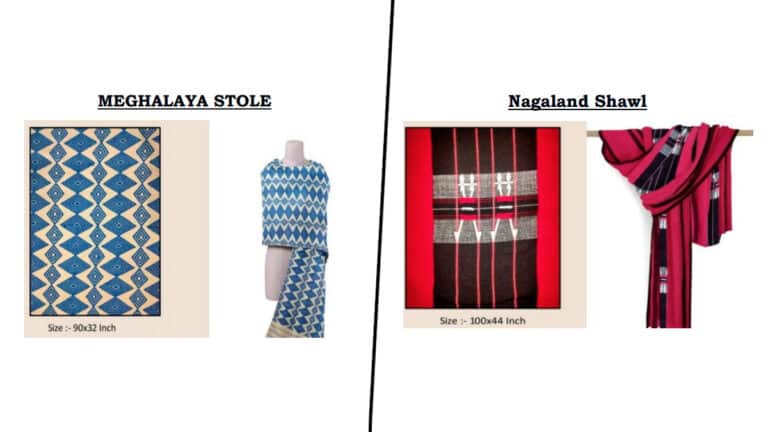
About Meghalaya stoles:
- Meghalaya stoles were originally woven for the Khasi and Jaintia royalty, who considered them a symbol of their power and status.
- The stoles were worn during ceremonial occasions and festivals.
- They are made using locally sourced wool, and natural dyes.
- These stoles are famous for their warmth and softness.
- The designs used in the stoles reflected the royal family’s beliefs, myths, and legends, and were a testament to their cultural heritage.
- They were used as a form of diplomatic gift-giving. The Khasi and Jaintia kings would often present these stoles to other rulers as a symbol of goodwill and respect.
About Nagaland shawls:
- These shawls are known for their vibrant colors, intricate designs, and the use of traditional weaving techniques, which have been passed down from generation to generation.
- One of the most striking features of the Naga shawl is the use of geometric and symbolic designs.
- The designs are inspired by the tribe’s myths, legends, and beliefs, with designs having specific meanings and significance.
- The Naga shawl is made from locally sourced materials such as cotton, silk, and wool.
- The colors used in these shawls are symbolic. E.g., Red color symbolizes courage, while black represents mourning.
- The colors use natural dyes made from plants and roots.
- The shawls are often worn during festivals, ceremonies, and other special occasions as symbols of rank and lineage. They are also used as blankets, seat coverings, and even as bags.
- The shawls are known for their durability and can last for several generations.
Q1) Who are Naga people?
Nagas are a hill people who are estimated to number about 2. 5 million (1.8 million in Nagaland, 0.6 million in Manipur and 0.1 million in Arunachal states) and living in the remote and mountainous country between the Indian state of Assam and Burma.






 Last updated on March, 2026
→ UPSC Final Result 2025 is now out.
→ UPSC has released UPSC Toppers List 2025 with the Civil Services final result on its official website.
→ Anuj Agnihotri secured AIR 1 in the UPSC Civil Services Examination 2025.
→ UPSC Marksheet 2025 is now out.
→ UPSC Notification 2026 & UPSC IFoS Notification 2026 is now out on the official website at upsconline.nic.in.
→ UPSC Calendar 2026 has been released.
→ Check out the latest UPSC Syllabus 2026 here.
→ UPSC Prelims 2026 will be conducted on 24th May, 2026 & UPSC Mains 2026 will be conducted on 21st August 2026.
→ The UPSC Selection Process is of 3 stages-Prelims, Mains and Interview.
→ Prepare effectively with Vajiram & Ravi’s UPSC Prelims Test Series 2026 featuring full-length mock tests, detailed solutions, and performance analysis.
→ Enroll in Vajiram & Ravi’s UPSC Mains Test Series 2026 for structured answer writing practice, expert evaluation, and exam-oriented feedback.
→ Join Vajiram & Ravi’s Best UPSC Mentorship Program for personalized guidance, strategy planning, and one-to-one support from experienced mentors.
→ Shakti Dubey secures AIR 1 in UPSC CSE Exam 2024.
→ Also check Best UPSC Coaching in India