Why in news?
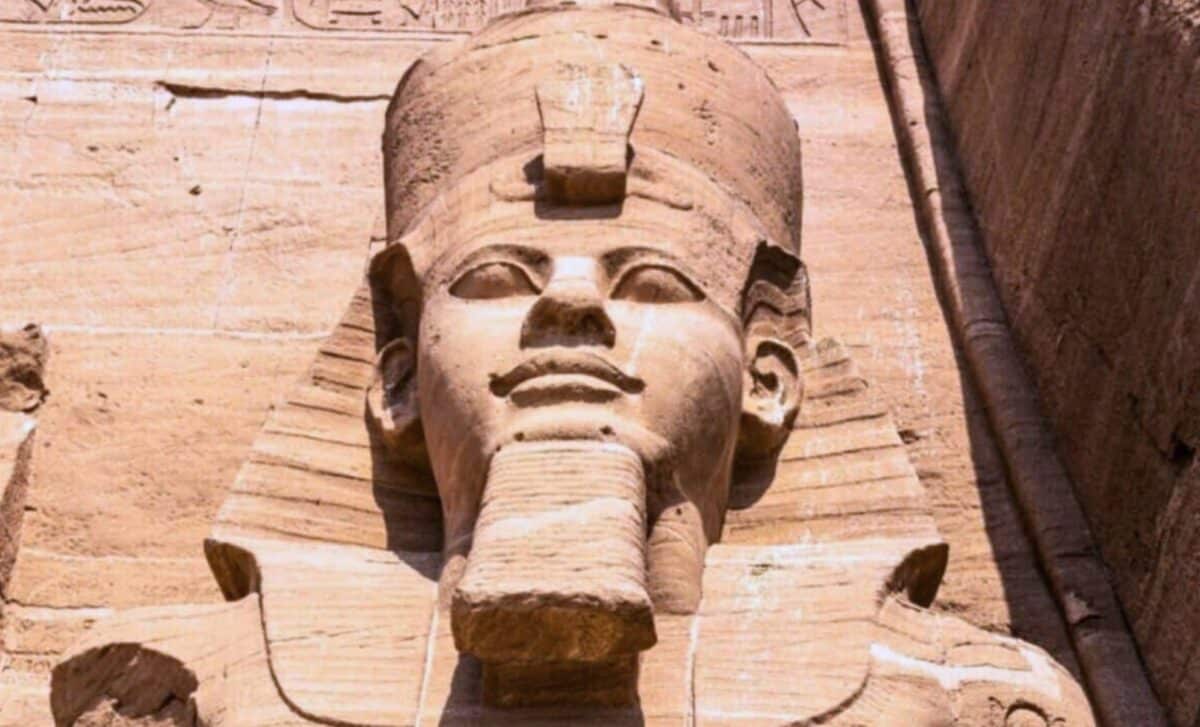
- To analyse 14 kilometres long rampart, researchers deployed a technique called muon tomography or muography, which uses muons to generate three-dimensional images of such large structures.
What are Muons?
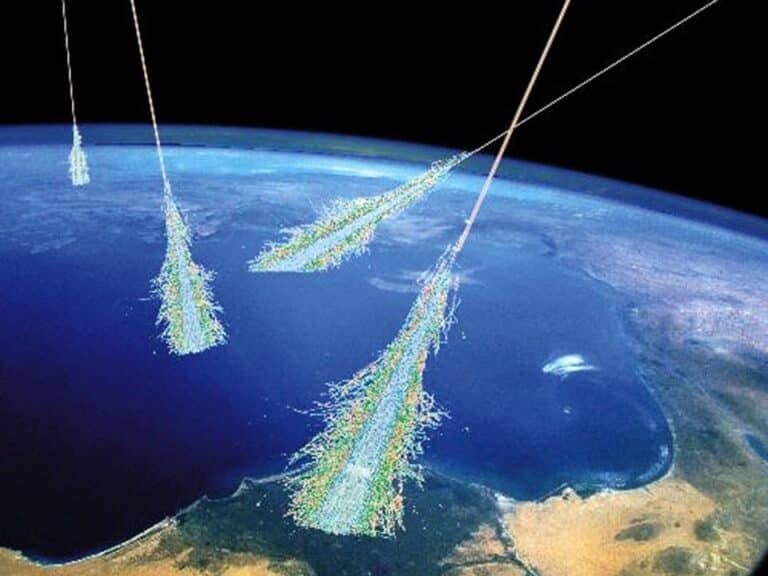
- Muons are subatomic particles raining from space.
- The muon was discovered as a constituent of cosmic-ray particle “showers” in 1936 by the American physicists Carl D. Anderson and Seth Neddermeyer.
- They are created when the particles in Earth’s atmosphere collide with cosmic rays — clusters of high-energy particles that move through space at just below the speed of light.
- It has two forms, the negatively charged muon and its positively charged antiparticle.
- These particles resemble electrons but are 207 times as massive. Therefore, they are sometimes called “fat electrons”.
- Muons are so heavy, they can travel through hundreds of metres of rock or other matter before getting absorbed or decaying into electrons and neutrinos
- They are highly unstable and exist for just 2.2 microseconds.
What is muon tomography?
- Although muon tomography was first used in the 1960s, it has only recently gained widespread use among researchers, particularly in archaeology.
- It is conceptually similar to X-ray but capable of scanning much larger and wider structures, owing to the penetration power of muons.
- All that is required is to place a muon detector underneath, within, or near the object of interest.
- The detector then tracks the number of muons going through the object from different directions, to form a three-dimensional image.
- The image is then compared with a muon image of the “free sky.” This indicates how many muons have been blocked. The final picture is essentially a shadow of the object, in the light of cosmic muons.”
Q1) What is an electron?
An electron is a stable subatomic particle with a negative electrical charge.





 Last updated on March, 2026
→ UPSC Final Result 2025 is now out.
→ UPSC has released UPSC Toppers List 2025 with the Civil Services final result on its official website.
→ Anuj Agnihotri secured AIR 1 in the UPSC Civil Services Examination 2025.
→ UPSC Marksheet 2025 is now out.
→ UPSC Notification 2026 & UPSC IFoS Notification 2026 is now out on the official website at upsconline.nic.in.
→ UPSC Calendar 2026 has been released.
→ Check out the latest UPSC Syllabus 2026 here.
→ UPSC Prelims 2026 will be conducted on 24th May, 2026 & UPSC Mains 2026 will be conducted on 21st August 2026.
→ The UPSC Selection Process is of 3 stages-Prelims, Mains and Interview.
→ Prepare effectively with Vajiram & Ravi’s UPSC Prelims Test Series 2026 featuring full-length mock tests, detailed solutions, and performance analysis.
→ Enroll in Vajiram & Ravi’s UPSC Mains Test Series 2026 for structured answer writing practice, expert evaluation, and exam-oriented feedback.
→ Join Vajiram & Ravi’s Best UPSC Mentorship Program for personalized guidance, strategy planning, and one-to-one support from experienced mentors.
→ Shakti Dubey secures AIR 1 in UPSC CSE Exam 2024.
→ Also check Best UPSC Coaching in India