About Nebula:
- A nebula is a giant cloud of dust and gas in space.
- Some nebulae (more than one nebula) come from the gas and dust thrown out by the explosion of a dying star, such as a supernova.
- Other nebulae are regions where new stars are beginning to form. For this reason, some nebulae are called “star nurseries.”
- How do stars form in a nebula?
- Nebulae are made of dust and gases—mostly hydrogen and helium.
- The dust and gases in a nebula are very spread out, but gravity can slowly begin to pull together clumps of dust and gas.
- As these clumps get bigger and bigger, their gravity gets stronger and stronger.
- Eventually, the clump of dust and gas gets so big that it collapses from its own gravity.
- The collapse causes the material at the center of the cloud to heat up-and this hot core is the beginning of a star.
- Nebulae existin the space between the stars—also known as interstellar space.
- The closest known nebula to Earth is called the Helix Nebula. It is approximately 700 light-years away from Earth.
- Nebulas come in many shapes and sizes and can be further divided into several subcategories, including planetary nebulas, supernova remnants, dark nebulas, and emission nebulas.
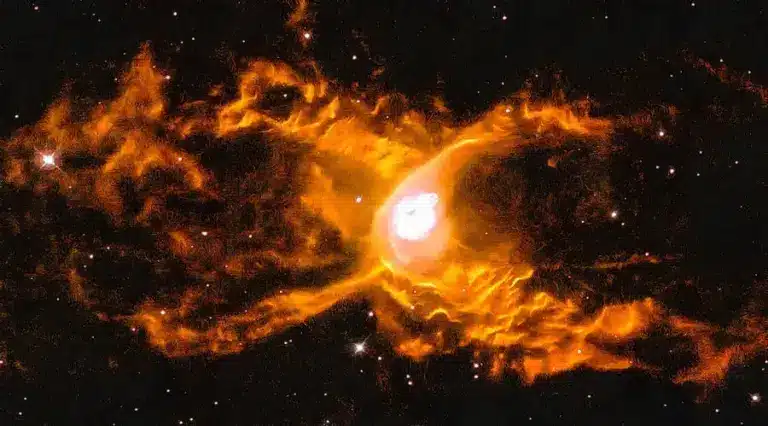
Red Spider Nebula:
- It is a planetary nebula located 3,000 light-years from Earth and can be found in the constellation of Sagittarius.
- It harbours one of the hottest stars known, which heats the gas around it to form shockwaves 62 billion miles (100 billion km) high.
Q1: What is a Supernova?
A supernova is the name given to the cataclysmic explosion of a massive star. They are the largest explosion that takes place in space. It can emit more energy in a few seconds than our sun will radiate in its lifetime of billions of years. They’re also the primary source of heavy elements in the universe. On average, a supernova will occur once every 50 years in a galaxy the size of the Milky Way.
Source: Cosmic Spider: Nasa’s Hubble Captures Stunning Image Of The Red Spider Nebula’s Celestial Beauty






 Last updated on March, 2026
→ UPSC Final Result 2025 is now out.
→ UPSC has released UPSC Toppers List 2025 with the Civil Services final result on its official website.
→ Anuj Agnihotri secured AIR 1 in the UPSC Civil Services Examination 2025.
→ UPSC Marksheet 2025 is now out.
→ UPSC Notification 2026 & UPSC IFoS Notification 2026 is now out on the official website at upsconline.nic.in.
→ UPSC Calendar 2026 has been released.
→ Check out the latest UPSC Syllabus 2026 here.
→ UPSC Prelims 2026 will be conducted on 24th May, 2026 & UPSC Mains 2026 will be conducted on 21st August 2026.
→ The UPSC Selection Process is of 3 stages-Prelims, Mains and Interview.
→ Prepare effectively with Vajiram & Ravi’s UPSC Prelims Test Series 2026 featuring full-length mock tests, detailed solutions, and performance analysis.
→ Enroll in Vajiram & Ravi’s UPSC Mains Test Series 2026 for structured answer writing practice, expert evaluation, and exam-oriented feedback.
→ Join Vajiram & Ravi’s Best UPSC Mentorship Program for personalized guidance, strategy planning, and one-to-one support from experienced mentors.
→ Shakti Dubey secures AIR 1 in UPSC CSE Exam 2024.
→ Also check Best UPSC Coaching in India