About SPECULOOS-3b
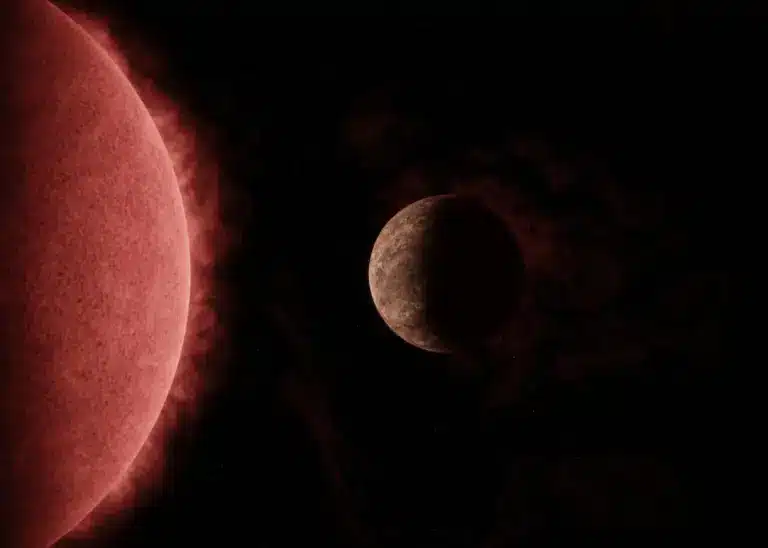
- It is an Earth-size planet orbiting an ultracool red dwarf star, 55 light-years away from Earth.
- This red dwarf, though similar in size to Jupiter, emits light 100 times dimmer than the sun and has half the temperature.
- The planet is only the second of its kind to be discovered around this type of star.
- SPECULOOS-3breceives high levels of radiation from its sun, probably leaving the planet without an atmosphere. The planet receives almost 16 times more energy per second than Earth receives from the Sun.
- It takes around 17 hours to complete an orbit of the star.
- The planet is thought to be tidally locked, so the same side, known as the dayside, always faces the star, like the Moon to Earth. The nightside would be locked in never-ending darkness.
- The discovery was made by the team from the SPECULOOS (Search for Planets EClipsing ULtra-cOOl Stars) project, which is led by the University of Liège, in Belgium, in collaboration with the Universities of Birmingham, Cambridge, Bern, and the Massachusetts Institute of Technology, using the observatory located in the Atacama Desert of northern Chile.
- The SPECULOOS project was established to search for exoplanets orbiting ultra-cool dwarf stars using a network of robotic telescopes based around the world.
What is a Red Dwarf Star?
- It is a type of low-mass star that is the most common type of star in the Milky Way galaxy.
- These stars are smaller and cooler than the Sun, with surface temperatures that range from about 2,200 to 3,500 Kelvin.
- They are also much dimmer than the Sun and emit most of their light in the infrared part of the spectrum.
- Unlike the sun, red dwarfs have incredibly long lifespans due to their slow consumption of nuclear fuel, making them interesting targets for studying planetary evolution and habitability over extended periods.
Q1: What is Tidal locking?
It is the phenomenon by which a body has the same rotational period as its orbital period around a partner. So, the Moon is tidally locked to the Earth because it rotates in exactly the same time as it takes to orbit the Earth. That is why we only see one side of the Moon.
Source: Astronomers discover new Earth-sized world orbiting an ultra-cool star





 Last updated on March, 2026
→ UPSC Final Result 2025 is now out.
→ UPSC has released UPSC Toppers List 2025 with the Civil Services final result on its official website.
→ Anuj Agnihotri secured AIR 1 in the UPSC Civil Services Examination 2025.
→ UPSC Marksheet 2025 is now out.
→ UPSC Notification 2026 & UPSC IFoS Notification 2026 is now out on the official website at upsconline.nic.in.
→ UPSC Calendar 2026 has been released.
→ Check out the latest UPSC Syllabus 2026 here.
→ UPSC Prelims 2026 will be conducted on 24th May, 2026 & UPSC Mains 2026 will be conducted on 21st August 2026.
→ The UPSC Selection Process is of 3 stages-Prelims, Mains and Interview.
→ Prepare effectively with Vajiram & Ravi’s UPSC Prelims Test Series 2026 featuring full-length mock tests, detailed solutions, and performance analysis.
→ Enroll in Vajiram & Ravi’s UPSC Mains Test Series 2026 for structured answer writing practice, expert evaluation, and exam-oriented feedback.
→ Join Vajiram & Ravi’s Best UPSC Mentorship Program for personalized guidance, strategy planning, and one-to-one support from experienced mentors.
→ Shakti Dubey secures AIR 1 in UPSC CSE Exam 2024.
→ Also check Best UPSC Coaching in India