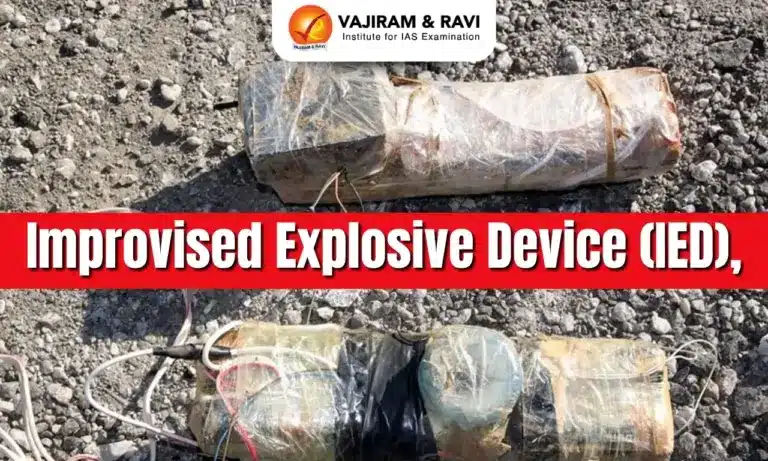
Improvised Explosive Device Latest News
J&K Police recently arrested seven locals linked to a terror module, seizing 2900 kg of IED-making materials and arms.
About Improvised Explosive Device
- An IED is a type of unconventional explosive weapon that can take any form and be activated in a variety of ways.
- IEDs are used by criminals, vandals, terrorists, suicide bombers, and insurgents.
- Because they are improvised, IEDs can come in many forms, ranging from a small pipe bomb to a sophisticated device capable of causing massive damage and loss of life.
- The extent of damage caused by an IED depends on its size, construction, and placement and whether it incorporates a high explosive or propellant.
- IEDs can be carried or delivered in a vehicle; carried, placed, or thrown by a person; delivered in a package; or concealed on the roadside.
- The term IED came into common usage during the Iraq War that began in 2003.
- IEDs are inexpensive and can be easily manufactured, concealed and detonated.
- Further, IEDs can be manufactured by using commonly available material or chemicals.
- Elements of an IED:
- It consists of a variety of components that include an initiator, switch, main charge, power source, and container.
- IEDs may be surrounded by or packed with additional materials or “enhancements” such as nails, glass, or metal fragments designed to increase the amount of shrapnel propelled by the explosion.
- An IED can be initiated by a variety of methods depending on the intended target.
- Materials Used as Explosives in IEDs:
- Many commonly available materials, such as fertilizer, gunpowder, and hydrogen peroxide, are used as explosive materials in IEDs.
- Explosives must contain a fuel and an oxidizer, which provides the oxygen needed to sustain the reaction.
- A common example is ANFO, a mixture of ammonium nitrate, which acts as the oxidizer, and fuel oil (the fuel source).
Source: TH






 Last updated on March, 2026
→ UPSC Final Result 2025 is now out.
→ UPSC has released UPSC Toppers List 2025 with the Civil Services final result on its official website.
→ Anuj Agnihotri secured AIR 1 in the UPSC Civil Services Examination 2025.
→ UPSC Marksheet 2025 is now out.
→ UPSC Notification 2026 & UPSC IFoS Notification 2026 is now out on the official website at upsconline.nic.in.
→ UPSC Calendar 2026 has been released.
→ Check out the latest UPSC Syllabus 2026 here.
→ UPSC Prelims 2026 will be conducted on 24th May, 2026 & UPSC Mains 2026 will be conducted on 21st August 2026.
→ The UPSC Selection Process is of 3 stages-Prelims, Mains and Interview.
→ Prepare effectively with Vajiram & Ravi’s UPSC Prelims Test Series 2026 featuring full-length mock tests, detailed solutions, and performance analysis.
→ Enroll in Vajiram & Ravi’s UPSC Mains Test Series 2026 for structured answer writing practice, expert evaluation, and exam-oriented feedback.
→ Join Vajiram & Ravi’s Best UPSC Mentorship Program for personalized guidance, strategy planning, and one-to-one support from experienced mentors.
→ Shakti Dubey secures AIR 1 in UPSC CSE Exam 2024.
→ Also check Best UPSC Coaching in India
Improvised Explosive Device FAQs
Q1. What is an Improvised Explosive Device (IED)?+
Q2. Which groups are known to use IEDs?+
Q3. What primarily determines the extent of damage caused by an IED?+
Q4. What does an IED usually contain?+
Tags: improvised explosive device prelims current affairs prelims pointers upsc prelims current affairs