About Comb Jellies:
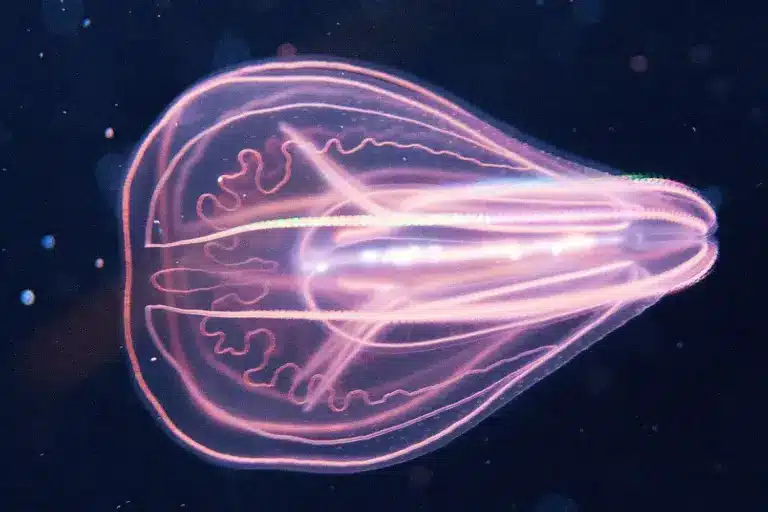
- They are transparent, gelatinous invertebrates that drift through the waters of our global ocean.
- They are one of the oldest multicellular phyla in the animal kingdom, probably existing already more than 500 million years.
- There are between 100 and 150 known species of comb jellies, the best known of which are found close to shore.
- Description:
- They are colorful, simple invertebrates that are part of the family Ctenophora.
- Each species varies in length, but the average size of a comb jelly is about four inches long.
- Comb jellies get their name from their eight rows of plates made of fused cilia(little hairs) that they use to move through the water, which look like combs.
- They are the largest animals known to use cilia for locomotion.
- They have two large, trailing tentacles that branch out to create the appearance of a net-like structure of many tentacles.
- These organs serve as sticky fishing lines, which they use to trap and move prey to their bodies.
- These animals have two major cell layers, the external epidermis and internal gastrodermis; in between these cell layers is the mesoderm that is what gives the animals their gelatinous appearance.
- Many species are bioluminescent, meaning they can use proteins in their bodies to create an ethereal blue or green glow in response to stimuli like touch.
- Comb jellies are carnivorous and opportunistic, feeding on whatever passes them by.
- Unlike their close relative, the jellyfish, comb jellies do not have stinging tentacles and are harmless to humans.
Q1: What are marine invertebrates?
Marine invertebrates comprise many groups of different organisms and occur from the sea surface to the seafloor and into the substrate. They represent the vast majority of marine biodiversity and include, for example, sponges, corals, bluebottles, worms, shells, sea urchins, starfish, crustaceans, sea cucumbers and nudibranchs.
News: Researchers discover new species of marine creatures that can age in reverse






 Last updated on April, 2026
→ UPSC Final Result 2025 is now out.
→ UPSC has released UPSC Toppers List 2025 with the Civil Services final result on its official website.
→ Anuj Agnihotri secured AIR 1 in the UPSC Civil Services Examination 2025.
→ UPSC Marksheet 2025 is now out.
→ UPSC Notification 2026 & UPSC IFoS Notification 2026 is now out on the official website at upsconline.nic.in.
→ UPSC Calendar 2026 has been released.
→ Check out the latest UPSC Syllabus 2026 here.
→ UPSC Prelims 2026 will be conducted on 24th May, 2026 & UPSC Mains 2026 will be conducted on 21st August 2026.
→ The UPSC Selection Process is of 3 stages-Prelims, Mains and Interview.
→ Prepare effectively with Vajiram & Ravi’s UPSC Prelims Test Series 2026 featuring full-length mock tests, detailed solutions, and performance analysis.
→ Enroll in Vajiram & Ravi’s UPSC Mains Test Series 2026 for structured answer writing practice, expert evaluation, and exam-oriented feedback.
→ Join Vajiram & Ravi’s Best UPSC Mentorship Program for personalized guidance, strategy planning, and one-to-one support from experienced mentors.
→ Shakti Dubey secures AIR 1 in UPSC CSE Exam 2024.
→ Also check Best UPSC Coaching in India