About Einstien Telescope:
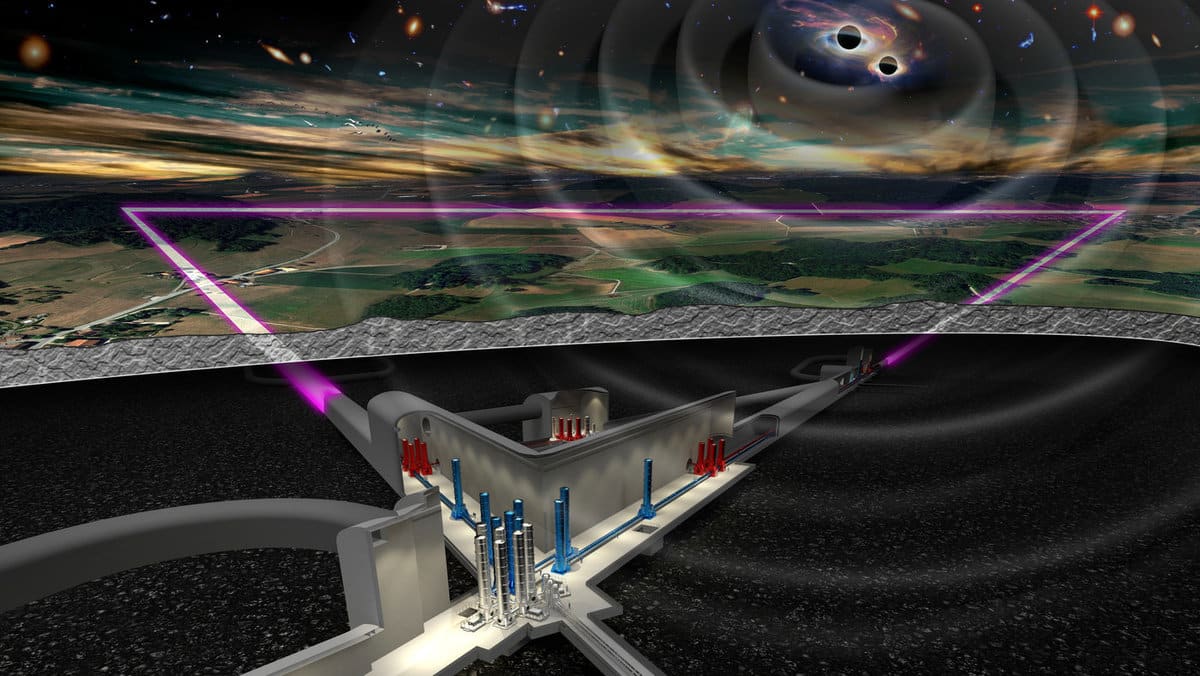
- It is an advanced gravitational-wave observatory, currently in the planning stage.
- It builds on the success of current, second-generation laser-interferometric detectors Advanced Virgo and Advanced LIGO, whose breakthrough discoveries of merging black holes (BHs) and neutron stars over the past 5 years have ushered scientists into the new era of gravitational-wave astronomy.
- The Einstein Telescope will achieve a greatly improved sensitivity by increasing the size of the interferometer from the 3km arm length of the Virgo detector to 10km, and by implementing a series of new technologies.
- The expected sensitivity of the Einstein Telescope will be at least a factor of ten times that of Ligo.
- Applications:
- It will make it possible, for the first time, to explore the Universe through gravitational waves along its cosmic history up to the cosmological dark ages, shedding light on open questions of fundamental physics and cosmology.
- It will probe the physics near black-hole horizons (from tests of general relativity to quantum gravity), help understand the nature of dark matter, and the nature of dark energy and possible modifications of general relativity at cosmological scales.
- Its low-frequency sensitivity will allow us to detect intermediate-mass black holes.
What are Gravitational Waves?
- They are ‘ripples’ in space-time caused by some of the most violent and energetic processes in the Universe.
- Albert Einstein predicted the existence of gravitational waves in 1916 in his general theory of relativity.
- Einstein’s mathematics showed that massive accelerating objects (things like neutron stars or black holes orbiting each other) would disrupt space-time in such a way that ‘waves’ of undulating space-time would propagate in all directions away from the source.
- These cosmic ripples would travel at the speed of light, carrying with them information about their origins, as well as clues to the nature of gravity itself.
- The strongest gravitational waves are produced by cataclysmic events such as colliding black holes, supernovae, and colliding neutron stars.
Q1) What are Gravitational Waves?
They are ‘ripples’ in space-time caused by some of the most violent and energetic processes in the Universe. Albert Einstein predicted the existence of gravitational waves in 1916 in his general theory of relativity.
Source: CERN is helping build Einstein Telescope, a next-generation gravitational wave detector


 Last updated on Oct, 2026
→ UPSC 2027 Notification will be released on 13 January 2027 at upsconline.nic.in.
→ Check Nobel Prize 2026 Winners List here.
→ Download PIB PRiSM Monthly Magazine 2026 here.
→ Check UPSC Monthly Current Affairs Magazine The Recitals here.
→ Check out the latest UPSC Syllabus here.
→ Download UPSC Model Answers for Mains 2026
→ UPSC Mains Question Paper 2026 is out now for Essay & GS Paper 1, 2, 3 & 4.
→ UPSC Calendar 2027 has been released.
→ Enroll in Vajiram & Ravi’s UPSC Mains Test Series 2027 for structured answer writing practice, expert evaluation, and exam-oriented feedback.
→ Join Vajiram & Ravi’s UPSC Mentorship Program 2027 for personalized guidance, strategy planning, and one-to-one support from experienced mentors.
→ Go through the UPSC Mains Previous Year Papers to enhance your preparation.
→ UPSC has released UPSC Toppers List 2025 with the Civil Services final result on its official website.
→ Also check Best UPSC Coaching in India