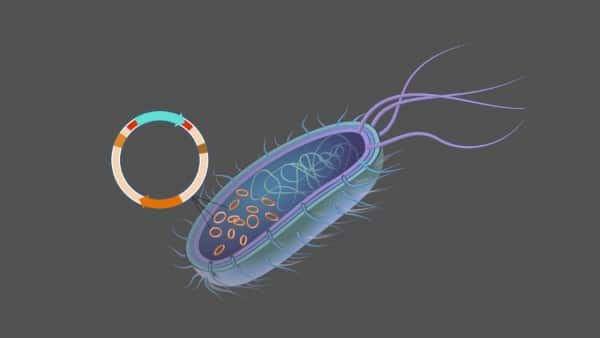
About Exclusome
- It is a newly discovered organelle in mammalian cells.
- It is made up of DNA rings known as plasmids.
- It is located within the cell plasma.
- This is peculiar because eukaryotic cells (cells with nuclei) usually keep most of their DNA in the cell nucleus, where it is organized into chromosomes.
- Instead, in the exclusome, it is organized into plasmids –small, circular DNA strands that can replicate independently of chromosomes and are usually found in bacteria and other microscopic organisms.
- What has the discovery revealed?
- Some of the plasmids that end up in the exclusome originate from outside the cell, while others—known as telomeric rings—come from the capped ends of chromosomes, the telomeres.
- Particularly in certain cancer cells, the ones from the telomeres are regularly pinched off and joined together to form rings.
- The cell nucleus weeds out such DNA rings and deposits them, together with the plasmids coming from outside the cell, in the cell plasma.
- This proves that cells are capable of differentiating between DNA that is their own and still needed and DNA that is foreign or presumably no longer required, which they then eject from the nucleus.
- In this way, the exclusome may have a protective function, guarding the cell’s genetic integrity.
What is an Organelle?
- Organelles are small, specialized structures in cells that operate like organs by carrying out specific tasks.
- Among the more important cell organelles are the nuclei, which store genetic information; mitochondria, which produce chemical energy; and ribosomes, which assemble proteins.





What is a Chromosome?
- A chromosome is a long, thread-like structure found in the nucleus of eukaryotic cells, including the cells of animals, plants, and fungi.
- Each chromosome is made up of DNA tightly coiled many times around proteinscalled histones that support its structure.
- Chromosomes help ensure that DNA is replicated and distributed appropriately during cell division.
- It plays a fundamental role in the transmission of hereditary traits from one generation to the next.
Q1: What is DNA?
DNA, or deoxyribonucleic acid, is the hereditary material in humans and almost all other organisms. Nearly every cell in a person’s body has the same DNA. Most DNA is located in the cell nucleus (where it is called nuclear DNA), but a small amount of DNA can also be found in the mitochondria (where it is called mitochondrial DNA or mtDNA)
Source: Cell biologists identify new organelle present in mammalian cells made of rings of DNA

 Last updated on March, 2026
→ UPSC Final Result 2025 is now out.
→ UPSC has released UPSC Toppers List 2025 with the Civil Services final result on its official website.
→ Anuj Agnihotri secured AIR 1 in the UPSC Civil Services Examination 2025.
→ UPSC Marksheet 2025 is now out.
→ UPSC Notification 2026 & UPSC IFoS Notification 2026 is now out on the official website at upsconline.nic.in.
→ UPSC Calendar 2026 has been released.
→ Check out the latest UPSC Syllabus 2026 here.
→ UPSC Prelims 2026 will be conducted on 24th May, 2026 & UPSC Mains 2026 will be conducted on 21st August 2026.
→ The UPSC Selection Process is of 3 stages-Prelims, Mains and Interview.
→ Prepare effectively with Vajiram & Ravi’s UPSC Prelims Test Series 2026 featuring full-length mock tests, detailed solutions, and performance analysis.
→ Enroll in Vajiram & Ravi’s UPSC Mains Test Series 2026 for structured answer writing practice, expert evaluation, and exam-oriented feedback.
→ Join Vajiram & Ravi’s Best UPSC Mentorship Program for personalized guidance, strategy planning, and one-to-one support from experienced mentors.
→ Shakti Dubey secures AIR 1 in UPSC CSE Exam 2024.
→ Also check Best UPSC Coaching in India