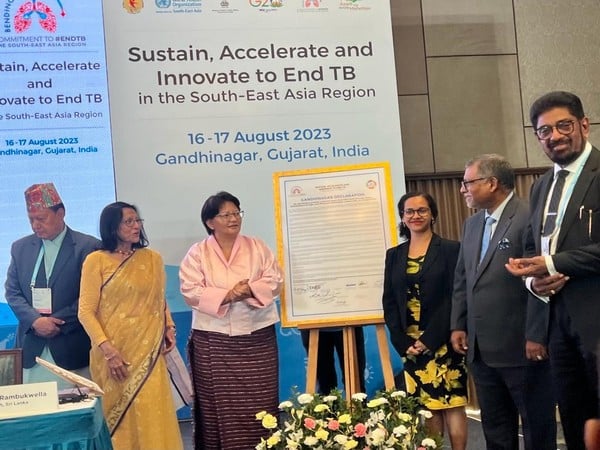
About Gandhinagar Declaration
- It was adopted at the end of the two-day meeting held in Gandhinagar, Gujarat, to follow up on the progress made to end tuberculosis (TB) by the countries of the WHO South-East Asia Region.
- The Declaration calls for establishing high-level multisectoral commission reporting to the highest political level in each country for synergy of efforts among various stakeholders and to monitor progress towards ending TB and other priority diseases.
- These high-level multisectoral commission on TB could also help build responsive health systems and advance universal health coverage and health security.
- The declaration calls for ensuring appropriate adoption and use of science and technology for equitable and human rights-based TB services that are accessible to all, irrespective of any social, cultural, or demographic divide, through an integrated, primary health care approach.
- It emphasises on the allocation of necessary resources to meet TB service coverage targets and address social determinants to have a multi-disease impact.
- The declaration calls on WHO to maintain TB as a Flagship Priority Programme over the coming years and provide leadership and technical support to countries for sustained and accelerated approaches supported by research and innovation.
- It calls upon all partners to enhance their support to end TB and priority diseases in the Region as per the UN Sustainable Development Goals target 3.3 – End the epidemics of AIDS, tuberculosis, malaria and neglected tropical diseases and combat hepatitis, water-borne diseases, and other communicable diseases.
Q1) What is tuberculosis (TB)?
Tuberculosis (TB) is a bacterial infectious disease caused by the bacterium Mycobacterium tuberculosis. It primarily affects the lungs but can also affect other parts of the body, such as the brain, spine, and kidneys. TB is a major global health concern and remains one of the top infectious killers worldwide.





 Last updated on March, 2026
→ UPSC Final Result 2025 is now out.
→ UPSC has released UPSC Toppers List 2025 with the Civil Services final result on its official website.
→ Anuj Agnihotri secured AIR 1 in the UPSC Civil Services Examination 2025.
→ UPSC Marksheet 2025 is now out.
→ UPSC Notification 2026 & UPSC IFoS Notification 2026 is now out on the official website at upsconline.nic.in.
→ UPSC Calendar 2026 has been released.
→ Check out the latest UPSC Syllabus 2026 here.
→ UPSC Prelims 2026 will be conducted on 24th May, 2026 & UPSC Mains 2026 will be conducted on 21st August 2026.
→ The UPSC Selection Process is of 3 stages-Prelims, Mains and Interview.
→ Prepare effectively with Vajiram & Ravi’s UPSC Prelims Test Series 2026 featuring full-length mock tests, detailed solutions, and performance analysis.
→ Enroll in Vajiram & Ravi’s UPSC Mains Test Series 2026 for structured answer writing practice, expert evaluation, and exam-oriented feedback.
→ Join Vajiram & Ravi’s Best UPSC Mentorship Program for personalized guidance, strategy planning, and one-to-one support from experienced mentors.
→ Shakti Dubey secures AIR 1 in UPSC CSE Exam 2024.
→ Also check Best UPSC Coaching in India