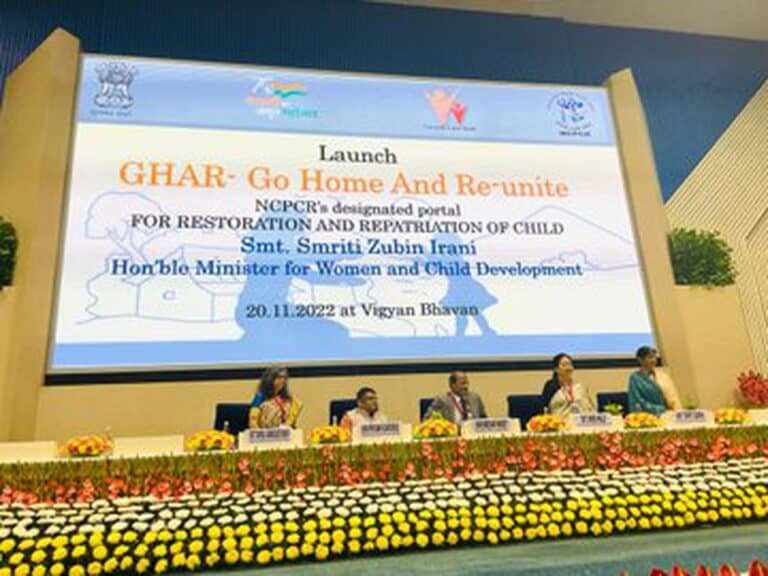
About the Ghar Portal:
- The portal – “GHAR – Go Home and Re-Unite” will be a platform for information on children from every district to smoothen the process of their repatriation and restoration.
Salient features of the Ghar portal
- Digital tracking and monitoring of children who are in the Juvenile Justice system and have to be repatriated to another Country/State/District.
- Digital transfer of cases of children to the concerned Juvenile Justice Board/Child Welfare Committee of the State. It will help in speedy repatriation of children.
- Where there is a requirement of a translator/interpreter/expert, request will be made to the concerned State Government.
- Child Welfare Committees and District Child Protection Officers can ensure proper restoration and rehabilitation of children by digitally monitoring the progress of the case of the child.
- A checklist format will be provided in the forms so that the children who are being hard to repatriate or children who are not getting their entitled compensation or other monetary benefits can be identified.
- List of Government implemented schemes will be provided, so that at the time of restoration the Child Welfare Committees can link the child with the schemes to strengthen the family and ensure that child remains with his/her family.
Juvenile Justice (Care and Protection of Children) Act, 2015
- The Act provides for protection of children in need of care and protection and those in conflict with law by catering to their basic needs through care, protection, development, treatment and social re-integration.
- The Child Welfare Committees have been empowered to take decisions with regard to the children in need of care and protection for the best interest of the children.
- Every State Government has to constitute a District Child Protection Unit (DCPU) for every district to take up matters relating to children.
- To ensure effective coordination in the Child Safety, Protection and Development; District Magistrates have been made the head of DCPUs. DMs have been empowered to review the functioning of DCPUs and CWCs at regular intervals to ensure prompt decisions.
Q1) What is the constitution of the Child Welfare committee?
For the Children in need and care of protection, the State Government may, by notification in the Official Gazette, constitute for every district or group of districts, specified in the notification, one or more Child Welfare Committees. The Committee consists of a Chairperson and four other members, of whom at least one shall be a woman and another, an expert on matters concerning children. The Committee functions as a Bench of Magistrates.
Source: PIB






 Last updated on April, 2026
→ UPSC Final Result 2025 is now out.
→ UPSC has released UPSC Toppers List 2025 with the Civil Services final result on its official website.
→ Anuj Agnihotri secured AIR 1 in the UPSC Civil Services Examination 2025.
→ UPSC Marksheet 2025 is now out.
→ UPSC Notification 2026 & UPSC IFoS Notification 2026 is now out on the official website at upsconline.nic.in.
→ UPSC Calendar 2026 has been released.
→ Check out the latest UPSC Syllabus 2026 here.
→ UPSC Prelims 2026 will be conducted on 24th May, 2026 & UPSC Mains 2026 will be conducted on 21st August 2026.
→ The UPSC Selection Process is of 3 stages-Prelims, Mains and Interview.
→ Prepare effectively with Vajiram & Ravi’s UPSC Prelims Test Series 2026 featuring full-length mock tests, detailed solutions, and performance analysis.
→ Enroll in Vajiram & Ravi’s UPSC Mains Test Series 2026 for structured answer writing practice, expert evaluation, and exam-oriented feedback.
→ Join Vajiram & Ravi’s Best UPSC Mentorship Program for personalized guidance, strategy planning, and one-to-one support from experienced mentors.
→ Shakti Dubey secures AIR 1 in UPSC CSE Exam 2024.
→ Also check Best UPSC Coaching in India