Key findings:
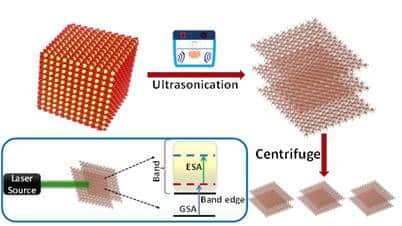
- Nanoflakes of a material called hematene extracted from iron ore have been found capable of withstanding and acting as shield from high laser intensities.
- Hence it could be used to make devices called optical limiters that can protect sensitive optical equipment from light-induced damage.
- Radiation from laser sources is highly concentrated and powerful and can be detrimental to sensitive equipment such as sensors, detectors, and other optical devices.
- When the input intensity increases optical limiters control the amount of light that passes through, thereby preventing damage to the optical component.
- These devices are often useful in laser technologies, military, telecommunications, aircrafts, and scientific research in several ways.
- They found that 2D nanoflakes of hematene is capable of withstanding very high laser intensities, and they exhibited excellent optical limiting of green laser light (532 nm) while maintaining a high linear transmission (about 87%) for low-intensity light.
Key facts about Hematene:
- It is extracted from naturally occurring hematite, the mineral form of iron(III) oxide, using a combination of sonication, centrifugation and vacuum-assisted filtration.
- It measures 3 atoms thick and has a more efficient photocatalysis.
- It is ferromagnetic (the mechanism by which certain materials like iron form permanent magnets, or are attracted to magnets) like a common magnet.
- It is capable of withstanding and acting as shield from high laser intensities
Q) What is an Ore?
Ore refers to a naturally occurring mineral or rock that contains a valuable substance, usually a metal or valuable mineral, in sufficient amounts to make mining economically feasible. These minerals or metals are typically extracted and processed to obtain the valuable elements they contain.






 Last updated on March, 2026
→ UPSC Final Result 2025 is now out.
→ UPSC has released UPSC Toppers List 2025 with the Civil Services final result on its official website.
→ Anuj Agnihotri secured AIR 1 in the UPSC Civil Services Examination 2025.
→ UPSC Marksheet 2025 is now out.
→ UPSC Notification 2026 & UPSC IFoS Notification 2026 is now out on the official website at upsconline.nic.in.
→ UPSC Calendar 2026 has been released.
→ Check out the latest UPSC Syllabus 2026 here.
→ UPSC Prelims 2026 will be conducted on 24th May, 2026 & UPSC Mains 2026 will be conducted on 21st August 2026.
→ The UPSC Selection Process is of 3 stages-Prelims, Mains and Interview.
→ Prepare effectively with Vajiram & Ravi’s UPSC Prelims Test Series 2026 featuring full-length mock tests, detailed solutions, and performance analysis.
→ Enroll in Vajiram & Ravi’s UPSC Mains Test Series 2026 for structured answer writing practice, expert evaluation, and exam-oriented feedback.
→ Join Vajiram & Ravi’s Best UPSC Mentorship Program for personalized guidance, strategy planning, and one-to-one support from experienced mentors.
→ Shakti Dubey secures AIR 1 in UPSC CSE Exam 2024.
→ Also check Best UPSC Coaching in India