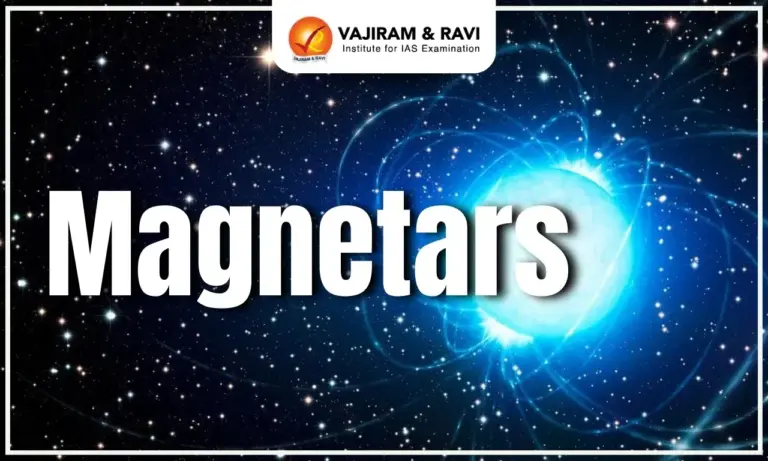
Magnetars Latest News
Researchers have found observational evidence that magnetar flares can produce heavy elements like gold through a process known as r-process nucleosynthesis. Until now, gold was believed to form predominantly in neutron star mergers.
What Are Magnetars?
- Magnetars are a type of neutron star characterised by exceptionally strong magnetic fields, estimated to be a thousand times stronger than typical neutron stars. Occasionally, they emit intense bursts of energy in the form of flares.
- The discovery was based on data from a giant flare emitted by a magnetar in 2004, during which unusual gamma-ray emissions were recorded almost a day after the initial flare by NASA’s Compton Gamma Ray Observatory.
- The delayed emission was not consistent with standard flare afterglows. Instead, it displayed signatures of radioactive decay from neutron-rich isotopes, suggesting the presence of r-process nucleosynthesis.
What Is R-Process Nucleosynthesis?
- The r-process or rapid neutron-capture process is a series of nuclear reactions where atomic nuclei rapidly capture neutrons, forming heavy elements like gold, platinum, and uranium. It requires extreme energy environments and neutron-rich matter.
- Researchers estimated that approximately 1.9 septillion kg of r-process material was ejected at nearly light speed during the flare. This material likely underwent rapid neutron capture, resulting in the synthesis of heavy elements.
- This discovery suggests that magnetars could have contributed to the universe’s heavy element inventory much earlier than neutron star collisions, offering insights into the chemical evolution of galaxies.





Magnetars FAQs
Q1. What is a magnetar?
Ans: A magnetar is a type of neutron star with an extremely powerful magnetic field, up to 1,000 times stronger than typical neutron stars.
Q2. What are magnetar flares?
Ans: Magnetar flares are intense bursts of X-rays and gamma rays caused by magnetic field instability or starquakes on a magnetar’s surface.
Source: TH

 Last updated on April, 2026
→ UPSC Final Result 2025 is now out.
→ UPSC has released UPSC Toppers List 2025 with the Civil Services final result on its official website.
→ Anuj Agnihotri secured AIR 1 in the UPSC Civil Services Examination 2025.
→ UPSC Marksheet 2025 is now out.
→ UPSC Notification 2026 & UPSC IFoS Notification 2026 is now out on the official website at upsconline.nic.in.
→ UPSC Calendar 2026 has been released.
→ Check out the latest UPSC Syllabus 2026 here.
→ UPSC Prelims 2026 will be conducted on 24th May, 2026 & UPSC Mains 2026 will be conducted on 21st August 2026.
→ The UPSC Selection Process is of 3 stages-Prelims, Mains and Interview.
→ Prepare effectively with Vajiram & Ravi’s UPSC Prelims Test Series 2026 featuring full-length mock tests, detailed solutions, and performance analysis.
→ Enroll in Vajiram & Ravi’s UPSC Mains Test Series 2026 for structured answer writing practice, expert evaluation, and exam-oriented feedback.
→ Join Vajiram & Ravi’s Best UPSC Mentorship Program for personalized guidance, strategy planning, and one-to-one support from experienced mentors.
→ Shakti Dubey secures AIR 1 in UPSC CSE Exam 2024.
→ Also check Best UPSC Coaching in India
Tags: Magnetars prelims pointers upsc prelims current affairs