Why in news?
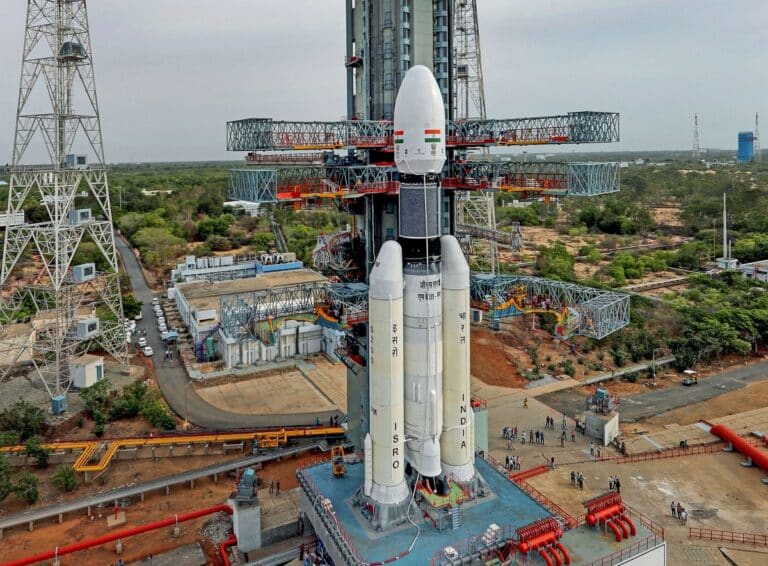
- The GSLV-F12/NVS-01 mission is designed to deploy the NVS-01 navigation satellite into a geosynchronous transfer orbit (GTO).
About NVS-01:
- It is the first in the series of second-generation navigation satellites built by ISRO’s UR Rao Satellite Centre in Bengaluru.
- At present, India uses its Navigation with Indian Constellation (NavIC) series of satellites for civilian and defence navigation in the Indian mainland and even 1500 kms beyond India’s borders.
- NVS series of satellites will sustain and augment the NavIC with enhanced features.
- This series incorporates L1 band signals additionally to widen the services.
- For the first time, an indigenous atomic clock will be flown in NVS-01.
What is Navigation with Indian Constellation (NavIC):
- It is a regional navigation satellite system established by the ISRO to meet the positioning, navigation and timing requirements of the nation.
- NavIC was erstwhile known as Indian Regional Navigation Satellite System (IRNSS).
- It is a constellation of seven satellites that work with a 24X7 network of ground stations while orbiting above Earth.
- Three satellites are placed in geostationary orbit and four in inclined geosynchronous orbit.
- Coverage: The NavIC coverage area includes India and a region up to 1,500km beyond the nation’s boundary.
- Services offered:
- It offers two services — Standard Position Service for civilian users and Restricted Service for strategic users.
- The system is used in terrestrial, aerial, marine transportation, location-based services, personal mobility, resource monitoring, surveying and geodesy, scientific research etc.
What is Geosynchronous Transfer Orbit (GTO)?
- To attain geosynchronous (and also geostationary) Earth orbits, a spacecraft is first launched into an elliptical GTO.
- There on, the satellite will independently use its onboard propulsion systems to perform orbit-raising manoeuvres and reach its intended orbit.
Q1) What is Geosynchronous Transfer Orbit (GTO)?
To attain geosynchronous (and also geostationary) Earth orbits, a spacecraft is first launched into an elliptical GTO. There on, the satellite will independently use its onboard propulsion systems to perform orbit-raising manoeuvres and reach its intended orbit.
Source: ISRO To Launch NVS-01 Navigation Satellite On May 29






 Last updated on April, 2026
→ UPSC Final Result 2025 is now out.
→ UPSC has released UPSC Toppers List 2025 with the Civil Services final result on its official website.
→ Anuj Agnihotri secured AIR 1 in the UPSC Civil Services Examination 2025.
→ UPSC Marksheet 2025 is now out.
→ UPSC Notification 2026 & UPSC IFoS Notification 2026 is now out on the official website at upsconline.nic.in.
→ UPSC Calendar 2026 has been released.
→ Check out the latest UPSC Syllabus 2026 here.
→ UPSC Prelims 2026 will be conducted on 24th May, 2026 & UPSC Mains 2026 will be conducted on 21st August 2026.
→ The UPSC Selection Process is of 3 stages-Prelims, Mains and Interview.
→ Prepare effectively with Vajiram & Ravi’s UPSC Prelims Test Series 2026 featuring full-length mock tests, detailed solutions, and performance analysis.
→ Enroll in Vajiram & Ravi’s UPSC Mains Test Series 2026 for structured answer writing practice, expert evaluation, and exam-oriented feedback.
→ Join Vajiram & Ravi’s Best UPSC Mentorship Program for personalized guidance, strategy planning, and one-to-one support from experienced mentors.
→ Shakti Dubey secures AIR 1 in UPSC CSE Exam 2024.
→ Also check Best UPSC Coaching in India