About Phtheirospermum lushaiorum
- It is a new species of hemi-parasitic terrestrial plant.
- These hemi-parasitic plants lack fully developed root system and form connections with another plant, from which they obtain some or all of their water and minerals.
- Such plants have chlorophyll and produce their own food by photosynthesis, and in some cases, are capable of limited growth in the absence of the host plant.
- They tap into the sap-conducting tissue of the host by means of specialized structures called haustoria.
- The new species has been found in Phawngpui National Park of Mizoram.
- Phtheirospermum lushaiorum attaches themselves to the roots of their host and appear like normal plants growing in the soil.
- They flower only during July to September and fruits are produced during August to October.
- The specific epithet “lushaiorum” is named after the “Lushai” tribe of Mizoram.
Key Facts about Phawngpui National Park
- It is located in the Lawngtlai district under the Lai Autonomous District Council of Mizoram, towards the southeast bordering Myanmar.
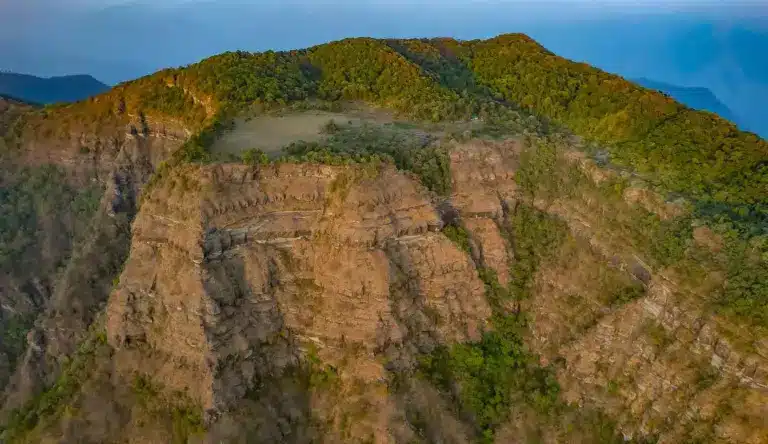
- It derives its name from the Phawngpui Mountain, the highest peak in the state, reaching 2157 meters.
- It covers an area of 50 sq. km, including the entire Phawngpui Mountain along with cliffs and patches of natural grasslands.
- This park is also called Phawngpui Blue Mountain National Park,as the mountainous region of Phawngpui is often covered by a thin layer of clouds,which makes it blue in appearance from a distance.
- Flora: The flora of Phawngpui mostly includes grasses, orchids, trees of rhododendrons, and oak.
- Fauna: It is home to an amazing variety of birdlife, including the rare Blyth’s Tragopan, Dark Rumped Swift, and Mrs. Hume’s Pheasant, the Mizoram state bird, and endangered mammals like the Slow Loris, Tiger, Leopard, Leopard Cat, Serow, Goral, Asiatic Black Bear, Stump-tailed Macaque, and Capped Langur.
Q1: What is Chlorophyll?
It is the natural compound present in green plants that gives them their color. It helps plants to absorb energy from the sun as they undergo the process of photosynthesis.
Source: New hemiparasite plant species named after Lushai tribe of Mizoram






 Last updated on March, 2026
→ UPSC Final Result 2025 is now out.
→ UPSC has released UPSC Toppers List 2025 with the Civil Services final result on its official website.
→ Anuj Agnihotri secured AIR 1 in the UPSC Civil Services Examination 2025.
→ UPSC Marksheet 2025 is now out.
→ UPSC Notification 2026 & UPSC IFoS Notification 2026 is now out on the official website at upsconline.nic.in.
→ UPSC Calendar 2026 has been released.
→ Check out the latest UPSC Syllabus 2026 here.
→ UPSC Prelims 2026 will be conducted on 24th May, 2026 & UPSC Mains 2026 will be conducted on 21st August 2026.
→ The UPSC Selection Process is of 3 stages-Prelims, Mains and Interview.
→ Prepare effectively with Vajiram & Ravi’s UPSC Prelims Test Series 2026 featuring full-length mock tests, detailed solutions, and performance analysis.
→ Enroll in Vajiram & Ravi’s UPSC Mains Test Series 2026 for structured answer writing practice, expert evaluation, and exam-oriented feedback.
→ Join Vajiram & Ravi’s Best UPSC Mentorship Program for personalized guidance, strategy planning, and one-to-one support from experienced mentors.
→ Shakti Dubey secures AIR 1 in UPSC CSE Exam 2024.
→ Also check Best UPSC Coaching in India