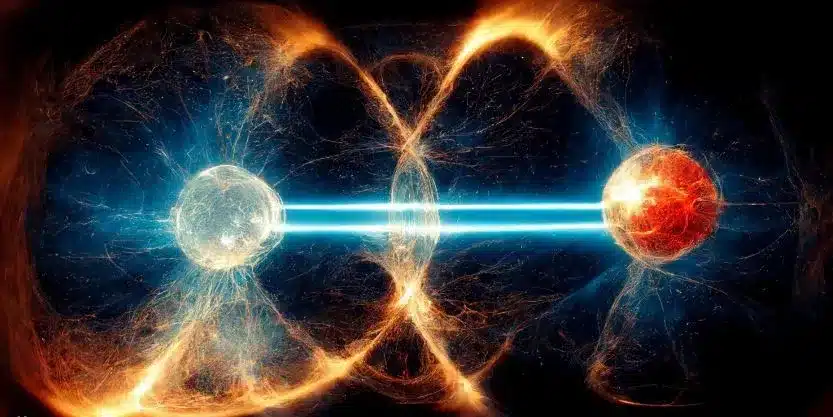
About Quantum Nonlocality:
- While classical physics assumes locality, the principle of nonlocality is a feature of many interpretations of quantum mechanics.
- Nonlocality describes the apparent ability of objects to instantaneously know abouteach other’s state, even when separated by large distances (potentially even billions of light years), almost as if the universe at large instantaneously arranges its particles in anticipation of future events.
- Thus, in the quantum world, despitewhat Einsteinhad established about the speed of light being the maximum speed for anything in the universe, instantaneous action or transfer of information does appear to be possible.
- This is in direct contravention of the “principle of locality” (or what Einstein called the “principle of local action”), the ideathat distant objects cannot have direct influence on one another, and that an object is directly influenced only by its immediate surroundings, an idea on which almost all of physics is predicated.
- Nonlocalityoccurs due to the phenomenon of entanglement, whereby particles that interact with each otherbecome permanently correlated, or dependent on each other’s states and properties, to the extent that they effectively lose their individuality and, in many ways, behave as a single entity.
- Nonlocality suggests that the “separate” parts of the universe are actually potentially connected in an intimate and immediate way.
Q1: What are the methods to create Entanglement?
There are several methods such as the Special crystals method, Cooling of the particles method, Nuclear decay and Splitting of an individual photon.Quantum entanglement works on a quantum principle where the quantum state of atomic or subatomic particles are linked in such a way that action performed on one particle will affect another particle separated in space and time.


 Last updated on Oct, 2026
→ UPSC 2027 Notification will be released on 13 January 2027 at upsconline.nic.in.
→ Check Nobel Prize 2026 Winners List here.
→ Download PIB PRiSM Monthly Magazine 2026 here.
→ Check UPSC Monthly Current Affairs Magazine The Recitals here.
→ Check out the latest UPSC Syllabus here.
→ Download UPSC Model Answers for Mains 2026
→ UPSC Mains Question Paper 2026 is out now for Essay & GS Paper 1, 2, 3 & 4.
→ UPSC Calendar 2027 has been released.
→ Enroll in Vajiram & Ravi’s UPSC Mains Test Series 2027 for structured answer writing practice, expert evaluation, and exam-oriented feedback.
→ Join Vajiram & Ravi’s UPSC Mentorship Program 2027 for personalized guidance, strategy planning, and one-to-one support from experienced mentors.
→ Go through the UPSC Mains Previous Year Papers to enhance your preparation.
→ UPSC has released UPSC Toppers List 2025 with the Civil Services final result on its official website.
→ Also check Best UPSC Coaching in India