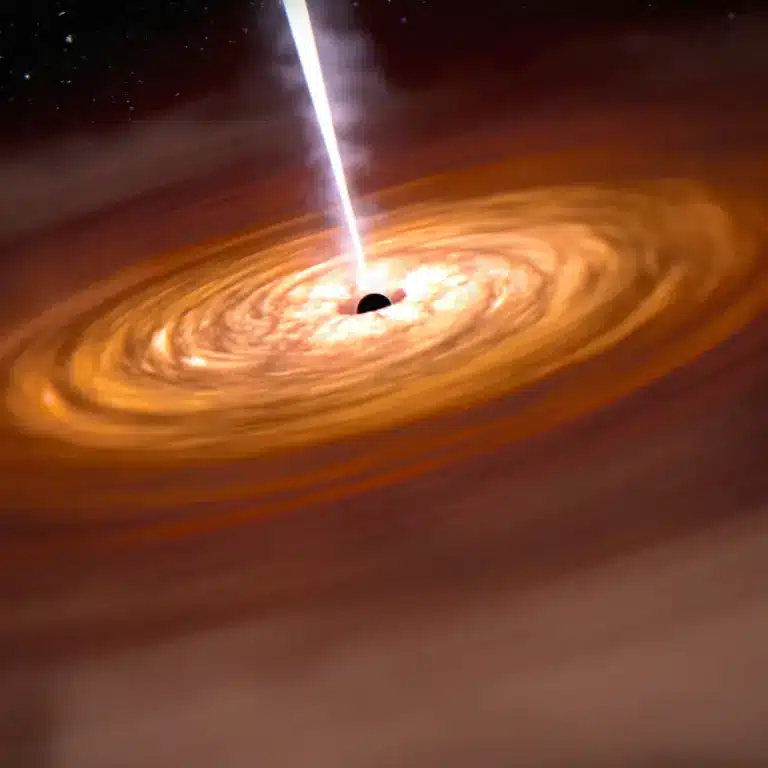
About is Sagittarius A* (Sgr A*):
- It is a supermassive black hole located at the center of our spiral galaxy, the Milky Way.
- It is mostly dormant and only occasionally absorbs gas or dust, but nonetheless has an estimated mass 4.3 million times that of the sun.
- It is located in the constellation Sagittarius.
- It has a diameter of around 14.6 million miles (23.5 million kilometers).
- It is a strong source of radio waves. Most of the radio radiation is from a synchrotron mechanism, indicating the presence of free electrons and magnetic fields.
- The event horizon of the black hole has a radius of 12 million km (7 million miles).
What is a Black hole?
- A black hole is a region in space where gravity pulls so much that even light cannot get out.
- The gravity is so strong because matter has been squeezed into a tiny space. This can happen when a star is dying.
- Because no light can get out, it is difficult to detect a black hole.
- The largest black holes are called “supermassive.” These black holes have masses that are more than 1 million suns together.
- Albert Einstein first predicted the existence of black holes in 1916, with his general theory of relativity.





What is the ‘event horizon’ of a Black hole?
- It is the boundary defining the region of space around a black hole from which nothing (not even light) can escape.
- The escape velocity for an object within the event horizon exceeds the speed of light.
- The radius of the event horizon is called the Schwarzschild radius, after the German astronomer Karl Schwarzschild.
Q1: What are Radio waves?
Radio waves are a type of electromagnetic radiation with wavelengths ranging from about one millimeter to over 100 kilometers. They are part of the electromagnetic spectrum, which includes various forms of electromagnetic radiation, such as visible light, microwaves, and X-rays. Radio waves are characterized by their relatively long wavelengths and low frequencies compared to other types of electromagnetic waves.
Source: Scientists spot intermediate-mass black hole lurking at centre of Milky Way star cluster

 Last updated on March, 2026
→ UPSC Final Result 2025 is now out.
→ UPSC has released UPSC Toppers List 2025 with the Civil Services final result on its official website.
→ Anuj Agnihotri secured AIR 1 in the UPSC Civil Services Examination 2025.
→ UPSC Marksheet 2025 is now out.
→ UPSC Notification 2026 & UPSC IFoS Notification 2026 is now out on the official website at upsconline.nic.in.
→ UPSC Calendar 2026 has been released.
→ Check out the latest UPSC Syllabus 2026 here.
→ UPSC Prelims 2026 will be conducted on 24th May, 2026 & UPSC Mains 2026 will be conducted on 21st August 2026.
→ The UPSC Selection Process is of 3 stages-Prelims, Mains and Interview.
→ Prepare effectively with Vajiram & Ravi’s UPSC Prelims Test Series 2026 featuring full-length mock tests, detailed solutions, and performance analysis.
→ Enroll in Vajiram & Ravi’s UPSC Mains Test Series 2026 for structured answer writing practice, expert evaluation, and exam-oriented feedback.
→ Join Vajiram & Ravi’s Best UPSC Mentorship Program for personalized guidance, strategy planning, and one-to-one support from experienced mentors.
→ Shakti Dubey secures AIR 1 in UPSC CSE Exam 2024.
→ Also check Best UPSC Coaching in India