Seagrass Latest News
According to recent study, seagrass has been declining at a rate of 1-2 per cent per year for the past century and nearly 5 percent of species are now endangered.
About Seagrass
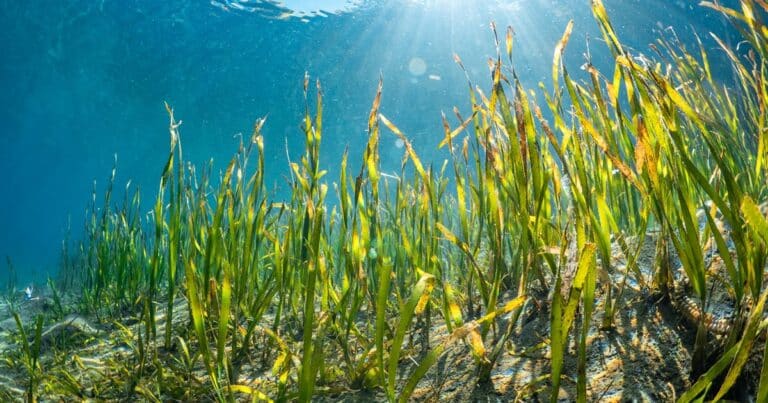
- It is a flowering plant that grows submerged in shallow marine waters like bays and lagoons.
- They are so-named because most species have long green, grass-like leaves.
- Characteristics of Seagrass
- Seagrasses have roots, stems, and leaves and produce flowers and seeds.
- Like terrestrial plants, seagrass also photosynthesizes and manufactures their own food and releases oxygen.
- They evolved around 100 million years ago, and there are approximately 72 different seagrass species that belong to four major groups.





Distribution of Seagrass
- They are found on all continents except Antarctica.
- The tropical waters of the Indo-Pacific hold the highest diversity of seagrasses in the world.
- India too has vast seagrass meadows, home to 16 species of seagrass with major concentrations in the Gulf of Mannar, Palk Bay, Andaman and Nicobar Islands, Lakshadweep Islands and the Gulf of Kutch.
Advantages of Seagrass
- They are better than trees for capturing carbon and providing food for millions of people. Beyond supporting marine life, seagrass also acts as a natural barrier, protecting coastal communities from storms and erosion.
- These underwater plants can store carbon up to 35 times faster than tropical rainforests, locking it away for thousands of years.
- Threats: Pollution from cities, industries, and agriculture continues to degrade these meadows, while coastal development and tourism put additional pressure on fragile habitats of Seagrass.
Seagrass FAQs
Q1: What is sea grass used for?
Ans: Seagrasses support commercial fisheries and biodiversity, clean the surrounding water and help take carbon dioxide out of the atmosphere
Q2: What is the significance of sea grass?
Ans: Seagrasses provide shelter and food to an incredibly diverse community of animals, from tiny invertebrates to large fish, crabs, turtles, marine mammals and birds.
Source: DTH

 Last updated on April, 2026
→ UPSC Final Result 2025 is now out.
→ UPSC has released UPSC Toppers List 2025 with the Civil Services final result on its official website.
→ Anuj Agnihotri secured AIR 1 in the UPSC Civil Services Examination 2025.
→ UPSC Marksheet 2025 is now out.
→ UPSC Notification 2026 & UPSC IFoS Notification 2026 is now out on the official website at upsconline.nic.in.
→ UPSC Calendar 2026 has been released.
→ Check out the latest UPSC Syllabus 2026 here.
→ UPSC Prelims 2026 will be conducted on 24th May, 2026 & UPSC Mains 2026 will be conducted on 21st August 2026.
→ The UPSC Selection Process is of 3 stages-Prelims, Mains and Interview.
→ Prepare effectively with Vajiram & Ravi’s UPSC Prelims Test Series 2026 featuring full-length mock tests, detailed solutions, and performance analysis.
→ Enroll in Vajiram & Ravi’s UPSC Mains Test Series 2026 for structured answer writing practice, expert evaluation, and exam-oriented feedback.
→ Join Vajiram & Ravi’s Best UPSC Mentorship Program for personalized guidance, strategy planning, and one-to-one support from experienced mentors.
→ Shakti Dubey secures AIR 1 in UPSC CSE Exam 2024.
→ Also check Best UPSC Coaching in India