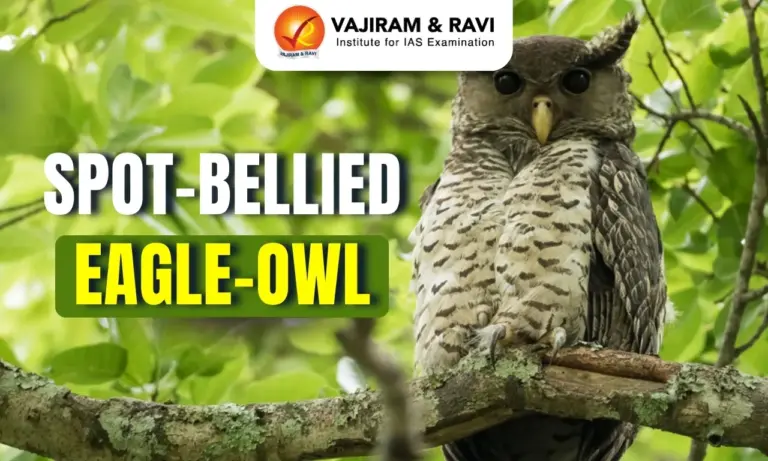
Spot-Bellied Eagle-Owl Latest News
A rare and mysterious night bird, the Spot-bellied Eagle-Owl, known as the ‘Ghost of the Forest’, was recently caught on camera in Uttarakhand’s Corbett Reserve.
About Spot-Bellied Eagle-Owl
- The spot-bellied eagle-owl, also known as the forest eagle-owl, is a large bird of prey with a formidable appearance.
- Scientific Name: Ketupa nipalensis





Spot-Bellied Eagle-Owl Habitat and Distribution
- It is commonly found in India, Sri Lanka, Nepal, Bhutan, Bangladesh, and parts of Southeast Asia.
- It can be found in a variety of habitats, including tropical and subtropical forests, woodlands, and savannas.
Spot-Bellied Eagle-Owl Features
- It is a very large owl. It can be from 50 to 65 cm (20 to 26 in) long. This makes it one of the longest owls in the world.
- It also has very long wings. Its wingspan can reach up to 1.7 meters.
- The most distinguishing feature is its striking colouration. The upper parts of its body are a rich chocolate brown, speckled with white spots.
- The feathers on its wings and tail are barred with alternating shades of brown and white, creating a stunning pattern that helps it blend in with its surroundings.
- The underside of the owl is where it gets its name; its belly and breast are a light cream colour, covered in bold black spots.
- It is primarily nocturnal.
- It is a solitary bird that is territorial and maintains a home range.
- It is famous for its strange, human-like calls.
Spot-Bellied Eagle-Owl Conservation Status
It is classified as ‘Least Concern‘ under the IUCN Red List.
Source: ETVB

 Last updated on April, 2026
→ UPSC Final Result 2025 is now out.
→ UPSC has released UPSC Toppers List 2025 with the Civil Services final result on its official website.
→ Anuj Agnihotri secured AIR 1 in the UPSC Civil Services Examination 2025.
→ UPSC Marksheet 2025 is now out.
→ UPSC Notification 2026 & UPSC IFoS Notification 2026 is now out on the official website at upsconline.nic.in.
→ UPSC Calendar 2026 has been released.
→ Check out the latest UPSC Syllabus 2026 here.
→ UPSC Prelims 2026 will be conducted on 24th May, 2026 & UPSC Mains 2026 will be conducted on 21st August 2026.
→ The UPSC Selection Process is of 3 stages-Prelims, Mains and Interview.
→ Prepare effectively with Vajiram & Ravi’s UPSC Prelims Test Series 2026 featuring full-length mock tests, detailed solutions, and performance analysis.
→ Enroll in Vajiram & Ravi’s UPSC Mains Test Series 2026 for structured answer writing practice, expert evaluation, and exam-oriented feedback.
→ Join Vajiram & Ravi’s Best UPSC Mentorship Program for personalized guidance, strategy planning, and one-to-one support from experienced mentors.
→ Shakti Dubey secures AIR 1 in UPSC CSE Exam 2024.
→ Also check Best UPSC Coaching in India
Spot-bellied Eagle-Owl FAQ's
Q1. What is the scientific name of the spot-bellied eagle-owl?+
Q2. In which countries is the spot-bellied eagle-owl commonly found?+
Q3. Why is it called the spot-bellied eagle-owl?+
Q4. What is the colour of the upper parts of the spot-bellied eagle-owl?+
Q5. What is the IUCN conservation status of the spot-bellied eagle-owl?+
Tags: prelims pointers spot-bellied eagle-owl upsc current affairs upsc prelims current affairs