About Trichoglossum:
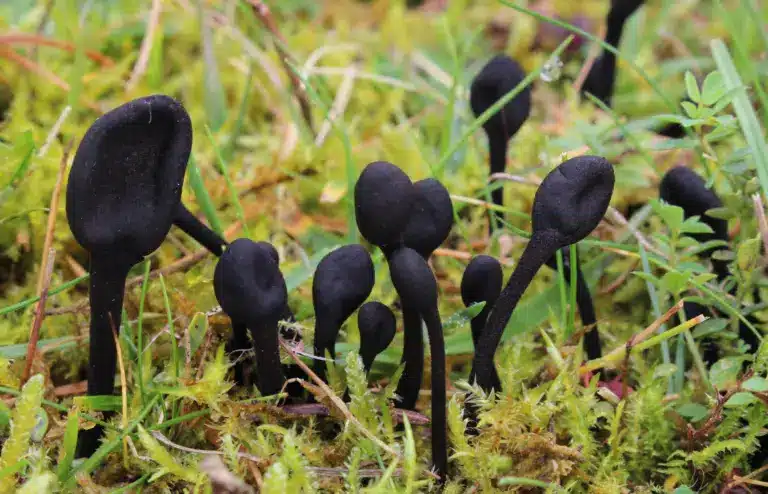
- Trichoglossum is a genus of fungus classified within the family Geoglossaceae (Ascomycota), commonly known as “hairy earth tongues” fungus due to their numerous filaments resembling mushrooms.
- They are black, dark, or brown in colour.
- They exhibit saprotrophic behavior but can also be found as endophytes in plant roots.
- 55 Trichoglossum genera have been identified globally. Of these, 21 are recognized species.
- They are globally distributed in tropical and temperate forests at least five out of seven continents of the world.
- They play a critical role in the decomposition of organic matter.
Key Facts about Fungi:
- Fungi, along with Animalia (animals), Plantae (plants), Protista, Archaea/Archaebacteria, and Bacteria or Eubacteria,form the six ‘kingdoms’ of biology.
- They are eukaryotic organisms, i.e., their cells contain membrane-bound organelles and clearly defined nuclei.
- Reproduction: Fungi usually reproduceboth sexually and asexually.
- Distribution:
o Fungi are either terrestrial or aquatic, the latter living in freshwater or marine environments.
o They are found in all temperate and tropical regions of the world where there is sufficient moisture to enable them to grow.
o A few species of fungi live in the Arctic and Antarctic regions, although they are rare and are more often found living in symbiosis with algae in the form of lichens.
- Importance of fungi:
o They help in breaking down dead organic material; they continue the cycle of nutrients through ecosystems.
o Fungi, as food, play a role in human nutrition in the form of mushrooms.
o They also act as agents of fermentation in the production of bread, cheeses, alcoholic beverages, and numerous other food preparations.
o Secondary metabolites of fungi are used as medicines, such as antibiotics and anticoagulants.
Q1: What are saprotrophs?
Saprotrophs, also known as saprophytes, are organisms that obtain their nutrients by decomposing and absorbing organic matter from dead or decaying organisms. These organisms play a vital role in breaking down complex organic compounds into simpler forms, facilitating the recycling of nutrients in ecosystems.
Source:New species of fungus aiding in increasing soil fertility discovered in Kerala






 Last updated on April, 2026
→ UPSC Final Result 2025 is now out.
→ UPSC has released UPSC Toppers List 2025 with the Civil Services final result on its official website.
→ Anuj Agnihotri secured AIR 1 in the UPSC Civil Services Examination 2025.
→ UPSC Marksheet 2025 is now out.
→ UPSC Notification 2026 & UPSC IFoS Notification 2026 is now out on the official website at upsconline.nic.in.
→ UPSC Calendar 2026 has been released.
→ Check out the latest UPSC Syllabus 2026 here.
→ UPSC Prelims 2026 will be conducted on 24th May, 2026 & UPSC Mains 2026 will be conducted on 21st August 2026.
→ The UPSC Selection Process is of 3 stages-Prelims, Mains and Interview.
→ Prepare effectively with Vajiram & Ravi’s UPSC Prelims Test Series 2026 featuring full-length mock tests, detailed solutions, and performance analysis.
→ Enroll in Vajiram & Ravi’s UPSC Mains Test Series 2026 for structured answer writing practice, expert evaluation, and exam-oriented feedback.
→ Join Vajiram & Ravi’s Best UPSC Mentorship Program for personalized guidance, strategy planning, and one-to-one support from experienced mentors.
→ Shakti Dubey secures AIR 1 in UPSC CSE Exam 2024.
→ Also check Best UPSC Coaching in India