WHO Pandemic Agreement Latest News
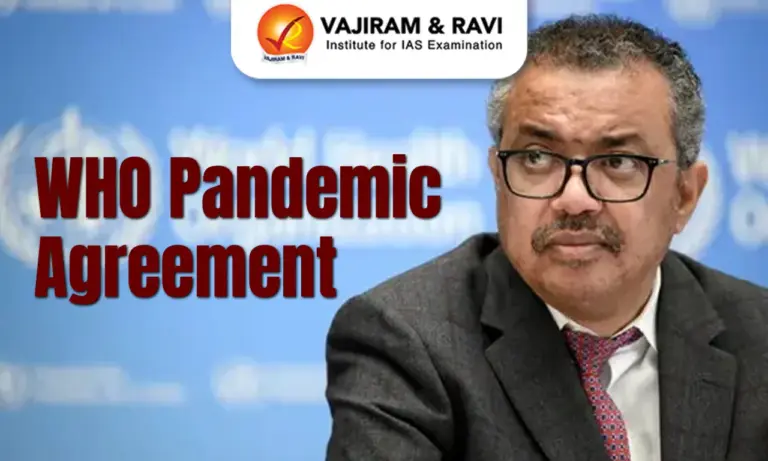
- Member States of the World Health Organization (WHO) have unanimously adopted the world’s first Pandemic Agreement at the 78th World Health Assembly.
- This historic decision follows over three years of negotiations initiated in response to the COVID-19 pandemic.
- The agreement, which is legally binding, aims to strengthen global preparedness, response, and equity in handling future pandemics.
World Health Assembly (WHA)
- The World Health Assembly (WHA) is the decision-making body of the World Health Organization (WHO).
- It is composed of delegates from all WHO Member States.
- The Assembly meets annually to determine policies, approve budgets, and review work programs.
- The assembly is held at Geneva, Switzerland.
Functions
- Sets WHO’s policies and priorities.
- Appoints the Director-General of WHO.
- Approves WHO’s budget and work programs.
- Adopts international treaties and agreements under Article 19 of the WHO Constitution.
- Monitors global health trends and coordinates international responses.
Notable Achievements
- Adoption of the International Health Regulations (IHR) – legal framework for global health security.
- Eradication of Smallpox (1980) – declared by WHA.
- Framework Convention on Tobacco Control (2003) – the first international health treaty.
- Pandemic Influenza Preparedness Framework (2011).
- Adoption of the WHO Pandemic Agreement (2025) – historic legal agreement post-COVID-19.
Recent Focus Areas
- COVID-19 response and pandemic preparedness
- Universal Health Coverage (UHC)
- Antimicrobial resistance (AMR)
- Health equity and access to essential medicines
- Non-communicable diseases (NCDs) and mental health





Key Highlights of WHO Pandemic Agreement
- The pandemic agreement was adopted at the 78th World Health Assembly.
- Full implementation awaits the finalization of key mechanisms by May 2026, followed by ratification by at least 60 countries for it to enter into force.
Legal Framework and Historical Significance
- This is only the second international legal agreement under Article 19 of the WHO Constitution.
- The first was the WHO Framework Convention on Tobacco Control (2003).
- It marks a milestone in global health governance and pandemic resilience.
Objective
- The agreement aims to strengthen global pandemic prevention, preparedness, and response, guided by equity, solidarity, transparency, and scientific evidence.
- It also respects the sovereign rights of states.
Prevention and Surveillance
- Countries are encouraged to:
- Develop and implement national pandemic prevention plans.
- Improve early detection and control of infectious diseases.
- Focus on areas like routine immunisation, lab safety, antimicrobial resistance, and zoonotic disease prevention.
Sustainable Local Production
- Nations should:
- Ensure equitable distribution and rapid scale-up of pandemic-related health products (e.g., vaccines).
- Aim for sustainable, timely, and fair access to these products during pandemics.
Technology Transfer
- Technology and knowledge transfer, particularly to developing countries, should be encouraged on mutually agreed terms.
- Use of licensing, financing, and regulatory incentives to facilitate transfer.
- Promote regional/global tech hubs coordinated by WHO.
Pathogen Access and Benefit Sharing (PABS)
- A new system (PABS) will enable rapid sharing of pathogen data with manufacturers.
- In return, manufacturers must provide 20% of real-time production to WHO (10% as donations, rest at affordable prices).
- Participation is open to all companies, regardless of location.
- Detailed mechanism to be negotiated and finalized by May 2026.
Supply Chain and Logistics
- A Global Supply Chain and Logistics Network will be established for equitable and timely access to health products.
- Countries should use the network during emergencies to ensure need-based, fair distribution.
- WHO will coordinate its structure and operations.
Respect for National Sovereignty
- The agreement does not grant WHO authority to impose or mandate national laws or pandemic response actions (e.g., lockdowns, vaccine mandates, travel bans).
- It ensures state sovereignty is preserved in all aspects of implementation.
Absence of USA from the Pact
- The US’ absence from the agreement casts a long shadow over its effectiveness.
- U.S. negotiators left discussions about the accord after President Donald Trump began a 12-month process of withdrawing the U.S. from the agency when he took office in January.
WHO Pandemic Agreement FAQs
Q1. What is the WHO Pandemic Agreement?
Ans. A global treaty to improve pandemic response, prevention, and preparedness through equity, science, and cooperation.
Q2. When was the agreement adopted?
Ans. At the 78th World Health Assembly in 2024, after three years of negotiation.
Q3. What is PABS?
Ans. The Pathogen Access and Benefit-Sharing system ensures rapid pathogen data sharing and equitable product distribution.
Q4. Does the agreement affect national sovereignty?
Ans. No. WHO cannot impose laws or actions like lockdowns or vaccine mandates.
Q5. When will the agreement come into force?
Ans. After 60 countries ratify it and finalise mechanisms by May 2026.

 Last updated on March, 2026
→ UPSC Final Result 2025 is now out.
→ UPSC has released UPSC Toppers List 2025 with the Civil Services final result on its official website.
→ Anuj Agnihotri secured AIR 1 in the UPSC Civil Services Examination 2025.
→ UPSC Marksheet 2025 is now out.
→ UPSC Notification 2026 & UPSC IFoS Notification 2026 is now out on the official website at upsconline.nic.in.
→ UPSC Calendar 2026 has been released.
→ Check out the latest UPSC Syllabus 2026 here.
→ UPSC Prelims 2026 will be conducted on 24th May, 2026 & UPSC Mains 2026 will be conducted on 21st August 2026.
→ The UPSC Selection Process is of 3 stages-Prelims, Mains and Interview.
→ Prepare effectively with Vajiram & Ravi’s UPSC Prelims Test Series 2026 featuring full-length mock tests, detailed solutions, and performance analysis.
→ Enroll in Vajiram & Ravi’s UPSC Mains Test Series 2026 for structured answer writing practice, expert evaluation, and exam-oriented feedback.
→ Join Vajiram & Ravi’s Best UPSC Mentorship Program for personalized guidance, strategy planning, and one-to-one support from experienced mentors.
→ Shakti Dubey secures AIR 1 in UPSC CSE Exam 2024.
→ Also check Best UPSC Coaching in India
Tags: mains articles upsc current affairs upsc mains current affiars who adopts first-ever pandemic agreement