Green Revolution Debt Latest News
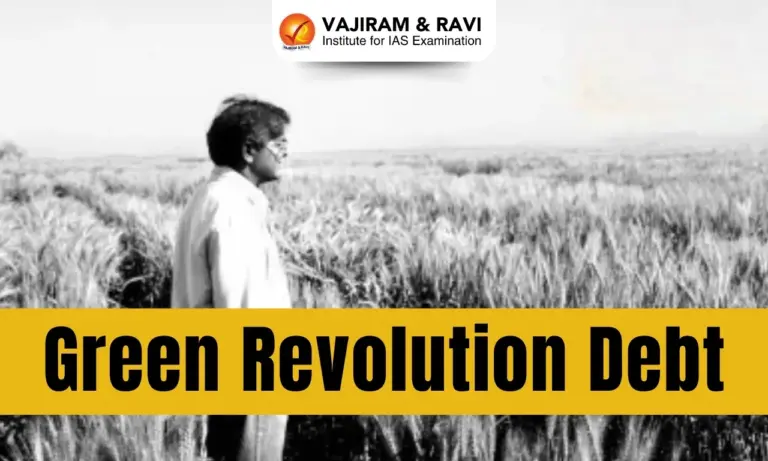
- William S. Gaud of USAID coined the term “Green Revolution” in 1968, highlighting efforts like India’s adoption of high-yield wheat varieties to tackle global food challenges.
- USAID, which played a key role in supporting such agricultural advances, was shut down by the Trump administration from July 1.
- Its closure has affected institutions like CIMMYT, a major centre for maize and wheat research.
- CIMMYT, linked to Norman Borlaug, developed key semi-dwarf wheat varieties that sparked India’s Green Revolution.
- Initially funded by Mexico and the Rockefeller Foundation, CIMMYT later relied heavily on USAID, which contributed $83 million of its $211 million funding in 2024.
- With USAID now shut, CIMMYT is turning to India—one of its biggest beneficiaries—for future support.
CIMMYT
- Mexico-headquartered International Maize and Wheat Improvement Center or CIMMYT is a major centre for maize and wheat research.
- CIMMYT is to wheat what the Philippines-based International Rice Research Institute (IRRI) — established by the Ford and Rockefeller foundations in 1960 — has been to the other big cereal grain crop.
- It developed semi-dwarf wheat varieties like Lerma Rojo 64A and Sonora 63, first sown in India in 1964–65, sparking the Green Revolution.
- Renowned agricultural scientist Norman Borlaug was closely associated with CIMMYT.
- It originated from a Mexican government and Rockefeller Foundation initiative in the 1940s–50s.
- USAID later became CIMMYT’s main funder, contributing $83 million of its $211 million grant revenues in 2024.
- With USAID dismantled, CIMMYT is now seeking India as a major funding partner.





How Wheat and Rice Research Became Cold War Tools
- CIMMYT and IRRI, key institutions backed by US foundations, helped expand wheat and rice production globally, especially in developing countries like India.
- This was part of US Cold War strategy to prevent food-related political instability and communist influence.
- Borlaug’s wheat varieties and IRRI’s semi-dwarf rice strains significantly increased crop yields and reduced growing times.
- Borlaug’s wheat varieties boosted Indian wheat yields from 1–1.5 tonnes to 4–4.5 tonnes per hectare, overcoming issues like lodging in traditional tall cultivars.
- Borlaug received the 1970 Nobel Peace Prize for his contributions to global food security.
How India Benefited from the Green Revolution
- The Green Revolution in India was driven by wheat and rice varieties from CIMMYT and IRRI.
- Indian scientists adapted these into wheat varieties like Kalyan Sona and Sonalika in 1967–68 using CIMMYT breeding material.
- At IARI New Delhi, scientists led by VS Mathur developed high-yielding wheat varieties such as HD 2285 (1982), HD 2329 (1985), and later HD 2967 (2011), pushing wheat yields to 7+ tonnes per hectare.
- In rice, V Ramachandra Rao and MV Reddy at Andhra Pradesh Agricultural University created mega varieties like Swarna (1982) and Samba Mahsuri (1986).
- IARI scientists developed top-selling basmati varieties like Pusa Basmati 1 (1989), 1121 (2003), and 1509 (2013).
- India exported 6.1 million tonnes of basmati worth $5.94 billion in 2024–25, with over 90% from IARI varieties.
- Norman Borlaug credited India’s success to strong institutions like IARI and leadership from MS Swaminathan.
Why India Still Needs CIMMYT and IRRI
- In 2024–25, six out of the top 10 wheat varieties in India—covering over 20 million hectares out of 32 million hectares—were developed using CIMMYT germplasm.
- The only major recent Indian-bred wheat variety, HD 2967, peaked at 12–14 million hectares in 2017–19. Most new varieties since rely on CIMMYT material.
- CIMMYT and IRRI remain crucial for India’s food security and agricultural growth.
Conclusion
- In 2024, India contributed just $0.8 million to CIMMYT and $18.3 million to IRRI, despite being a major beneficiary.
- India should increase funding for these global institutions, focusing on strategic research in heat and drought tolerance, nitrogen use efficiency, gene editing, and AI tools.
- However, this support must complement—not replace—investment in India’s own agricultural research system.

 Last updated on April, 2026
→ UPSC Final Result 2025 is now out.
→ UPSC has released UPSC Toppers List 2025 with the Civil Services final result on its official website.
→ Anuj Agnihotri secured AIR 1 in the UPSC Civil Services Examination 2025.
→ UPSC Marksheet 2025 is now out.
→ UPSC Notification 2026 & UPSC IFoS Notification 2026 is now out on the official website at upsconline.nic.in.
→ UPSC Calendar 2026 has been released.
→ Check out the latest UPSC Syllabus 2026 here.
→ UPSC Prelims 2026 will be conducted on 24th May, 2026 & UPSC Mains 2026 will be conducted on 21st August 2026.
→ The UPSC Selection Process is of 3 stages-Prelims, Mains and Interview.
→ Prepare effectively with Vajiram & Ravi’s UPSC Prelims Test Series 2026 featuring full-length mock tests, detailed solutions, and performance analysis.
→ Enroll in Vajiram & Ravi’s UPSC Mains Test Series 2026 for structured answer writing practice, expert evaluation, and exam-oriented feedback.
→ Join Vajiram & Ravi’s Best UPSC Mentorship Program for personalized guidance, strategy planning, and one-to-one support from experienced mentors.
→ Shakti Dubey secures AIR 1 in UPSC CSE Exam 2024.
→ Also check Best UPSC Coaching in India
Green Revolution Debt FAQs
Q1. What is CIMMYT’s role in India’s agriculture?+
Q2. Why did CIMMYT look to India for support?+
Q3. How did India benefit from IRRI and CIMMYT?+
Q4. Why is continued support for CIMMYT important?+
Q5. How much does India contribute to CIMMYT and IRRI?+
Tags: green revolution debt mains articles upsc current affairs upsc mains current affairs