What’s in today’s article?
- Why in News?
- About Commissioner of Railway Safety (CRS)
- How CRS Became Independent of Ministry of Railways?
Why in News?
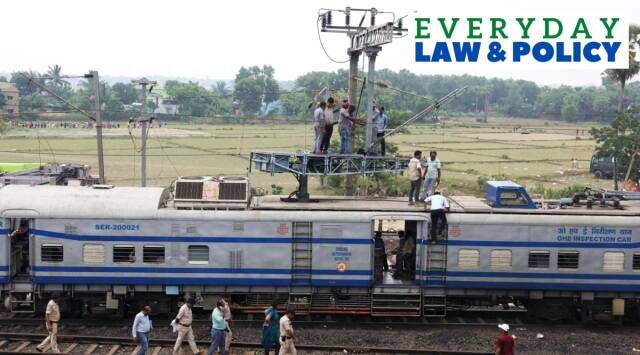
- Investigation into the recent tragic train accident in Odisha, the deadliest train crash in India in over two decades, is being conducted by the Commissioner of Railway Safety (CRS) for the south-eastern circle.
About Commissioner of Railway Safety (CRS)
- The Commissioner of Railway Safety (CRS) is a statutory body. It is headed by the Chief Commissioner of Railway Safety.
- As the name suggests, CRS deals with matters related to safety of rail travel and operations, as laid down in the Railways Act, 1989.
- Investigating serious train accidents is one of the key responsibilities of the CRS.
- The commission also makes recommendations to the government
- Headquarters – Lucknow, Uttar Pradesh
- It is, however, worth noting that the CRS does not report to the Ministry of Railways of the Railway Board.
- It is, in fact, under the administrative control of the Ministry of Civil Aviation (MoCA).
- The reason or principle behind this, put simply, is to keep the CRS insulated from the influence of the country’s railway establishment and prevent conflicts of interest.




How CRS Became Independent of Ministry of Railways?
- The Government of India Act, 1935 said that functions for securing the safety of railway operations should be performed by an authority independent of the federal railway authority or the Railway Board.
- These functions included conducting railway accident probes.
- But due to the outbreak of the Second World War in 1939, the idea did not take off and the Railway Inspectorate continued to function under the control of the Railway Board.
- Consequently, in May 1941, the Railway Inspectorate was separated from the Railway Board and put under the administrative control of the then Department of Posts and Air.
- Since then, the Inspectorate, which was re-designated as the Commissioner of Railway Safety in 1961, has been under the control of the central ministry exercising control over civil aviation in India.
Q1) Which was the first passenger train in India?
On 16th April 1853, the first passenger train ran between Bori Bunder (Bombay) and Thane, a distance of 34 km with 14 coaches and 400 passengers.
Q2) When was the Railway Budget merged with the general budget?
The Railway Budget was merged with the Union Budget in 2017, ending a practice that began in 1924 under British rule. A Niti Aayog commission submitted a white paper recommendation to do away with the practice of a separate Railway Budget.
Source: Why is CRS, the body investigating the Odisha rail accident, under the Aviation Ministry

 Last updated on March, 2026
→ UPSC Final Result 2025 is now out.
→ UPSC has released UPSC Toppers List 2025 with the Civil Services final result on its official website.
→ Anuj Agnihotri secured AIR 1 in the UPSC Civil Services Examination 2025.
→ UPSC Marksheet 2025 is now out.
→ UPSC Notification 2026 & UPSC IFoS Notification 2026 is now out on the official website at upsconline.nic.in.
→ UPSC Calendar 2026 has been released.
→ Check out the latest UPSC Syllabus 2026 here.
→ UPSC Prelims 2026 will be conducted on 24th May, 2026 & UPSC Mains 2026 will be conducted on 21st August 2026.
→ The UPSC Selection Process is of 3 stages-Prelims, Mains and Interview.
→ Prepare effectively with Vajiram & Ravi’s UPSC Prelims Test Series 2026 featuring full-length mock tests, detailed solutions, and performance analysis.
→ Enroll in Vajiram & Ravi’s UPSC Mains Test Series 2026 for structured answer writing practice, expert evaluation, and exam-oriented feedback.
→ Join Vajiram & Ravi’s Best UPSC Mentorship Program for personalized guidance, strategy planning, and one-to-one support from experienced mentors.
→ Shakti Dubey secures AIR 1 in UPSC CSE Exam 2024.
→ Also check Best UPSC Coaching in India