
What’s in Today’s Article?
- Why in News?
- Why is India Transitioning to Hyperlocal Extreme Weather Forecasting?
- What are the Major Hurdles in the Indian Weather Forecasting?
- About the WINDS Portal
- Challenges in the Prediction of Air Pollution and Way Ahead
Why in News?
- The Union Ministry of Agriculture & Farmers Welfare, Government of India, has initiated the weather information network and data system (WINDS) to generate long-term, hyper-local weather data.





Why is India Transitioning to Hyperlocal Extreme Weather Forecasting?
- Weather forecasting plays a pivotal role in the country’s functioning because predicting rain, cyclones, heatwaves and drought accurately are critical to inform decision making on disaster management.
- In India, the Indian Meteorology Department (IMD) is the principal government agency in all matters relating to meteorology.
- It specialises in the incredibly complex science of predicting weather patterns by observing, modelling and interpreting a multitude of variables.
- However, in tropical countries like India, weather variability is inherently higher.
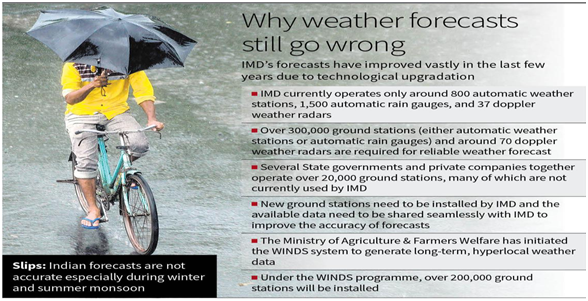
- IMD’s forecasts have improved vastly in the last few years as it has upgraded to technologies similar to the US, the UK and Japan, which are known to produce accurate forecasts.
- Yet, there are still many days and geographies for which Indian forecasts go wrong, especially during winter and summer monsoon.
Major Hurdle in the Indian Weather Forecasting
- Lack of weather monitoring ground stations:
- Currently, IMD operates around 800 automatic weather stations (AWS), 1,500 automatic rain gauges (ARG) and 37 doppler weather radars (DWR).
- This is against the total requirements of more than 3,00,000 ground stations (AWS/ARG) and around 70 DWRs.
- Several Indian State governments and private companies operate a significant network of ground stations (more than 20,000), many of which are not currently used by IMD due to inaccessibility and reliability of data.
- Old prediction technologies:
- Currently, most of the prediction software used in forecasting are based on the global forecasting system and weather research and forecasting models, both of which are not modern.
- Thus, there is an urgent need for an integrated system to fill these data gaps.
About the WINDS Portal
- It is a promising step forward by the Department of Agriculture & Farmers Welfare launched in July 2023.
- Under this programme, more than 200,000 ground stations (AWS and ARG) will be installed.
- It will help tremendously in enhancing weather data utilisation by generating long-term, hyper-local weather data and thus in improving weather predictions and decision making.
- The system will promote the data for wider applications in agriculture and other sectors and will help in creating a national-level data base.
- It will assist in establishing the protocols required to access the country-wide data by the various public and private concerns.
Challenges in the Prediction of Air Pollution and Way Ahead
- Air pollution continues to be a challenge. Dense fog mainly because of the high particulate matter and smog in the atmosphere have led to an increase in respiratory and other health-related issues.
- Air quality monitoring systems are currently very expensive and tend to be imported.
- However, thanks to the Make in India initiatives, many Indian companies have started to manufacture low-cost and highly reliable sensor-based air quality monitoring systems.
- These are also easy to install and have low maintenance costs.
- The IITs are helping and they have started centres of excellence in this domain, with a mission to establish a nation-wide network of affordable air quality sensors.
- An integrated AI/ML-based model with data from the new air quality and weather sensors will be a major step forward to accurately predict fog.
- It will help in timely decision making around transportation and the health-related impacts of air pollution.
Q1) What is the Make in India initiative?
‘Make in India’ initiative was launched globally in September 2014 as a part of India’s renewed focus on Manufacturing. The objective of the Initiative is to promote India as the most preferred global manufacturing destination.
Q2) What is the India Meteorological Department (IMD)?
Established in 1875, IMD is the National Meteorological Service of the country and the principal government agency in all matters relating to meteorology and allied subjects.
Source: India set to transition to hyperlocal extreme weather forecasting

 Last updated on March, 2026
→ UPSC Final Result 2025 is now out.
→ UPSC has released UPSC Toppers List 2025 with the Civil Services final result on its official website.
→ Anuj Agnihotri secured AIR 1 in the UPSC Civil Services Examination 2025.
→ UPSC Marksheet 2025 is now out.
→ UPSC Notification 2026 & UPSC IFoS Notification 2026 is now out on the official website at upsconline.nic.in.
→ UPSC Calendar 2026 has been released.
→ Check out the latest UPSC Syllabus 2026 here.
→ UPSC Prelims 2026 will be conducted on 24th May, 2026 & UPSC Mains 2026 will be conducted on 21st August 2026.
→ The UPSC Selection Process is of 3 stages-Prelims, Mains and Interview.
→ Prepare effectively with Vajiram & Ravi’s UPSC Prelims Test Series 2026 featuring full-length mock tests, detailed solutions, and performance analysis.
→ Enroll in Vajiram & Ravi’s UPSC Mains Test Series 2026 for structured answer writing practice, expert evaluation, and exam-oriented feedback.
→ Join Vajiram & Ravi’s Best UPSC Mentorship Program for personalized guidance, strategy planning, and one-to-one support from experienced mentors.
→ Shakti Dubey secures AIR 1 in UPSC CSE Exam 2024.
→ Also check Best UPSC Coaching in India