About Winter Solstice
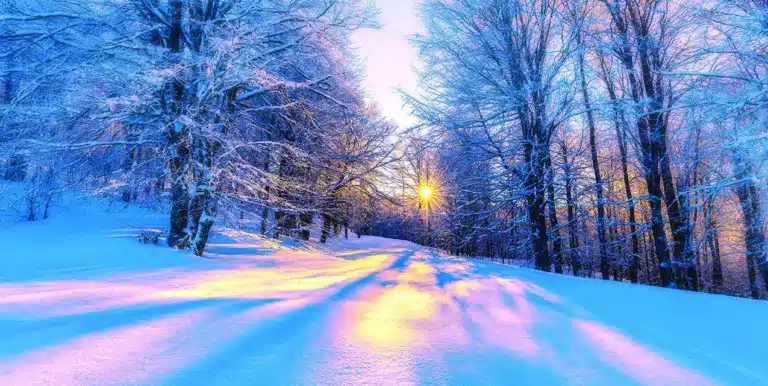
- The winter solstice marks the shortest day of the year.
- The Earth is tilted 23.4 degrees on its axis, so if the Earth’s pole is pointing towards or away from the Sun during the day, the arc the Sun travels through will rise and fall during the year.
- Winter Solstice happens when one of the Earth’s poles is far away from the Sun.
- It falls on December 21 or 22 in the Northern Hemisphere and June 20 or 21 in the Southern Hemisphere.
- The word solstice is derived from the Latin word solstitium, where ‘sol’ means Sun and ‘stitium’ means to stop.
- During the winter solstice, the days are the shortest. The duration of daylight will vary across countries.
- The winter solstice is significant in many cultures since it marks the symbolic death and rebirth of the Sun. Ancient monuments like Stonehenge are aligned with the sunrise or sunset on the winter solstice.
- December’s winter solstice:
- It is when the northern half of the Earth is tilted furthest away from the sun.
- The northern hemisphere will experience the fewest hours of sunlight, making it the shortest day of the year while the night is the longest.
- Every day after the winter solstice will grow longer in the northern hemisphere until its summer solstice, or the longest day of the year, between June 20 and 22.
- The event will also coincide with the peak of the Ursid meteor shower, an annual display that occurs over the northern hemisphere when the Earth passes through debris left by the comet 8P/Tuttle.
Q1) What is the Summer solstice?
It occurs when one of Earth’s poles is tilted toward the sun at its most extreme angle, and due to Earth’s tilt, this happens twice a year. In the Northern Hemisphere, the summer solstice falls in June (while the Southern Hemisphere experiences the winter solstice), and in the Southern Hemisphere, it falls in December (while the Northern Hemisphere experiences the winter solstice).
Source: India Set To Witness Shortest Day Of The Year Today, Here’s Why






 Last updated on March, 2026
→ UPSC Final Result 2025 is now out.
→ UPSC has released UPSC Toppers List 2025 with the Civil Services final result on its official website.
→ Anuj Agnihotri secured AIR 1 in the UPSC Civil Services Examination 2025.
→ UPSC Marksheet 2025 is now out.
→ UPSC Notification 2026 & UPSC IFoS Notification 2026 is now out on the official website at upsconline.nic.in.
→ UPSC Calendar 2026 has been released.
→ Check out the latest UPSC Syllabus 2026 here.
→ UPSC Prelims 2026 will be conducted on 24th May, 2026 & UPSC Mains 2026 will be conducted on 21st August 2026.
→ The UPSC Selection Process is of 3 stages-Prelims, Mains and Interview.
→ Prepare effectively with Vajiram & Ravi’s UPSC Prelims Test Series 2026 featuring full-length mock tests, detailed solutions, and performance analysis.
→ Enroll in Vajiram & Ravi’s UPSC Mains Test Series 2026 for structured answer writing practice, expert evaluation, and exam-oriented feedback.
→ Join Vajiram & Ravi’s Best UPSC Mentorship Program for personalized guidance, strategy planning, and one-to-one support from experienced mentors.
→ Shakti Dubey secures AIR 1 in UPSC CSE Exam 2024.
→ Also check Best UPSC Coaching in India