Why in the News?
As the world observes International Women’s Day on 8 March, the need to recognise and empower women farmers has gained renewed attention.
Moreover, 2026 has been declared as the ‘International Year of the Woman Farmer’, a global initiative led by the Food and Agriculture Organisation.
Role of Women in Agriculture
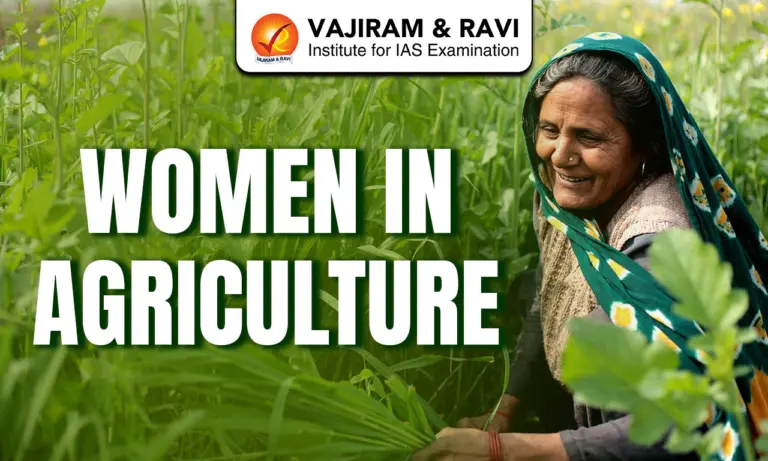
Women in agriculture form the backbone of India’s farming sector, contributing a significant share of the workforce and performing the majority of farm-related tasks across crops, horticulture, animal husbandry, and post-harvest operations.
- Women constitute about 64% of India’s agricultural workforce and are responsible for around 70% of all farm-related tasks.
- Approximately 80% of rural women are engaged in agriculture, performing work across crops, horticulture, animal husbandry, fisheries, and post-harvest activities.
- As per the ICAR 2020 report, women’s participation is 75% in crop production, 79% in horticulture, 51% in post-harvest operations, and 95% in animal husbandry and fisheries.





Structural Problems Faced by Women Farmers
Women perform a large share of agricultural work but are rarely recognised as farmers in law, policy, and land ownership. Because of this invisibility, they face barriers in accessing Land rights, Credit, Agricultural schemes, Extension services, Nutrition and food security benefits.
- Lack of Land Ownership
- Only 13.9% of agricultural land is in women’s names due to patrilineal inheritance, social norms, limited legal awareness, and administrative hurdles.
- Limited Access to Agricultural Resources
- Without legal recognition or land titles, women often face systemic barriers in accessing institutional credit, crop insurance, irrigation schemes, and agricultural extension services.
- Limited Decision-Making Power
- Women perform most farm operations, from sowing to harvesting, yet men control crucial decisions such as crop selection, sale of produce, and allocation of income.
- This reduces women’s agency and limits the benefits they could derive from their own labour.
- Feminisation of Agriculture and Double Burden
- With men migrating for work, women are increasingly responsible for managing farms and household duties simultaneously.
- This double burden leaves them overworked and stressed, making it difficult to maintain productivity and well-being.
- Vulnerability to Climate Change
- Women have limited access to climate information, resilient seeds, irrigation technology, and extension services.
- This reduces their ability to adapt to heatwaves, erratic rainfall, and other climate risks, increasing their vulnerability.
- Nutrition and Health Crisis
- Many rural diets remain cereal-dominated and nutritionally poor, resulting in high levels of anemia and micronutrient deficiencies among women.
- Food transfers through Public Distribution Systems are cereal-centric, with uneven integration of pulses, millets, and nutrient-dense foods.
- Poor maternal nutrition has intergenerational consequences, contributing to low birth weight, stunting and poor child development.
Way Forward
- Recognising women as farmers in laws, policies and agricultural databases is essential to ensure their visibility and inclusion in development programmes.
- Strengthening women’s land rights through effective implementation of inheritance laws and promotion of joint land titles can improve their access to resources and institutional support.
- Providing women farmers with access to institutional credit, crop insurance and irrigation facilities can help improve agricultural productivity and economic security.
- Agricultural policies should promote nutrition-sensitive farming by encouraging the cultivation and distribution of pulses, millets, fruits and vegetables through public programmes.
- Expanding access to agricultural technologies and labour-saving tools can reduce drudgery and improve the health and productivity of women farmers.
- Strengthening extension services and training programmes can enhance women’s knowledge of climate-resilient and sustainable agricultural practices.
- Encouraging women’s collectives, self-help groups and community-based initiatives can strengthen their bargaining power and improve access to markets and resources.
Impact of Empowering Women Farmers
Agricultural scientist M. S. Swaminathan emphasised the importance of women’s participation across the agricultural value chain, including conservation, cultivation, consumption and commercialisation.
- When women gain knowledge, rights, and institutional support, they can drive climate-resilient, biodiversity-rich, and nutrition-sensitive agriculture.
- Focusing on women in food security programmes improves outcomes not just for them but for entire communities.
Recognising women as farmers and ensuring their rights to land, resources, and food is key to building a fair, resilient, and nourished India.

 Last updated on March, 2026
→ UPSC Final Result 2025 is now out.
→ UPSC has released UPSC Toppers List 2025 with the Civil Services final result on its official website.
→ Anuj Agnihotri secured AIR 1 in the UPSC Civil Services Examination 2025.
→ UPSC Marksheet 2025 is now out.
→ UPSC Notification 2026 & UPSC IFoS Notification 2026 is now out on the official website at upsconline.nic.in.
→ UPSC Calendar 2026 has been released.
→ Check out the latest UPSC Syllabus 2026 here.
→ UPSC Prelims 2026 will be conducted on 24th May, 2026 & UPSC Mains 2026 will be conducted on 21st August 2026.
→ The UPSC Selection Process is of 3 stages-Prelims, Mains and Interview.
→ Prepare effectively with Vajiram & Ravi’s UPSC Prelims Test Series 2026 featuring full-length mock tests, detailed solutions, and performance analysis.
→ Enroll in Vajiram & Ravi’s UPSC Mains Test Series 2026 for structured answer writing practice, expert evaluation, and exam-oriented feedback.
→ Join Vajiram & Ravi’s Best UPSC Mentorship Program for personalized guidance, strategy planning, and one-to-one support from experienced mentors.
→ Shakti Dubey secures AIR 1 in UPSC CSE Exam 2024.
→ Also check Best UPSC Coaching in India
Women in Agriculture FAQs
Q1. Why is 2026 significant for women in agriculture?+
Q2. What is the role of women in agriculture in India?+
Q3. What challenges do women in agriculture face?+
Q4. How can the participation of women in agriculture be strengthened?+
Q5. What is the impact of empowering women in agriculture?+
Tags: women in agriculture