Woolly Mice Latest News
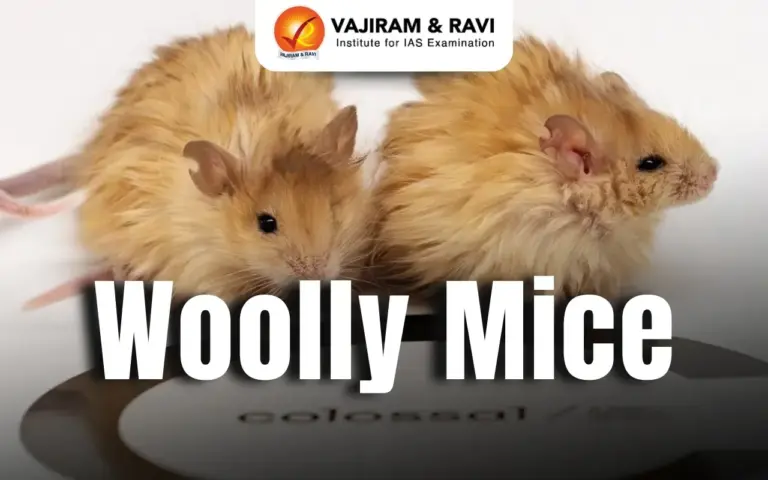
Scientists have successfully edited mouse DNA with genes from the woolly mammoth, creating the world’s first furry “woolly mice.” This breakthrough provides insights into how ancient species adapted to extreme cold.
About Woolly Mice
- Genetic Modifications: The woolly mice have been genetically engineered by modifying seven genes that code for traits like hair length, thickness, and colour. These modifications include genes such as FGF5 for longer hair and MC1R for a golden coat.
- Purpose: The creation of woolly mice serves as a proof-of-concept for the feasibility of gene editing in de-extinction efforts. It demonstrates the ability to recreate complex genetic combinations that took nature millions of years to develop
How did the Scientists Create Woolly Mice?
- Identifying Mammoth Genes: Scientists first compared mammoth DNA with their closest living relative, the Asian elephant, to identify genetic differences related to hair length, thickness, texture, colour, and body fat.
- Selecting Relevant Traits: They selected 10 mammoth gene variants linked to these traits and matched them with similar known genetic variants in laboratory mice for targeted gene editing.
- Gene Editing in Mice: Using CRISPR technology, scientists made eight precise edits to modify seven genes in the mice, incorporating mammoth-like traits responsible for a woolly coat and cold adaptation.
- Result: The genetically modified mice were born with thicker, longer fur, confirming that the selected mammoth genes influenced hair growth and cold resistance, as predicted by computational analysis.





Woolly Mice FAQs
Q1. What are woolly mice?
Ans. US company Colossal Biosciences has announced the creation of a “woolly mouse” — a laboratory mouse with a series of genetic modifications that lead to a woolly coat.
Q2. Which animal is woolly?
Ans. The woolly mammoth, an ancient elephant species, lived in Europe, Asia, and North America around 300,000 to 10,000 years ago.
Q3. Have scientists created a woolly mammoth?
Ans. Scientists have not created a woolly mammoth but genetically modified mice with mammoth-like traits, such as longer, wavy hair.
Source: IE

 Last updated on March, 2026
→ UPSC Final Result 2025 is now out.
→ UPSC has released UPSC Toppers List 2025 with the Civil Services final result on its official website.
→ Anuj Agnihotri secured AIR 1 in the UPSC Civil Services Examination 2025.
→ UPSC Marksheet 2025 is now out.
→ UPSC Notification 2026 & UPSC IFoS Notification 2026 is now out on the official website at upsconline.nic.in.
→ UPSC Calendar 2026 has been released.
→ Check out the latest UPSC Syllabus 2026 here.
→ UPSC Prelims 2026 will be conducted on 24th May, 2026 & UPSC Mains 2026 will be conducted on 21st August 2026.
→ The UPSC Selection Process is of 3 stages-Prelims, Mains and Interview.
→ Prepare effectively with Vajiram & Ravi’s UPSC Prelims Test Series 2026 featuring full-length mock tests, detailed solutions, and performance analysis.
→ Enroll in Vajiram & Ravi’s UPSC Mains Test Series 2026 for structured answer writing practice, expert evaluation, and exam-oriented feedback.
→ Join Vajiram & Ravi’s Best UPSC Mentorship Program for personalized guidance, strategy planning, and one-to-one support from experienced mentors.
→ Shakti Dubey secures AIR 1 in UPSC CSE Exam 2024.
→ Also check Best UPSC Coaching in India