Workers’ Rights Latest News
- A series of fatal industrial accidents across India has reignited concerns over the erosion of workers’ rights and safety standards, especially amid policy shifts that weaken labour protections under the new labour codes.
The Erosion of Workers’ Rights in India
- India’s industrial landscape is undergoing rapid transformation, but this growth has come at a high human cost.
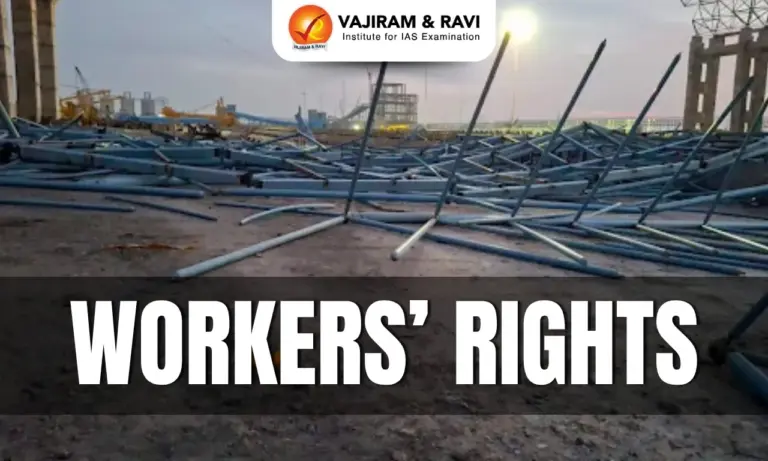
- A series of deadly industrial accidents, such as the Sigachi Industries chemical explosion in Telangana (June 2025), the Gokulesh Fireworks blast in Sivakasi (July 2025), and the Ennore Thermal Power Station collapse in Chennai (September 2025), have reignited debate over the weakening of workplace safety and labour protection laws in India.
- According to the British Safety Council, nearly one in four fatal workplace accidents worldwide occurs in India, though this is likely an underestimate due to widespread underreporting, especially among contract and informal workers.





Causes Behind Industrial Accidents
- Workplace accidents in India are not random or unavoidable; they are the result of preventable managerial neglect. Safety lapses often stem from outdated machinery, ignored maintenance schedules, and inadequate worker training.
- In the Telangana reactor explosion, for instance, the equipment was operating at double the permissible temperature. No alarms were triggered, no safety officers intervened, and the mandatory on-site ambulance was missing. Many injured workers were transported to hospitals in a damaged company bus.
- The International Labour Organisation (ILO) has repeatedly emphasised that most industrial accidents occur because of cost-cutting practices and management negligence.
- Employers frequently attribute such incidents to “human error,” but the underlying causes lie in unsafe working hours, excessive workloads, lack of rest, and poor wages that push workers into double shifts.
Evolution of Labour Protection in India
- India’s journey toward safer workplaces dates back to the Factories Act of 1881, which laid the foundation for regulating working conditions.
- Post-independence, the Factories Act, 1948, became the cornerstone of labour safety, covering licensing, machinery maintenance, working hours, and welfare facilities like canteens and crèches.
- The Act was strengthened through amendments in 1976 and 1987, the latter prompted by the Bhopal Gas Tragedy.
- It provided mechanisms for inspection, licensing, and enforcement, allowing unionised workers to file complaints and compel corrective actions.
- Compensation mechanisms were governed by laws like the Workmen’s Compensation Act (1923) and the Employees’ State Insurance Act (1948).
- These laws recognised workers’ right to compensation for injury or loss of income. However, enforcement was weak, and compensation often remained minimal. More critically, these laws rarely held employers criminally accountable.
The New Policy Framework and Its Implications
- Since the 1990s, the liberalisation era has seen a steady dilution of labour rights, justified under the banner of “labour flexibility.”
- Employers have demanded the ability to hire and fire freely, and governments have responded by weakening inspection systems and branding safety regulations as bureaucratic hurdles.
- In 2015, the Maharashtra government permitted employers to “self-certify” compliance with safety laws. This move, later emulated by other states under the Ease of Doing Business campaign, effectively reduced government oversight.
- The Occupational Safety, Health and Working Conditions (OSHWC) Code, 2020, which aims to consolidate existing labour laws, represents a major shift. Once implemented, it will replace the Factories Act and potentially convert workers’ safety from a statutory right into an executive discretion.
- This means that workplace safety will no longer be a legal obligation for employers but a matter of government enforcement will. At the same time, several states have extended working hours and reduced rest periods, a practice initially justified during the COVID-19 pandemic but now made permanent, as seen in Karnataka’s 2023 amendment.
The Broader Consequences of Weak Labour Protections
- Eroding safety standards not only endanger lives but also undermine productivity and economic sustainability.
- Research by the ILO shows that safe workplaces correlate with higher efficiency, lower absenteeism, and greater job satisfaction. Yet, India’s prevailing industrial culture continues to prioritise short-term profit maximisation over long-term sustainability.
- The lack of accountability has also weakened public trust. Trade unions and labour organisations have warned that unless the state restores workplace safety as a right and reinstates inspection as an enforcement mechanism, accidents will continue to claim lives.
Restoring the Balance Between Growth and Labour Justice
- India’s pursuit of rapid industrialisation and economic growth cannot come at the expense of workers’ dignity and safety. The path forward lies in reaffirming labour rights as fundamental rights, not as regulatory burdens.
- Reinforcing independent inspections, enhancing penalties for safety violations, and ensuring criminal liability for negligent employers are essential steps. The government must also expand social security coverage to include contract and gig workers, who now form a large portion of India’s workforce.
- Sustainable industrial growth requires a social contract that values both productivity and human life. Restoring the integrity of labour protections will not only save lives but also foster a more equitable and resilient economy.
Source: TH

 Last updated on March, 2026
→ UPSC Final Result 2025 is now out.
→ UPSC has released UPSC Toppers List 2025 with the Civil Services final result on its official website.
→ Anuj Agnihotri secured AIR 1 in the UPSC Civil Services Examination 2025.
→ UPSC Marksheet 2025 is now out.
→ UPSC Notification 2026 & UPSC IFoS Notification 2026 is now out on the official website at upsconline.nic.in.
→ UPSC Calendar 2026 has been released.
→ Check out the latest UPSC Syllabus 2026 here.
→ UPSC Prelims 2026 will be conducted on 24th May, 2026 & UPSC Mains 2026 will be conducted on 21st August 2026.
→ The UPSC Selection Process is of 3 stages-Prelims, Mains and Interview.
→ Prepare effectively with Vajiram & Ravi’s UPSC Prelims Test Series 2026 featuring full-length mock tests, detailed solutions, and performance analysis.
→ Enroll in Vajiram & Ravi’s UPSC Mains Test Series 2026 for structured answer writing practice, expert evaluation, and exam-oriented feedback.
→ Join Vajiram & Ravi’s Best UPSC Mentorship Program for personalized guidance, strategy planning, and one-to-one support from experienced mentors.
→ Shakti Dubey secures AIR 1 in UPSC CSE Exam 2024.
→ Also check Best UPSC Coaching in India
Workers' Rights FAQs
Q1. What recent incidents have highlighted the erosion of workers’ rights in India?+
Q2. What does the ILO say about industrial accidents?+
Q3. What key law governed worker safety before the new Code?+
Q4. How has the OSHWC Code, 2020 changed the framework of worker safety?+
Q5. What measures are needed to protect workers’ rights in India?+
Tags: mains articles upsc current affairs upsc mains current affairs workers' rights