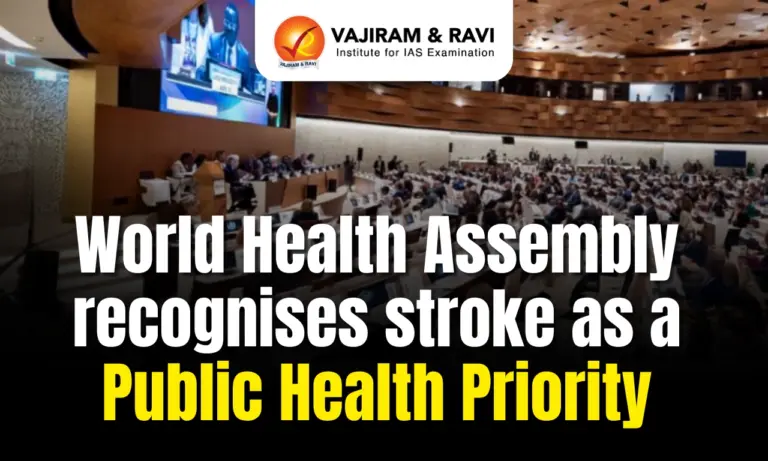
The World Health Assembly (WHA) adopted the first-ever resolution on stroke in May 2026, recognising stroke as a major public health priority. The resolution urges member countries to strengthen policies related to stroke prevention, risk-factor control, timely treatment, rehabilitation, and long-term support for stroke patients.
What is Stroke?
- According to the World Health Organization (WHO), stroke is a medical emergency that occurs when blood flow to the brain is interrupted due to blockage or bleeding.
- The interruption of blood supply can cause brain cell death, serious complications, permanent disability, or death if immediate treatment is not provided.
- Major risk factors include: Hypertension, Diabetes, Tobacco use, Obesity, Physical inactivity, Unhealthy diet, Air pollution, Alcohol misuse.
- Many of these risk factors are preventable or controllable through lifestyle changes, early diagnosis, and public health interventions.
World Health Assembly Resolution on Stroke Key Features
- The resolution titled “Reducing the burden of stroke: strengthening prevention, acute care, rehabilitation and health-system readiness” formally recognises stroke as a major global public health challenge requiring stronger national and international action.
- It was proposed by Chile, Egypt, Georgia, Palestine, Paraguay, and Tunisia at the 158th session of the WHO Executive Board on 3 February 2026, which recommended its adoption by the 79th World Health Assembly.
- The resolution notes that there has been no earlier focused WHO resolution comprehensively addressing stroke across prevention, acute care, rehabilitation, and system readiness, despite its time-sensitive and emergency nature.
- It calls for inclusion of stroke within national cardiovascular and neurological strategies as well as universal health coverage frameworks, with integrated focus on prevention, acute care, and rehabilitation.
- It urges implementation of population-level prevention measures such as control of hypertension, diabetes, obesity and dyslipidaemia, along with tobacco cessation, alcohol reduction, healthy diet promotion, physical activity, and reduction of air pollution.
- It emphasises strengthening emergency care systems to ensure rapid triage, timely transport, and access to imaging and reperfusion therapy, along with defining stroke-ready facilities with minimum standards.
- It supports scaling up acute treatments including intravenous thrombolysis and endovascular thrombectomy, along with standardised care protocols for intracerebral haemorrhage.
- It highlights the need to expand multidisciplinary stroke units and rehabilitation services, including inpatient care, early supported discharge, community-based rehabilitation, and palliative care for survivors.
- It calls for development of national stroke registries to collect standardised data on incidence, mortality, risk factors, treatment timelines, and outcomes for evidence-based policymaking.
- It promotes integration of digital health tools such as telemedicine, teleradiology, clinical decision support systems, and mobile health platforms to improve stroke care and follow-up.
- It mandates development of WHO technical guidance to support Member States in building equitable, context-specific stroke prevention, treatment, and rehabilitation systems.
- It supports strengthening access to essential medicines and diagnostics, including antihypertensives, anticoagulants, thrombolytics, and basic imaging, along with resilient supply chains.


Global Burden of Stroke
Stroke is one of the leading causes of death and disability globally.
- Stroke is the second-leading cause of death globally and the third-leading cause of disability.
- It is estimated that strokes affect 12 million people every year, killing more than half of them, and leaving two out of three survivors with a lasting disability.
- The burden of stroke has grown rapidly in low- and middle-income countries (LMICs), which account for approximately 87% of stroke deaths, where access to timely diagnosis, CT scans, stroke units, and specialised care remains limited.
- The number of new stroke cases and deaths increased by 70% and 44% respectively between 1990 and 2021.
- Women experience poorer functional recovery and higher mortality than men due to factors including age, more severe stroke, pre-stroke dependency, and depression.
- Men experience a substantial burden of stroke at younger ages, including premature mortality and long-term disability.
Stroke Burden in India
Stroke has emerged as a major public health challenge in India due to rising incidence, disability burden, and shortage of specialised neurological care.
- According to available estimates, India records between 108 and 172 stroke cases annually per one lakh population, with one-month case fatality rates ranging from 18% to 42%.
New findings from the Indian Council of Medical Research (ICMR)-led National Stroke Registry Programme reveal that
- Nearly one in seven stroke patients in India is below the age of 45 — a demographic once considered relatively low-risk for stroke.
- The registry analysed nearly 35,000 stroke cases reported from 30 hospitals across the country between 2020 and 2022.
- Only around 20% of patients reached hospitals within the critical therapeutic window of 4.5 hours — the period during which clot-dissolving drugs or advanced procedures such as mechanical thrombectomy can significantly reduce brain damage.
About the World Health Assembly
- The World Health Assembly is the decision-making body of the World Health Organization (WHO).
- It is attended by delegations from all WHO Member States and focuses on a specific health agenda prepared by the Executive Board.
- Its main functions include determining the policies of the WHO, appointing the Director-General, supervising financial policies, and reviewing and approving the proposed programme budget.
- The Health Assembly is held annually in Geneva, Switzerland.

 Last updated on Oct, 2026
→ UPSC 2027 Notification will be released on 13 January 2027 at upsconline.nic.in.
→ Check Nobel Prize 2026 Winners List here.
→ Download PIB PRiSM Monthly Magazine 2026 here.
→ Check UPSC Monthly Current Affairs Magazine The Recitals here.
→ Check out the latest UPSC Syllabus here.
→ Download UPSC Model Answers for Mains 2026
→ UPSC Mains Question Paper 2026 is out now for Essay & GS Paper 1, 2, 3 & 4.
→ UPSC Calendar 2027 has been released.
→ Enroll in Vajiram & Ravi’s UPSC Mains Test Series 2027 for structured answer writing practice, expert evaluation, and exam-oriented feedback.
→ Join Vajiram & Ravi’s UPSC Mentorship Program 2027 for personalized guidance, strategy planning, and one-to-one support from experienced mentors.
→ Go through the UPSC Mains Previous Year Papers to enhance your preparation.
→ UPSC has released UPSC Toppers List 2025 with the Civil Services final result on its official website.
→ Also check Best UPSC Coaching in India
World Health Assembly Recognises Stroke as a Public Health Priority FAQs
Q1. Why is the 2026 WHA resolution on stroke significant?+
Q2. What is stroke according to the WHO?+
Q3. What measures have been emphasised in the WHA resolution on stroke?+
Q4. What are the major risk factors for stroke?+
Q5. What is the global burden of stroke?+
Q6. What is the incidence of stroke in India?+
Q7. How can stroke risk be reduced?+