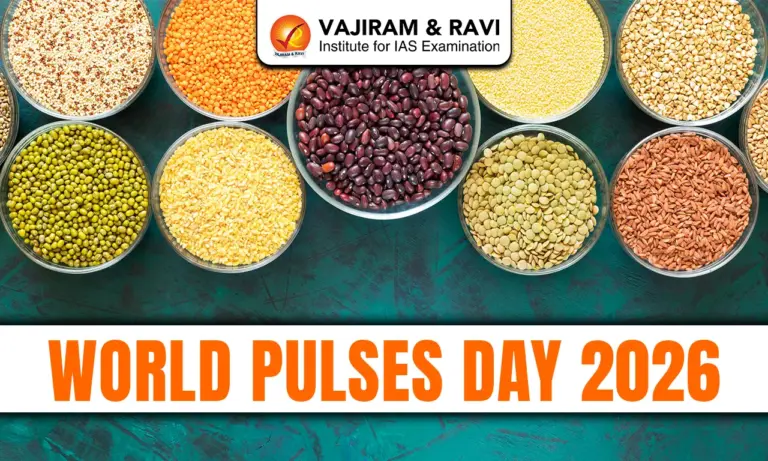
World Pulses Day is celebrated every year on 10th February. The day is celebrated as a day of recognition of pulses and their role in human nutrition, environmental well-being and sustainable agriculture. The day was declared as World Pulses Day under the United Nations General Assembly in 2016. The year was also marked as the International Year of Pulses. Due to the huge success of this celebration, the potential of the crops were recognised and added as a goal to be achieved under the 2030 Agenda for sustainable development
World Pulses Day 2026 Theme
- The theme of the World Pulses Day 2026 is “Pulses of the world: from modesty to excellence” was selected to highlight the required transformation-from humble origins to global recognition for their flavours, nutritional attributes and culinary diversity.
- The day focuses on raising awareness about the importance of pulses and their nutritional benefits. For farmers, pulses serve a dual purpose as they can be consumed to ensure household food security or sold to create economic stability. Additionally, the nitrogen-fixing properties of pulses enhance soil fertility, boosting the productivity and longevity of farmland. By incorporating pulses into intercropping and cover cropping practices, farmers can promote biodiversity in both farms and soils.
World Pulses Day 2026 Significance
- Nutritional and environmental importance: Pulses are rich in protein, fibre and micronutrients, and their cultivation improves soil fertility and reduces the need for chemical fertilizers, making them important for sustainable agriculture and food security.
- Declining consumption despite benefits: Even with their high value, per capita consumption of pulses has fallen in many countries due to changing food habits, urban lifestyles and the mistaken belief that pulses are only low-cost or traditional foods.
- Relevance of World Pulses Day 2026: World Pulses Day 2026 highlights the need to change these perceptions, promote pulses as modern, healthy and climate-friendly foods, and encourage their inclusion in diets worldwide to ensure affordable and nutritious food for all.





All About Pulses
- Pulses are nutrient-dense foods rich in protein, fibre, vitamins and minerals. They are an important plant-based protein source, especially for vegetarian and vegan diets, and when eaten with cereals, they provide better quality protein.
- Pulses support environmentally sustainable agriculture as they require less water, reduce dependence on chemical fertilizers through nitrogen fixation, and improve soil fertility and soil organic carbon, resulting in a low environmental footprint.
- Pulses contribute to both human health and farming systems. They are a sub-group of legumes such as chickpeas, peas, lentils and beans, and are widely used for human consumption, animal fodder and soil improvement, with peas, lentils and dried beans being the most commonly consumed.
Pulse Cultivation in India
- India produces the largest pulses(25%), followed by Canada(9%), China(6%) and European Union(5%).
- India has the largest production(25%), consumption (27%) and importer(14%) of pulses in the world.
- 75% of pulses are produced in the states of Madhya Pradesh (29.67%), Maharashtra (14.66%) and Rajasthan (13.75%).
- The maximum pulses produced in India are Chickpeas(48%), Pigeon Pea(14%), Black Gram (12%), Green Gram (8%) and lentil (7%).
Significance of Pulses
- Health Benefits: Pulses are rich in essential vitamins and minerals, making them a vital part of a healthy diet. They promote heart health, aid in weight management, and help prevent chronic diseases.
- Reducing Food Wastage: Unlike meat, which has a short shelf life, pulses have a long shelf life and enhance dietary diversity.
- Soil Fertility: Pulses naturally fix atmospheric nitrogen into the soil, improving soil biodiversity and fertility.
- Crop Rotation: Pulses are widely used in crop rotation, enhancing the efficiency of chemical fertilizers and supporting sustainable farming.
- Rural Employment: Pulses cultivation creates employment and entrepreneurial opportunities, especially for rural women and youth.
- Genetic Diversity: Pulses exhibit broad genetic diversity, enabling the development of climate-resilient varieties.
- Agroforestry: Growing pulses alongside other crops improves food security and boosts farmers’ income.
- Animal Husbandry: Pulse crop residues serve as high-quality feed for livestock.
Environmental Benefits: Pulses have a low carbon footprint and require minimal water, making them an environmentally sustainable protein source.

 Last updated on April, 2026
→ UPSC Final Result 2025 is now out.
→ UPSC has released UPSC Toppers List 2025 with the Civil Services final result on its official website.
→ Anuj Agnihotri secured AIR 1 in the UPSC Civil Services Examination 2025.
→ UPSC Marksheet 2025 is now out.
→ UPSC Notification 2026 & UPSC IFoS Notification 2026 is now out on the official website at upsconline.nic.in.
→ UPSC Calendar 2026 has been released.
→ Check out the latest UPSC Syllabus 2026 here.
→ UPSC Prelims 2026 will be conducted on 24th May, 2026 & UPSC Mains 2026 will be conducted on 21st August 2026.
→ The UPSC Selection Process is of 3 stages-Prelims, Mains and Interview.
→ Prepare effectively with Vajiram & Ravi’s UPSC Prelims Test Series 2026 featuring full-length mock tests, detailed solutions, and performance analysis.
→ Enroll in Vajiram & Ravi’s UPSC Mains Test Series 2026 for structured answer writing practice, expert evaluation, and exam-oriented feedback.
→ Join Vajiram & Ravi’s Best UPSC Mentorship Program for personalized guidance, strategy planning, and one-to-one support from experienced mentors.
→ Shakti Dubey secures AIR 1 in UPSC CSE Exam 2024.
→ Also check Best UPSC Coaching in India
World Pulses Day 2026 FAQs
Q1. What is the theme of the World Pulses Day 2026?+
Q2. What is World Pulses Day and when is it observed?+
Q3. Who declared World Pulses Day and when?+
Q4. Why is World Pulses Day 2026 significant?+
Q5. Which Country is the leading producer of pulses?+
Tags: World Pulses Day world pulses day 2026