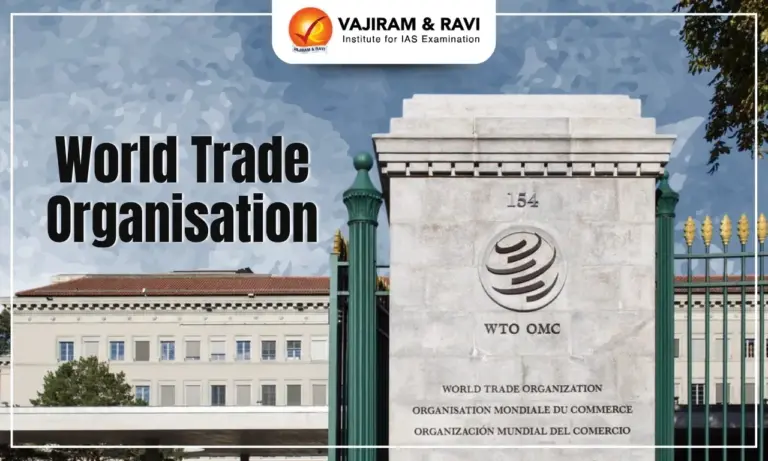
The World Trade Organisation is responsible for managing global trade by ensuring fair and free trade, resolving related disputes and working towards ensuring economic growth. In this article, we are going to cover all details about the World Trade Organisation, its history, objectives, structure and other relevant information.
World Trade Organisation Overview
The World Trade Organisation was established in 1995 as a global multilateral organisation that would make and implement rules for trading between nations of the world.
- The responsibility of the WTO is to promote and manage free trade.
- It acts as a forum for governments across the world to negotiate free trade agreements and manage trade disputes.
- Helps producers conduct international business smoothly.
- At present, the WTO consists of
- 164 members (including European Union), and
- 23 observer governments (like Iraq, Iran, Bhutan, Libya etc).
Key Objectives of WTO
The objectives of World Trade Organisations are:
- To establish and uphold rules governing international trade, with the aim of promoting global economic growth and generating employment opportunities.
- To serve as a platform for negotiations and oversight, facilitating further trade liberalisation by lowering trade barriers and ensuring fair, non-discriminatory practices.
- To provide a structured mechanism for resolving trade disputes, thereby fostering global peace, economic predictability, and geopolitical stability.
- To enhance the transparency of trade-related decision-making, empowering smaller and developing nations with a stronger voice in global trade governance.
- To collaborate with other key international economic institutions, ensuring coordinated and effective management of the global economy.
- To support developing countries in fully leveraging the benefits of the global trading system, thus reducing their operational costs and improving integration into global markets.
- To promote good governance by minimising arbitrariness, encouraging the use of clear, consistent, and rules-based approaches in trade administration.





World Trade Organisation Evolution
The World Trade Organisation’s history dates back to 1945 and officially came into existence in 1995.
Idea of International Trade Organisation (ITO)
- The idea behind creating the International Trade Organisation came through the western countries to manage the trade side of international economic cooperation.
- Apart from “Bretton woods” and UN specialised agency, WTO became the third international institution in the world.
- However, the major countries, including the USA, failed to get this treaty ratified in their respective legislatures.
- Thus, this treaty became a dead letter.
General Agreement on Tariffs and Trade (GATT)
The General Agreement on Tariffs and Trade (GATT) was established in 1947 and came into effect on January 1, 1948, with the signing of 23 founding countries in Geneva. Its primary objective was to gradually eliminate import quotas and reduce tariffs on merchandise trade to promote freer and fairer global trade.
From 1948 to 1994, GATT served as the primary framework governing most of the world’s trade in goods. It laid the foundation for multilateral trade rules and negotiations across successive trade rounds.
Uruguay Round (1986–1994)
As international trade became more complex, GATT’s mechanisms proved inadequate to address emerging issues in services, intellectual property, and dispute resolution.
The Uruguay Round, held from 1986 to 1994, was the most comprehensive and ambitious of all GATT trade negotiations. It not only expanded the scope of trade talks but also led to the creation of a more robust global trade body—the World Trade Organization (WTO).
The WTO Era
The WTO was formally established through the Marrakesh Agreement in April 1994, during a ministerial conference held in Marrakesh, Morocco. This marked a transition from GATT to the WTO regime, which came into force on January 1, 1995.
The original GATT contracting parties automatically became members of the WTO. The agreement was subsequently opened for accession by other countries, making the WTO a truly global organisation for regulating international trade in goods, services, and intellectual property.
India and World Trade Organisation
India was a member of GATT since 1948 and also the founding member of the World Trade Organisation.
Organisational Structure of WTO
The organisational structure of WTO consists of the Ministerial Conference, General Council, director general, trade policy review body etc.
Ministerial Council (MC)
- The Ministerial Conference is the topmost structural organisation of WTO and acts as a supreme governing body that makes all the decisions. It consists of all ministers of trade of all countries who are also the members of WTO.
- The conference is conducted every 2 years.
General Council (GC)
The WTO General Council is located in Geneva and is considered to the highest level decision making body. The council meets frequently to carry out the functions of World Trade Organisation. All the representatives are members of the council and they act on behalf of the Ministerial Conference. The Council is also responsible for acting as the Dispute Settlement Body as well as the Trade Policy Review Body.
Three Councils of WTO
The General Council has three WTO councils under it. These councils are:
- Council for Trade in Goods,
- Council for Trade in Services, and
- Council for Trade-Related Aspects of Intellectual Property Rights (TRIPS)
Director General (DG)
- The administration of the World Trade Organisation is conducted by the Secretariat, headed by the Director General (DG)
- The Director General (DG) is appointed by the Ministerial Conference (MC) for a tenure of four years.
- The Director General (DG) is assisted by the four Deputy Directors from different member countries.
Trade Policy Review Body (TPRB)
- The General Council meets as the Trade Policy Review Body (TPRB) to undertake trade policy reviews of members under the Trade Policy Review Mechanism (TPRM) and to consider the Director-General’s regular reports on trade policy development.
- Thus, the TPRB is open to all the members of the WTO.
Dispute Settlement Body (DSB)
- The General Council convenes itself as the Dispute Settlement Body (DSB) to deliberate upon and resolve the disputes among the WTO members.
- Such disputes may arise w.r.t. any agreement contained in the Final Act of the Uruguay Round that is subject to the Understanding of Rules and Procedures Governing the Settlement of Disputes (DSU).
- The DSB has the authority to:
- establish dispute settlement panels,
- refer matters to arbitration,
- adopt panel, Appellate Body and arbitration reports,
- maintain surveillance over the implementation of recommendations and rulings contained in such reports, and
- authorized suspension of concessions in the event of non-compliance with those recommendations and rulings.
Appellate Body
- The Appellate Body was established in 1995 under Article 17 of the Understanding on Rules and Procedures Governing the Settlement of Disputes (DSU).
- The DSB appoints persons to serve on the Appellate Body for a term of four years.
- It is a standing (permanent) body of 7 persons that hears appeals from reports issued by panels in disputes brought by members of the World Trade Organisation.
- The Appellate Body can uphold, reverse or modify the legal findings and conclusions of a panel.
- Once adopted by the Dispute Settlement Body (DSB), the reports of the Appellate Body must be accepted by the parties to the dispute.
- The seat of the Appellate Body is in Geneva, Switzerland.
Principles of World Trade Organisation
The WTO is guided by a set of foundational principles that aim to ensure a fair, predictable, and transparent international trading system. These principles are enshrined in the WTO Agreement and serve as the bedrock for global trade governance.
1. Non-Discrimination
Non-discrimination lies at the heart of the WTO’s multilateral trading system. It is intended to prevent unfair treatment among trading partners and promote equal opportunity in global trade.
a. Most Favoured Nation (MFN)
- Under the MFN principle, if a WTO member grants a trade advantage (like a reduced customs duty) to one country, it must extend the same benefit to all other WTO members.
- This principle applies to trade in goods, services, and aspects of intellectual property.
Exceptions to MFN:
- Formation of Free Trade Agreements (FTAs) and customs unions.
- Special market access for developing and least developed countries (LDCs).
- Anti-dumping and countervailing measures against unfair trade practices.
- Limited discriminatory treatment in services under specific conditions.
b. National Treatment
- Once goods have entered a country, they must be treated no less favourably than domestically-produced goods.
- This applies equally to services and intellectual property (trademarks, patents, copyrights).
- The principle ensures imported and local products compete on a level playing field after entry into the domestic market.
2. Free Trade and Market Access
One of the WTO’s primary objectives is to liberalise trade by reducing barriers to market entry.
a. Tariff Barriers
- Countries commit to reducing and “binding” tariffs at agreed levels.
- A bound tariff is a legally committed ceiling beyond which the tariff cannot be raised.
- The Uruguay Round led to extensive tariff binding across sectors.
b. Non-Tariff Barriers
- These include quotas, lack of transparency in trade policies, complex customs procedures, technical standards, and government procurement biases.
- WTO rules discourage or prohibit such barriers unless justified under specific conditions.
- Only duties, taxes, and safeguards are permitted under defined circumstances.
3. Promoting Fair Competition
WTO rules ensure that trade is conducted in a fair, predictable, and transparent manner.
- Equal treatment is mandated through MFN and national treatment provisions.
- The system guards against unfair trade practices such as dumping (selling goods at unfairly low prices) and the use of export subsidies that distort competition.
- Members can impose anti-dumping duties or countervailing measures after due investigation and adherence to WTO norms.
4. Special and Differential Treatment for Developing Countries
Recognising disparities in economic development, WTO agreements provide flexibility and support to developing and least-developed countries.
Key Provisions Include:
- Longer timelines for implementing commitments.
- Preferential market access in developed countries.
- Technical assistance and capacity-building measures.
- Requirements for developed nations to consider the developmental impact of their trade policies on poorer countries.
WTO Dispute Settlement Mechanism
The WTO Dispute Settlement Mechanism includes members of World Trade Organisation. The detailed process of Dispute Settlement by the World Trade Organisation is as follows:
Process of Dispute Settlement
- First stage: Consultation up to 60 days, aimed at settling the trade disputes through conciliation.
- Second stage (up to 1 year): In case the consultations fails to settle the dispute, the DSB forms a Dispute Panel.
- The report of the Dispute Panel can be rejected only through consensus among the DSB members.
- Appeal Stage: Either side can appeal the Dispute Panel’s ruling.
- Each appeal is heard by three members of a permanent 7-membered Appellate Body.
- The Appellate Body can uphold, reverse or modify the Dispte Panel’s rulings.
- The Dispute Settlement Body has to accept or reject the report of the Appeallate Body; Rejection of its report is only possible by consensus.
Present Issue with Dispute Settlement Mechanism
- The sanctioned strength of the Appellate Body (AB) is seven members.
- The Appellate Body members are appointed through consensus among the member countries.
- The AB must have a quorum of 3 judges to hear a particular case.
- The US has been blocking appointments of members to the Appellate Body (AB) as it feels that the AB is “unfair” and biased against it.
- Since December 10, 2019, the AB has been left with only 1 Judge and the quorum required to hear a case is minimum 3 judges. Hence, the Appellate Body has become dysfunctional.

 Last updated on March, 2026
→ UPSC Final Result 2025 is now out.
→ UPSC has released UPSC Toppers List 2025 with the Civil Services final result on its official website.
→ Anuj Agnihotri secured AIR 1 in the UPSC Civil Services Examination 2025.
→ UPSC Marksheet 2025 is now out.
→ UPSC Notification 2026 & UPSC IFoS Notification 2026 is now out on the official website at upsconline.nic.in.
→ UPSC Calendar 2026 has been released.
→ Check out the latest UPSC Syllabus 2026 here.
→ UPSC Prelims 2026 will be conducted on 24th May, 2026 & UPSC Mains 2026 will be conducted on 21st August 2026.
→ The UPSC Selection Process is of 3 stages-Prelims, Mains and Interview.
→ Prepare effectively with Vajiram & Ravi’s UPSC Prelims Test Series 2026 featuring full-length mock tests, detailed solutions, and performance analysis.
→ Enroll in Vajiram & Ravi’s UPSC Mains Test Series 2026 for structured answer writing practice, expert evaluation, and exam-oriented feedback.
→ Join Vajiram & Ravi’s Best UPSC Mentorship Program for personalized guidance, strategy planning, and one-to-one support from experienced mentors.
→ Shakti Dubey secures AIR 1 in UPSC CSE Exam 2024.
→ Also check Best UPSC Coaching in India
World Trade Organisation FAQs
Q1. What is the World Trade Organization?+
Q2. What are the 6 objectives of WTO?+
Q3. Who established the WTO?+
Q4. Is India a member of WTO?+
Q5. When was WTO established?+
Tags: world trade organisation wto