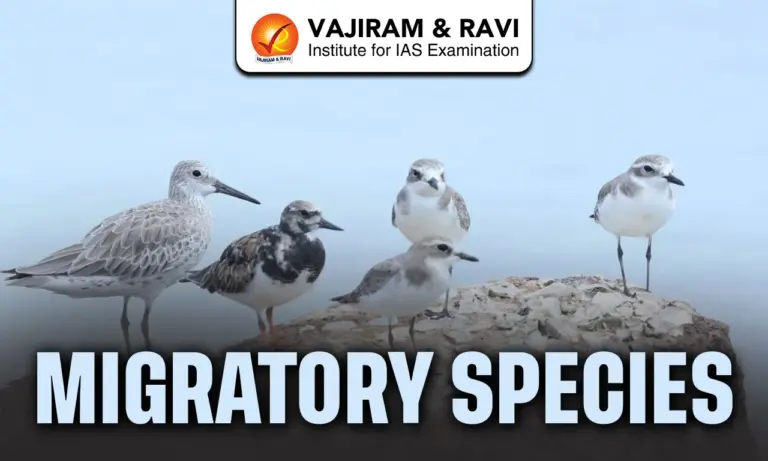
Migratory Species Latest News
- A new interim update to the State of the World’s Migratory Species Report warns that nearly half of the world’s migratory species populations are declining and many face growing extinction risks.
State of the World’s Migratory Species Report
- The State of the World’s Migratory Species Report is a global assessment that evaluates the conservation status of migratory animals across the world.
- It is prepared under the Convention on the Conservation of Migratory Species of Wild Animals (CMS), a legally binding international treaty established in 1979 under the United Nations Environment Programme (UNEP).
- The report provides comprehensive scientific information on migratory species, their population trends, conservation status, and the threats they face across their migratory routes.
- The first global State of the World’s Migratory Species Report, released in 2024, was the first comprehensive global assessment of migratory wildlife. It covered 1,189 species listed under the CMS treaty and also analysed trends among more than 3,000 additional migratory species worldwide.
- The report uses scientific data from sources such as the IUCN Red List, population monitoring studies, and scientific literature to evaluate extinction risks and population changes.





Importance of Migratory Species
- Migratory species play a crucial role in maintaining ecological balance and supporting human livelihoods. For example:
- Migratory birds help in pollination and pest control.
- Marine animals such as whales and fish help maintain ocean food chains.
- Migratory herds on land distribute nutrients and shape ecosystems across landscapes.
- These species are also important for cultural traditions, tourism, and food systems in many parts of the world.
- However, migration itself creates vulnerability. If a single habitat along their migration route is destroyed, the entire migration chain may collapse. Protecting migratory species, therefore, requires coordinated conservation efforts across multiple countries.
Major Findings of the Latest Report
- Declining Populations of Migratory Species
- The report highlights alarming trends in migratory wildlife populations.
- Around 49% of migratory species populations protected under the CMS treaty are declining.
- Approximately 24% of these species now face the risk of extinction.
- This represents a worsening situation compared to earlier assessments, with the proportion of declining species increasing by about 5 percentage points in just two years.
- Out of the 1,189 species listed under the CMS, nearly 582 species show declining population trends.
- Rising Extinction Risks
- The report found that 26 migratory species have moved into higher extinction-risk categories on the IUCN Red List.
- Among these, 18 are migratory shorebirds, highlighting severe threats to coastal and wetland ecosystems.
- Many migratory animals affected include:
- Birds such as cranes and pelicans
- Ungulates like wildebeest
- Freshwater fish species
- Marine animals such as sharks, rays, and turtles
- These findings underline the growing vulnerability of migratory wildlife across multiple ecosystems.
- Habitat Loss and Overexploitation as Major Threats
- The report identifies habitat loss and overexploitation as the two biggest threats facing migratory species globally.
- Human activities such as:
- Urban expansion
- Infrastructure development
- Agriculture
- Overfishing and hunting
- have disrupted key migratory routes and habitats.
- For example, infrastructure projects such as roads, railways, fences, and pipelines are creating barriers that block migration paths of large animals such as ungulates in Central Asia.
- Because migratory species depend on multiple habitats along their routes, damage at even one location can significantly affect their survival.
- Emerging Threat from Avian Influenza
- The report also highlights the growing impact of Highly Pathogenic Avian Influenza (H5N1) on migratory wildlife.
- The disease has caused mass mortality events among several migratory bird species and has also affected marine mammals.
- Species impacted include:
- African Penguins
- Humboldt Penguins
- Peruvian Pelicans
- Red-crowned Cranes
- Marine mammals such as the South American Sea Lion and South American Fur Seal have also been affected.
- Disease outbreaks add to existing pressures from habitat loss and climate change.
- Progress in Conservation Efforts
- Despite the overall decline, the report notes some encouraging conservation successes.
- Seven migratory species listed under CMS have shown improvements in conservation status, including:
- Saiga Antelope
- Scimitar-horned Oryx
- Mediterranean Monk Seal
- These examples demonstrate that coordinated conservation actions across countries can help restore populations of endangered migratory species.
- Importance of Key Biodiversity Areas
- The report identified 9,372 Key Biodiversity Areas (KBAs) that are important habitats for migratory species.
- However, 47% of these areas currently lack protection, leaving many critical migratory habitats vulnerable to human pressures.
- Strengthening protection of these areas is essential for ensuring the survival of migratory species.

 Last updated on March, 2026
→ UPSC Final Result 2025 is now out.
→ UPSC has released UPSC Toppers List 2025 with the Civil Services final result on its official website.
→ Anuj Agnihotri secured AIR 1 in the UPSC Civil Services Examination 2025.
→ UPSC Marksheet 2025 is now out.
→ UPSC Notification 2026 & UPSC IFoS Notification 2026 is now out on the official website at upsconline.nic.in.
→ UPSC Calendar 2026 has been released.
→ Check out the latest UPSC Syllabus 2026 here.
→ UPSC Prelims 2026 will be conducted on 24th May, 2026 & UPSC Mains 2026 will be conducted on 21st August 2026.
→ The UPSC Selection Process is of 3 stages-Prelims, Mains and Interview.
→ Prepare effectively with Vajiram & Ravi’s UPSC Prelims Test Series 2026 featuring full-length mock tests, detailed solutions, and performance analysis.
→ Enroll in Vajiram & Ravi’s UPSC Mains Test Series 2026 for structured answer writing practice, expert evaluation, and exam-oriented feedback.
→ Join Vajiram & Ravi’s Best UPSC Mentorship Program for personalized guidance, strategy planning, and one-to-one support from experienced mentors.
→ Shakti Dubey secures AIR 1 in UPSC CSE Exam 2024.
→ Also check Best UPSC Coaching in India
Migratory Species FAQs
Q1. What is the State of the World’s Migratory Species Report?+
Q2. What proportion of migratory species populations are declining globally?+
Q3. How many migratory species are listed under the CMS treaty?+
Q4. What are the main threats to migratory species?+
Q5. Which international treaty protects migratory wildlife?+
Tags: mains articles migratory species upsc current affairs upsc mains current affairs